


Former Executive Yuan secretary-general Lin Yi-shih (林益世) was indicted yesterday on corruption-related charges, prosecutors said.
Lin was accused of demanding bribes, pocketing about NT$60 million (US$2 million) in bribes, concealing illegal gains and keeping unaccountable assets, the Supreme Prosecutors’ Office Special Investigation Division (SID) said.
Although prosecutors did not seek a specific sentence for Lin, the crime of accepting bribes alone carries a minimum prison sentence of 10 years.
SID spokesman Chen Hung-ta (陳宏達) said the prosecutors did not specify a sentence for Lin because the Control Yuan has deemed the practice inappropriate.
Lin’s case came to light on June 27 when a local magazine reported that he helped Kaohsiung-based Ti Yung Co (地勇選礦公司) secure a slag treatment contract from a subsidiary of China Steel Corp (CSC, 中鋼) in 2010, when Lin was serving as a legislator of the Chinese Nationalist Party (KMT).
In return, Ti Yung owner Chen Chi-hsiang (陳啟祥) gave Lin NT$63 million, the indictment read.
The magazine reported that Lin demanded a further NT$83 million from Chen early this year after he was appointed Cabinet secretary-general. When Chen refused to pay up, Lin allegedly pressured CSC, a listed company in which the government has a controlling stake, to stop supplying slag to Ti Yung.
Lin, 42, was taken into custody by prosecutors for investigation on July 2.
Lin’s mother, Shen Juo-lan (沈若蘭), who allegedly received the bribe along with Lin, was indicted as another principal offender in the case, according to the indictment.
Lin’s wife, Peng Ai-chia (彭愛佳), and two of his maternal uncles — Shen Huan-yao (沈煥瑤) and Shen Huan-chang (沈煥璋) — were charged with money laundering for concealing the bribe on behalf of Lin, the indictment read.
Chen Chi-hsiang, who gave testimony against Lin as a witness for the prosecutors, was under investigation in a separate case by the Kaohsiung District Prosecutors’ Office.
Executive Yuan spokesperson Cheng Li-wun (鄭麗文) said the Cabinet had no further comment other than that it respected the investigation conducted by the judiciary and hoped it would adhere to the principles of justice and fairness.
KMT Legislator Lu Hsueh-chang (呂學樟), convener of the legislative Judiciary and Organic Laws and Statutes Committee, said there was still room for argument as to whether Lin is guilty and which laws would be applied to the case when it is tried in court.
Lin and his attorney could argue that Lin was not in a position to decide whom subsidiary companies of state-owned enterprises sign contracts with because Lin — either as a lawmaker or KMT policy committee chief then — did not have that kind of power, Lu said.
Prosecutors applied articles under the Anti-Corruption Act (貪汙治罪條例) to indict Lin, but it is debatable whether the act was applicable to Lin’s case, Lu said, adding: “Lin did have a say in contract matters, but he did not have the final say.”
Democratic Progressive Party (DPP) Chairman Su Tseng-chang (蘇貞昌) said “it was not a surprise that Lin was indicted, but the results the SID announced were a lot different from what most people had expected. Does the indictment indeed reflect the entire picture of the case?”
DPP Legislator Pan Men-an (潘孟安) said that while he would comment further after reading the indictment, it appeared the SID had already “drawn a red line” before making the indictment.
Taiwan Solidarity Union Legislator Hsu Chung-hsin (許忠信) said it was strange that Lin’s father, Lin Hsien-pao (林仙保), who was present at the meeting between Lin and Chen Chi-hsiang, had never been subpoenaed by the investigators and the SID had not offered an explanation of the omission.

The nation’s fastest supercomputer, Nano 4 (晶創26), is scheduled to be launched in the third quarter, and would be used to train large language models in finance and national defense sectors, the National Center for High-Performance Computing (NCHC) said. The supercomputer, which would operate at about 86.05 petaflops, is being tested at a new cloud computing center in the Southern Taiwan Science Park in Tainan. The exterior of the server cabinet features chip circuitry patterns overlaid with a map of Taiwan, highlighting the nation’s central position in the semiconductor industry. The center also houses Taiwania 2, Taiwania 3, Forerunner 1 and
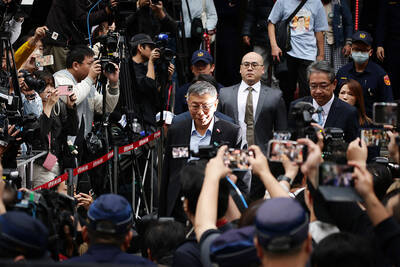
FIRST TRIAL: Ko’s lawyers sought reduced bail and other concessions, as did other defendants, but the bail judge denied their requests, citing the severity of the sentences Former Taipei mayor Ko Wen-je (柯文哲) was yesterday sentenced to 17 years in prison and had his civil rights suspended for six years over corruption, embezzlement and other charges. Taipei prosecutors in December last year asked the Taipei District Court for a combined 28-year, six-month sentence for the four cases against Ko, who founded the Taiwan People’s Party (TPP). The cases were linked to the Core Pacific City (京華城購物中心) redevelopment project and the mismanagement of political donations. Other defendants convicted on separate charges included Chinese Nationalist Party (KMT) Taipei City Councilor Angela Ying (應曉薇), who was handed a 15-year, six-month sentence; Core Pacific
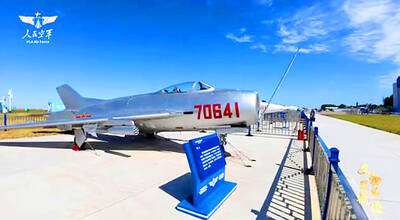
J-6 REMODEL: The converted drones are part of Beijing’s expanding mix of airpower weapons, including bombers with stand-off missiles and UAV swarms, the report said China has stationed obsolete supersonic fighters converted to attack drones at six air bases close to the Taiwan Strait, a report published this month by the Arlington, Virginia-based Mitchell Institute for Aerospace Studies said. Satellite imagery of the airfields from the institute’s “China Airpower Tracker” shows what appear to be lines of stubby, swept-winged aircraft matching the shape of J-6 fighters that first flew with the Chinese People’s Liberation Army (PLA) Air Force in the 1960s. Since their conversion to drones, the aircraft have been identified at five bases in China’s Fujian Province and one in Guangdong Province, the report said. J.

China used fake LinkedIn profiles to harvest sensitive data from NATO and EU institutions by soliciting information from staff, a European security source said on Friday. The operation, allegedly orchestrated by the Chinese Ministry of State Security, targeted dozens of employees at the military alliance or EU organizations through fictitious accounts, the source said, confirming reports in French and Belgian media. Posing as recruiters on the online professional networking platform, Chinese spies would initially request paid reports before later soliciting non-public or even classified information. One particularly active fake profile used the name “Kevin Zhang,” claiming to be the head


 RSS
RSS