


The medal dreams of Taiwanese pair Chuang Chia-jung (莊佳容) and Hsieh Su-wei (謝淑薇) came to an end yesterday as they lost to Andrea Hlavackova and Lucie Hradecka of the Czech Republic in the quarter-finals of the women’s doubles in the Olympic tennis competition at Wimbledon.
The Czech No. 4 seeds earned their 6-3, 6-4 victory over the more consistent, but less spectacular Taiwanese women by playing the big points well, converting four of six break points compared with Chuang and Hsieh’s two out of five.
The first set started badly for Chuang, 27, and Hsieh, 26, as the Taiwanese failed to hold their serves and found themselves 0-5 down in what seemed like no time at all. Hsieh then left the court for a lengthy medical timeout and things did not look good when she returned with strapping round the top of her left leg, needing to hold her serve to stay in the set.
Perhaps surprisingly, she did so easily, clinching the game with an impressive forehand winner before Hlavackova dropped her serve in the next game to give Hsieh and Chuang some hope of getting back in contention.
Chuang then served an ace as she held her serve and Hsieh seemed fairly untroubled by her injury, but the revival proved to be a false dawn.
In the next game, Hsieh hit a return wide on the first of two set points and the Czechs were in the driving seat.
The second set started well for the unseeded Taiwanese, though, as Hlavackova was broken in the second game, before Chuang held her serve to leave the Kaohsiung-born duo up 3-0.
However, calamity struck in game five as Hsieh served up the only double fault of the contest by the Taiwanese, before hitting a forehand long on break point to hand the Czechs the game.
Worse was to follow, when a hard-fought seventh game was decided by a good volley at the net by Hlavackova to put the Czechs 4-3 ahead.
Hsieh saved a match point on her own serve in game nine, but a Hlavackova volley at the net in the next game ended the one hour, 22 minute contest.
The Taiwanese had earned their quarter-finals place by beating Italian No. 7 seeds Flavia Pennetta and Francesca Schiavone 6-7 (3), 7-5, 6-4 on Wednesday in a second-round match that had begun on Tuesday, before being halted for bad light.
The victory meant Chuang and Hsieh became the first Taiwanese to reach the last 16 of an Olympic tennis tournament.
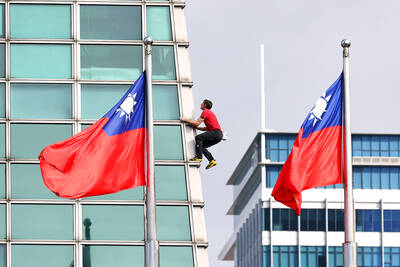
DAREDEVIL: Honnold said it had always been a dream of his to climb Taipei 101, while a Netflix producer said the skyscraper was ‘a real icon of this country’ US climber Alex Honnold yesterday took on Taiwan’s tallest building, becoming the first person to scale Taipei 101 without a rope, harness or safety net. Hundreds of spectators gathered at the base of the 101-story skyscraper to watch Honnold, 40, embark on his daredevil feat, which was also broadcast live on Netflix. Dressed in a red T-shirt and yellow custom-made climbing shoes, Honnold swiftly moved up the southeast face of the glass and steel building. At one point, he stepped onto a platform midway up to wave down at fans and onlookers who were taking photos. People watching from inside
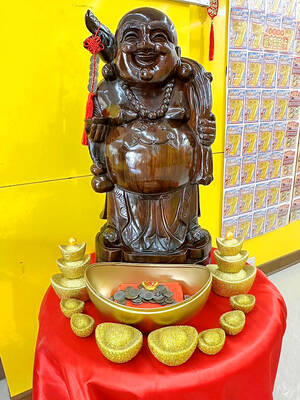
A Vietnamese migrant worker yesterday won NT$12 million (US$379,627) on a Lunar New Year scratch card in Kaohsiung as part of Taiwan Lottery Co’s (台灣彩券) “NT$12 Million Grand Fortune” (1200萬大吉利) game. The man was the first top-prize winner of the new game launched on Jan. 6 to mark the Lunar New Year. Three Vietnamese migrant workers visited a Taiwan Lottery shop on Xinyue Street in Kaohsiung’s Gangshan District (崗山), a store representative said. The player bought multiple tickets and, after winning nothing, held the final lottery ticket in one hand and rubbed the store’s statue of the Maitreya Buddha’s belly with the other,
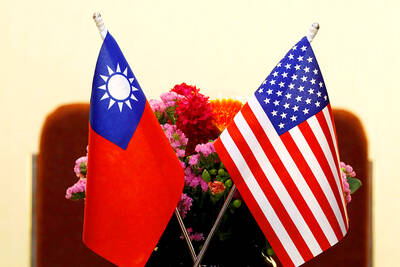
‘NATO-PLUS’: ‘Our strategic partners in the Indo-Pacific are facing increasing aggression by the Chinese Communist Party,’ US Representative Rob Wittman said The US House of Representatives on Monday released its version of the Consolidated Appropriations Act, which includes US$1.15 billion to support security cooperation with Taiwan. The omnibus act, covering US$1.2 trillion of spending, allocates US$1 billion for the Taiwan Security Cooperation Initiative, as well as US$150 million for the replacement of defense articles and reimbursement of defense services provided to Taiwan. The fund allocations were based on the US National Defense Authorization Act for fiscal 2026 that was passed by the US Congress last month and authorized up to US$1 billion to the US Defense Security Cooperation Agency in support of the
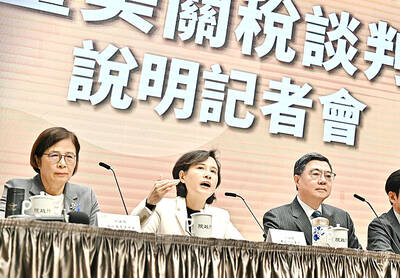
HIGH-TECH DEAL: Chipmakers that expand in the US would be able to import up to 2.5 times their new capacity with no extra tariffs during an approved construction period Taiwan aims to build a “democratic” high-tech supply chain with the US and form a strategic artificial intelligence (AI) partnership under the new tariffs deal it sealed with Washington last week, Taipei’s top negotiator in the talks said yesterday. US President Donald Trump has pushed Taiwan, a major producer of semiconductors which runs a large trade surplus with the US, to invest more in the US, specifically in chips that power AI. Under the terms of the long-negotiated deal, chipmakers such as Taiwan Semiconductor Manufacturing Co (TSMC, 台積電) that expand US production would incur a lower tariff on semiconductors or related manufacturing


 RSS
RSS