


The Democratic Progressive Party (DPP) yesterday described the controversy surrounding its presidential candidate Tsai Ing-wen’s (蔡英文) involvement with a biotechnology start-up as “Taiwan’s Watergate scandal,” claiming that administrative and judiciary agencies have been used as campaign tools to benefit the presidential campaign of the Chinese Nationalist Party (KMT).
The accusation came after the Supreme Prosecutors’ Office Special Investigation Division (SID) launched an investigation into the National Development Fund (NDF) on Tuesday night and seized information about three investment deals made between 2005 and 2008, when Tsai served as vice premier.
The DPP accused Council for Economic Planning and Development (CEPD) Minister Christina Liu (劉憶如) of being the KMT’s “hired thug” by fabricating documents to suggest Tsai’s wrongdoings in the formation of and the government’s investment in Yu Chang Biologics Co (宇昌生技股份有限公司).
Photos: Liberty Times
Yesterday afternoon, the DPP filed lawsuits with the Taipei District Prosecutors’ Office against Liu and KMT legislators Chiu Yi (邱毅), Hsieh Kuo-liang (謝國樑) and Lin Yi-shih (林益世), charging them with document forgery and violating the Presidential and Vice Presidential Election and Recall Act (總統副總統選舉罷免法).
The party also condemned what it called the SID’s collaboration with the KMT.
‘WATERGATE’
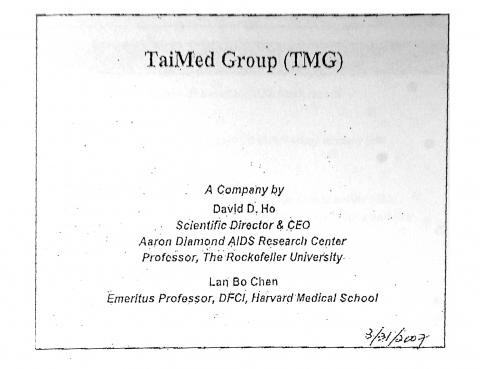
Photo: Liberty Times
“The case has now become Taiwan’s Watergate, a definite political scandal. We demand that President Ma Ying-jeou (馬英九) and the SID explain why they have resorted to the measure to influence the presidential election,” DPP spokesperson Chen Chi-mai (陳其邁) said.
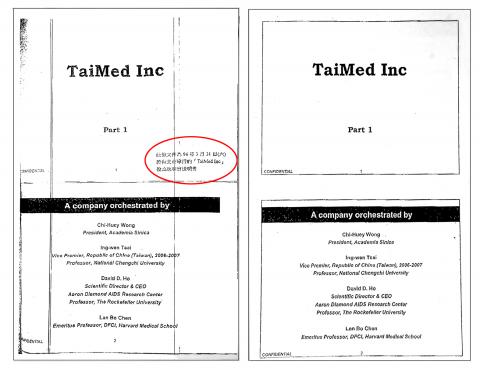
Liu and the KMT on Monday accused the DPP chairperson of involvement in wrongdoings when they displayed a document that they said was distributed by TaiMed Group, from which Yu Chang Biologics was formed, at an investors’ conference on March 31, 2007, and said the presentation document listed Tsai as one of the principal leaders of the start-up during the time she was vice premier.
However, the document was actually a TaiMed Group presentation from Aug. 19, 2007 — three months after Tsai left office, the DPP said on Tuesday, but the KMT inserted additional information on the document copies provided to the media that indicated it had come from the March investors’ conference.
The DPP demanded a formal apology from Liu and the three KMT lawmakers.
While Liu apologized on Tuesday evening for “confusing the dates” of the document, her refusal to say the document had been fabricated was the reason behind the DPP’s decision to file the lawsuit, Chen said at a press conference.
Liu’s mistake was more than carelessly misstating the date, Chen said, as the document appeared to have been fabricated before Monday because Liu repeatedly said in the press conference that “the March 31 document” was important in determining Tsai’s role in the case.
At the press conference on Tuesday evening in which she ostensibly apologized, Liu said there were what she called “more questionable points” concerning the Yu Chang case, Chen added.
CAMPAIGN TIE-IN
In light of this, the DPP stepped up its claims of the behind-the-scenes political maneuvering by the KMT to benefit its presidential campaign.
“This is a case where the ruling party has exploited state institutions and attacked its opponent with fabricated information,” Chen said.
Citing news reports from various media outlets between Friday last week and Monday, Chen said an unidentified high-ranking KMT official had been quoted as saying that “Tsai could face legal issues if she played a specific role in the case.”
“This seemed to us a sophisticatedly plotted political conspiracy ... We want to identify who the official is and what the KMT’s motive is to politicize this case,” DPP spokesman Chuang Ruei-hsiung (莊瑞雄) said.
“Most people have by now become accustomed to the KMT’s “smear campaign trilogy of so-called whistleblowing, intensive media scrutiny and judicial oppression,” Chuang said.
“But we are surprised that the last part [judiciary oppression] came so quickly,” he said, adding that the SID might even try to summon DPP politicians, including Tsai, former premier Su Tseng-chang (蘇貞昌) and former council chairperson Ho Mei-yueh (何美玥), for questioning before election day.
At a separate setting in the afternoon, Liu confirmed the SID had arrived at the fund’s office a day earlier to retrieve documents related to the Yu Chang Biologics investment case.
The SID has also had access to the documents about two other companies — Taiwan Biopharmaceuticals Co (南華生技) and TaiMed Biotech Fund (台懋生技創投) — that had once applied for funding from the NFD on their “strange” connections with the Yu Chang deal, Liu added.
LIU’S REACTION
When asked for her reaction to being sued by the DPP, Liu said she had to confront it, but added that it was a political move on the DPP’s part.
“The things I have done were part of my responsibilities to the legislature and I have never violated administrative neutrality,” Liu said.
Meanwhile, the DPP yesterday also filed a lawsuit against Tsai Ling-yi (蔡令怡), wife of Premier Wu Den-yih (吳敦義), for allegedly spreading false statements and violating election laws.
At a KMT rally in Penghu on Sunday, Tsai Ling-yi said Tsai Ing-wen had transferred public funds of NT$1.1 billion (US$36.3 million) to the accounts of her family businesses, DPP spokesperson Kang Yu-cheng (康裕成) said.
Those comments violated election laws, which prohibit false statements for the purpose of getting a candidate elected or impeding a person’s election chances, Kang said.
Tsai Ling-yi said last night she “could have cited incorrect information.”
When asked by reporters whether she would apologize for the remark, she said: “If I have used incorrect information, I would apologize.”
Additional reporting by Amy Su

Tropical Storm Gaemi strengthened into a typhoon at 2pm yesterday, and could make landfall in Yilan County tomorrow, the Central Weather Administration (CWA) said yesterday. The agency was scheduled to issue a sea warning at 11:30pm yesterday, and could issue a land warning later today. Gaemi was moving north-northwest at 4kph, carrying maximum sustained winds near its center of up to 118.8kph and gusts of 154.8kph. The circumference is forecast to reach eastern Taiwan tomorrow morning, with the center making landfall in Yilan County later that night before departing from the north coast, CWA weather forecaster Kuan Shin-ping (官欣平) said yesterday. Uncertainty remains and

SEA WARNING LIKELY: The storm, named Gaemi, could become a moderate typhoon on Wednesday or Thursday, with the Taipei City Government preparing for flooding A tropical depression east of the Philippines developed into a tropical storm named Gaemi at 2pm yesterday, and was moving toward eastern Taiwan, the Central Weather Administration (CWA) said. Gaemi could begin to affect Taiwan proper on Tuesday, lasting until Friday, and could develop into a moderate typhoon on Wednesday or Thursday, it said. A sea warning for Gaemi could be issued as early as Tuesday morning, it added. Gaemi, the third tropical storm in the Pacific Ocean this typhoon season, is projected to begin moving northwest today, and be closest to Taiwan on Wednesday or Thursday, the agency said. Today, there would likely

DISRUPTIONS: The high-speed rail is to operate as normal, while several airlines either canceled flights or announced early departures or late arrivals Schools and offices in 15 cities and counties are to be closed today due to Typhoon Gaemi, local governments announced last night. The 15 are: Taipei, New Taipei City, Taoyuan, Tainan, Keelung, Hsinchu and Kaohsiung, as well as Yilan, Hualien, Hsinchu, Miaoli, Chiayi, Pingtung, Penghu and Lienchiang counties. People should brace for torrential rainfall brought by the storm, with its center forecast to make landfall on the east coast between tonight and tomorrow morning, the Central Weather Administration (CWA) said. The agency issued a sea warning for the typhoon at 11:30pm on Monday, followed by a land warning at 11:30am yesterday. As of

CASUALTY: A 70-year-old woman was killed by a falling tree in Kaohsiung as the premier warned all government agencies to remain on high alert for the next 24 hours Schools and offices nationwide are to be closed for a second day today as Typhoon Gaemi crosses over the nation, bringing torrential rain and whipping winds. Gaemi was forecast to make landfall late last night. From Tuesday night, its outer band brought substantial rainfall and strong winds to the nation. As of 6:15pm last night, the typhoon’s center was 20km southeast of Hualien County, Central Weather Administration (CWA) data showed. It was moving at 19kph and had a radius of 250km. As of 3pm yesterday, one woman had died, while 58 people were injured, the Central Emergency Operation Center said. The 70-year-old


 RSS
RSS