


Democratic Progressive Party (DPP) presidential candidate Tsai Ing-wen (蔡英文) increased her lead over President Ma Ying-jeou (馬英九) to 6.6 percentage points — gaining ground in central Taiwan and Hakka constituencies in particular — according to a survey by Taiwan Brain Trust (TBT).
The survey found that 40.1 percent of respondents said they would support Tsai, while 33.5 percent would vote for Ma, who is seeking re-election, and 11.2 percent for People First Party (PFP) Chairman James Soong (宋楚瑜), TBT poll center director Chen Jin-ji (陳錦稷) told a press conference yesterday.
Tsai expanded her lead from 3.7 percentage points in the previous poll conducted by the think tank, which was released on Nov. 2. The increase mainly came from significant gains in central Taiwan, including Greater Taichung, Changhua and Nantou, as well as the predominantly Hakka constituencies of Miaoli, Hsinchu and Taoyuan, Chen said.
Although Tsai still trailed in the two regions — by 4.3 percentage points in central Taiwan and 2 percentage points in Hakka counties, she has closed the gap rapidly by gaining voter support of 9.2 and 7.7 percentage points respectively in these areas in less than a month.
The DPP candidate surpassed Ma in female voter support for the first time, the poll showed, with 37.6 percent of female respondents saying they would vote for Tsai against 36.3 percent for Ma.
Tsai continued to widen her advantage in southern Taiwan, leading by 25.2 percentage points in Yunlin, Chiayi and Greater Tainan and 28 percentage points in Greater Kaohsiung and Pingtung, TBT chief executive officer Lo Chih-cheng (羅致政) said.
The survey collected 1,068 samples between Nov. 18 and Monday and had a 3 percent margin of error.
The survey also asked respondents about their views on the nation’s fiscal situation, as well as the current administration’s tax policy, with more than half expressing concern about these issues.
A total of 59.1 percent of respondents said the Ma administration’s tax policy favored capitalists, and 51.3 percent said Ma had favored his associates in the distribution of national resources and budgets.
Almost 60 percent disagreed that the increasing national debt was “the result and an effect of the global situation,” as Ma has said, with 70.7 percent of respondents saying they were very concerned about the worsening national debt situation since Ma took office in 2008.
The survey results showed that while national finances may be a complex issue, the majority of people shared the same feelings and views, National Taiwan University professor Kenneth Lin (林向愷) said.
“The 30-49 age bracket, which represents the primary work force, was particularly worried about the worsening fiscal situation. That should mean something to the Ma administration,” Lin said.
Meanwhile, a public opinion poll conducted by the Chinese-language Liberty Times (the Taipei Times’ sister newspaper) and released yesterday showed Tsai leading by 2.4 percentage points.
In the survey, 35.79 percent of respondents said they would vote for Tsai against 33.39 percent for Ma and 9.8 percent for Soong.
It found male voters favored Tsai and female voters tended to support Ma, with Tsai leading 37.91 percent to Ma’s 30.02 percent among men and Tsai trailing Ma by about 4.5 percentage points among women.
The survey had 1,285 samples with a margin of error of 2.73 percent.

SECURITY: As China is ‘reshaping’ Hong Kong’s population, Taiwan must raise the eligibility threshold for applications from Hong Kongers, Chiu Chui-cheng said When Hong Kong and Macau citizens apply for residency in Taiwan, it would be under a new category that includes a “national security observation period,” Mainland Affairs Council (MAC) Minister Chiu Chui-cheng (邱垂正) said yesterday. President William Lai (賴清德) on March 13 announced 17 strategies to counter China’s aggression toward Taiwan, including incorporating national security considerations into the review process for residency applications from Hong Kong and Macau citizens. The situation in Hong Kong is constantly changing, Chiu said to media yesterday on the sidelines of the Taipei Technology Run hosted by the Taipei Neihu Technology Park Development Association. With

CARROT AND STICK: While unrelenting in its military threats, China attracted nearly 40,000 Taiwanese to over 400 business events last year Nearly 40,000 Taiwanese last year joined industry events in China, such as conferences and trade fairs, supported by the Chinese government, a study showed yesterday, as Beijing ramps up a charm offensive toward Taipei alongside military pressure. China has long taken a carrot-and-stick approach to Taiwan, threatening it with the prospect of military action while reaching out to those it believes are amenable to Beijing’s point of view. Taiwanese security officials are wary of what they see as Beijing’s influence campaigns to sway public opinion after Taipei and Beijing gradually resumed travel links halted by the COVID-19 pandemic, but the scale of
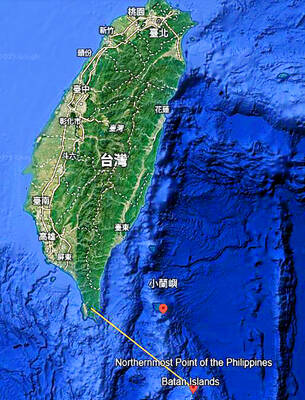
A US Marine Corps regiment equipped with Naval Strike Missiles (NSM) is set to participate in the upcoming Balikatan 25 exercise in the Luzon Strait, marking the system’s first-ever deployment in the Philippines. US and Philippine officials have separately confirmed that the Navy Marine Expeditionary Ship Interdiction System (NMESIS) — the mobile launch platform for the Naval Strike Missile — would take part in the joint exercise. The missiles are being deployed to “a strategic first island chain chokepoint” in the waters between Taiwan proper and the Philippines, US-based Naval News reported. “The Luzon Strait and Bashi Channel represent a critical access
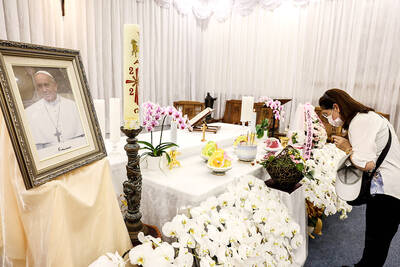
Pope Francis is be laid to rest on Saturday after lying in state for three days in St Peter’s Basilica, where the faithful are expected to flock to pay their respects to history’s first Latin American pontiff. The cardinals met yesterday in the Vatican’s synod hall to chart the next steps before a conclave begins to choose Francis’ successor, as condolences poured in from around the world. According to current norms, the conclave must begin between May 5 and 10. The cardinals set the funeral for Saturday at 10am in St Peter’s Square, to be celebrated by the dean of the College


 RSS
RSS