


People First Party (PFP) Chairman James Soong (宋楚瑜) yesterday officially signed up for the Jan. 14 presidential election, calling on the public to look beyond party lines and vote for him.
Ending months of speculation about his determination to join the race, Soong and his running mate, Lin Ruey-shiung (林瑞雄), completed the registration process at the Central Election Commission (CEC) and promised to improve the overall environment for Taiwanese at a press conference together with the party’s legislator-at-large candidates.
“Elections in democratic societies look to elect wise and capable candidates, rather than pan-blue or pan-green [candidates]. Taiwan has suffered from the vicious conflict between the two camps in the past 10 years, and people should put a stop to this and find new hope through their ballot,” Soong said.
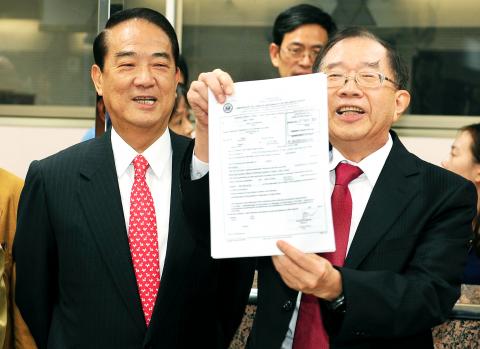
Photo: Chang Chia-ming, Taipei Times
Amid cheers from about 100 supporters chanting “Let’s send Soong to the Presidential Office,” Soong slammed President Ma Ying-jeou (馬英九) and the Chinese Nationalist Party (KMT), accusing them of poor performance and incompetence in leading the nation forward. He also accused the former Democratic Progressive Party (DPP) administration of corruption.
“Ma launched a ‘home stay’ campaign; I think we should let those who don’t have the people in mind ‘stay home,’” he said.
“The DPP’s presidential campaign slogan is ‘Taiwan Next,’ but Taiwan should be the first. I will make Taiwan the pride of Asia,” he said.
The Soong-Lin ticket was the third team to formally throw its hat into the ring, following the lead of the KMT ticket of Ma and Premier Wu Den-yih (吳敦義) and the DPP pairing of Chairperson Tsai Ing-wen (蔡英文) and Su Jia-chyuan (蘇嘉全).
Lin displayed a document he said would dispel rumors that he possesses dual citizenship. The document, issued by the US Department of State on Monday, reads “certificate of loss of nationality of the United States.”
According to the Presidential and Vice Presidential Election and Recall Act (總統副總統選舉罷免法), aspirants should not hold dual nationality on the date they register their candidacies.
“I am no longer a US citizen, and I think this should stop the rumors,” Lin said.
The commission said it would collect the documents provided by Lin and double-check them with related government agencies.
The issue of Lin’s nationality drew attention after Yok Mu-ming (郁慕明), chairman of a KMT splinter group, the New Party, was quoted in a recent newspaper report as saying that the Soong-Lin ticket might not register for the presidential election because Lin was “probably still a US citizen.”
Soong said he looked forward to hearing a public apology from Yok over the nationality issue.
The PFP also unveiled its list of 18 legislator-at-large candidates, with PFP adviser and National Chengchi University professor Thomas Lee (李桐豪), writer Chang Hsiao-feng (張曉風), former Miaoli County commissioner Fu Hsueh-peng (傅學鵬) and Ming Chuan University assistant professor Chen Yi-jie (陳怡潔) topping the list.
Soong’s registration, viewed as a potential election spoiler in the eyes of the KMT, has put an end to a possible cooperation between the two parties.
Former KMT chairman Wu Poh-hsiung (吳伯雄) acknowledged that Soong’s participation in the race has engendered a sense of crisis in the pan-blue camp amid fears of a split in the vote.
“Instead of complaining about each other, we should turn this sense of crisis into strength and join efforts to claim victory in the elections,” he said.
Chuang Po-chun (莊伯仲), director of the KMT’s Culture and Communication Committee, said the KMT respected Soong’s decision, adding that the two parties would engage in a gentleman’s race in the presidential and legislative elections.
Additional reporting by CNA

PRECISION STRIKES: The most significant reason to deploy HIMARS to outlying islands is to establish a ‘dead zone’ that the PLA would not dare enter, a source said A High Mobility Artillery Rocket System (HIMARS) would be deployed to Penghu County and Dongyin Island (東引) in Lienchiang County (Matsu) to force the Chinese military to retreat at least 100km from the coastline, a military source said yesterday. Taiwan has been procuring HIMARS and Army Tactical Missile Systems (ATACMS) from the US in batches. Once all batches have been delivered, Taiwan would possess 111 HIMARS units and 504 ATACMS, which have a range of 300km. Considering that “offense is the best defense,” the military plans to forward-deploy the systems to outlying islands such as Penghu and Dongyin so that

WHAT WAS ALL THAT FOR? Jaw Shaw-kong said that Cheng Li-wen had pushed for more drastic cuts and attacked him, just for the outcome to be nearly identical to his bill The legislature yesterday passed a supplementary budget bill to fund the purchase of separate packages of US military equipment, with the combined amount of spending capped at NT$780 billion (US$24.8 billion). The Chinese Nationalist Party (KMT) and Taiwan People’s Party (TPP) used their legislative majority to pass the bill, which runs until 2033 and has two main funding provisions. One was for NT$300 billion of arms sales already approved by the US for Taiwan on Dec. 17 last year, the other was for NT$480 billion for another arms package expected to be announced by Washington. The bill, which fell short of the NT$1.25

‘CLEAR MESSAGE’: The bill would set up an interagency ‘tiger team’ to review sanctions tools and other economic options to help deter any Chinese aggression toward Taiwan US Representative Young Kim has introduced a bill to deter Chinese aggression against Taiwan, calling for an interagency “tiger team” to preplan coordinated sanctions and economic measures in response to possible Chinese military or political action against Taiwan. “[Chinese President] Xi Jinping [習近平] has directed the People’s Liberation Army to be ready to invade Taiwan by 2027. China has a plan. America should have one too,” Kim said in a news release on Thursday last week. She introduced the “Deter PRC [People’s Republic of China] aggression against Taiwan act” to “ensure the US has a coordinated sanctions strategy ready should

A former television news host and six military personnel — active and retired — have been indicted on espionage charges, Kaohsiung prosecutors said yesterday. Lin Chen-you (林宸佑), a former CTi News host and YouTuber, last year allegedly made videos at the direction of a Chinese agent criticizing the Democratic Progressive Party’s recall campaign, the Ciaotou District Prosecutors’ Office told a news conference in Kaohsiung. He allegedly received 4,325 tether coins for the videos from an unidentified person surnamed Huang (黃), believed to be an agent of a hostile foreign power, they said. Lin, also known as Ma Te (馬德), has a show named


 RSS
RSS