


The Chinese Nationalist Party (KMT) made NT$3.5 billion (US$121.5 million) last year, primarily on business investments, far outpacing the amount made by the Democratic Progressive Party (DPP), information from the Ministry of the Interior (MOI) showed.
Stock dividends accounted for almost NT$2.9 billion last year and made up more than four-fifths of the KMT’s total earnings, raising concerns about the extent to which the party depends on earnings from its assets and not donations.
The figures, published on Thursday by the ministry, reveal that political contributions to the KMT amounted to NT$240 million, or 6.9 percent of its earnings. It also earned NT$251 million in vote subsidies and an income of NT$76 million from party dues.
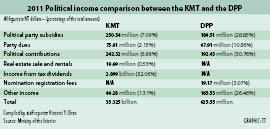
The DPP, meanwhile, received NT$192 million in political contributions and a total income of NT$626 million.
The figures come from audited information reported by political parties and are calculated separately from donations received by mayoral candidates in November’s special municipality elections.
DPP politicians have accused the KMT of using its party assets to heavily subsidize the election campaigns of local and national candidates — giving it an unfair advantage, given that most of the assets were controversially accumulated during one-party rule before the 1990s.
President Ma Ying-jeou (馬英九), who also serves as the KMT chairman, has pledged to divest the party of such assets, resulting in the NT$25 billion sale of three media companies and its former headquarters in 2005. Ma said the remaining assets would be put in trust.
However, that the KMT managed to make NT$2.9 billion in stock dividends alone last year — primarily from two party-controlled investment companies — has raised new questions about to what extent the party has rid itself of the assets.
“Where is the so-called fair competition that President Ma has talked about?” DPP spokesperson Chuang Ruei-hsiung (莊瑞雄) asked yesterday, pointing to past promises by Ma and former KMT chairperson Wu Poh-hsiung (吳伯雄) to divest the KMT of all dubious assets. “They have bounced this check again and again.”
Despite the NT$3.5 billion earnings, the KMT also had expenses of NT$2.9 billion — mainly on salaries and office rent — with the remainder going to cover a shortfall from the previous year.
However, there are concerns that the NT$2.6 billion spent on those two items might have gone on helping election candidates.
“We really don’t know,” said another DPP spokesperson, Chen Chi-mai (陳其邁).
Chen said the disclosure should be a wake-up call for lawmakers to pass the long-stalled Political Party Act (政黨法) that would ban political parties from operating or investing in profit-making enterprises.
Meanwhile, while the DPP did not have any stock dividend earnings, it did earn NT$181 million, mainly from government vote subsidies, as well as NT$166 million in “other income” listed with the MOI that included some interest payments and other types of subsidies for political parties. Party dues accounted for NT$68 million.
The party reported human resource costs of NT$129 million and rental costs for its headquarters in Taipei of NT$18 million.
In response to the criticism, KMT spokesperson Lai Su-ju (賴素如) yesterday said the party has put most of its assets into trust and that it would sell Central Investment Co via a transparent process.
The KMT has failed four times to sell the company through a public bidding process. The company has a net worth of about NT$20 billion and it is the last of the party’s most controversial assets, following the sale of its Policy Research and Development Department, three media outlets and its former headquarters.
Lai said the KMT would continue its efforts to sell the company through a public and transparent process, while urging the DPP to stop manipulating the party asset issue for political purposes.
“The KMT has put most of its assets into a trust fund and no longer runs any businesses. However, the DPP chooses to ignore our efforts and brings up the old issue during every election ... We expect the DPP to seek support by presenting policies,” she said.
According to the KMT, the party’s annual personnel and miscellaneous expenses were about NT$1.5 billion. Lai said the party covered its expenses through public donations.
ADDITIONAL REPORTING BY MO YAN-CHIH

Tropical Storm Gaemi strengthened into a typhoon at 2pm yesterday, and could make landfall in Yilan County tomorrow, the Central Weather Administration (CWA) said yesterday. The agency was scheduled to issue a sea warning at 11:30pm yesterday, and could issue a land warning later today. Gaemi was moving north-northwest at 4kph, carrying maximum sustained winds near its center of up to 118.8kph and gusts of 154.8kph. The circumference is forecast to reach eastern Taiwan tomorrow morning, with the center making landfall in Yilan County later that night before departing from the north coast, CWA weather forecaster Kuan Shin-ping (官欣平) said yesterday. Uncertainty remains and

SEA WARNING LIKELY: The storm, named Gaemi, could become a moderate typhoon on Wednesday or Thursday, with the Taipei City Government preparing for flooding A tropical depression east of the Philippines developed into a tropical storm named Gaemi at 2pm yesterday, and was moving toward eastern Taiwan, the Central Weather Administration (CWA) said. Gaemi could begin to affect Taiwan proper on Tuesday, lasting until Friday, and could develop into a moderate typhoon on Wednesday or Thursday, it said. A sea warning for Gaemi could be issued as early as Tuesday morning, it added. Gaemi, the third tropical storm in the Pacific Ocean this typhoon season, is projected to begin moving northwest today, and be closest to Taiwan on Wednesday or Thursday, the agency said. Today, there would likely

DISRUPTIONS: The high-speed rail is to operate as normal, while several airlines either canceled flights or announced early departures or late arrivals Schools and offices in 15 cities and counties are to be closed today due to Typhoon Gaemi, local governments announced last night. The 15 are: Taipei, New Taipei City, Taoyuan, Tainan, Keelung, Hsinchu and Kaohsiung, as well as Yilan, Hualien, Hsinchu, Miaoli, Chiayi, Pingtung, Penghu and Lienchiang counties. People should brace for torrential rainfall brought by the storm, with its center forecast to make landfall on the east coast between tonight and tomorrow morning, the Central Weather Administration (CWA) said. The agency issued a sea warning for the typhoon at 11:30pm on Monday, followed by a land warning at 11:30am yesterday. As of

CASUALTY: A 70-year-old woman was killed by a falling tree in Kaohsiung as the premier warned all government agencies to remain on high alert for the next 24 hours Schools and offices nationwide are to be closed for a second day today as Typhoon Gaemi crosses over the nation, bringing torrential rain and whipping winds. Gaemi was forecast to make landfall late last night. From Tuesday night, its outer band brought substantial rainfall and strong winds to the nation. As of 6:15pm last night, the typhoon’s center was 20km southeast of Hualien County, Central Weather Administration (CWA) data showed. It was moving at 19kph and had a radius of 250km. As of 3pm yesterday, one woman had died, while 58 people were injured, the Central Emergency Operation Center said. The 70-year-old


 RSS
RSS