


US President Barack Obama voiced hope on Wednesday for a further easing of tensions across the Taiwan Strait as he reaffirmed his commitment to the “one China” policy and to the Taiwan Relations Act (TRA), a law passed by the US Congress in 1979 that requires the US to provide Taiwan with the means to defend itself.
Welcoming Chinese President Hu Jintao (胡錦濤) for a state visit, Obama praised a major trade pact sealed last year between China and Taiwan.
“I welcome the progress that’s been made on both sides of the Taiwan Strait in reducing tensions and building economic ties,” Obama told a joint press conference. “We hope this progress continues, because it’s in the interests of both sides, the region and the United States. Indeed, I reaffirmed our commitment to a ‘one China’ policy based on the three US-China communiques and the Taiwan Relations Act.”
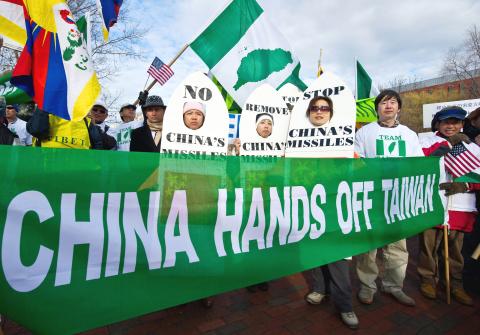
Photo: AFP
In a joint statement, Hu said that Taiwan “concerns China’s sovereignty and territorial integrity” and hoped the US would “honor its relevant commitments and appreciate and support the Chinese side’s position on this issue.”
During the press conference, which was disrupted by technical and translation problems, Obama touched on some of the other topics dealt with during the White House talks.
He said that the yuan was undervalued, that the two countries were expanding and deepening dialogue and cooperation between their militaries, and added that the US had a fundamental interest in regional stability, maintaining freedom of navigation and unimpeded commerce.
The two leaders agreed that North Korea must avoid further provocations.
On the delicate issue of human rights, Obama seemed to deliberately avoid being over-critical.
Although he said he was “candid” on the subject, Obama seems to have ignored congressional wishes that he bring up specific cases of abuse, such as that of jailed Nobel Peace Prize winner Liu Xiaobo (劉曉波).
Hu ignored a question from a US reporter on human rights, but when prodded with a follow-up, said: “China is always committed to the protection and promotion of human rights and, in the course of human rights, China has also made enormous progress, recognized widely in the world.”
However, he also acknowledged that “a lot still needs to be done.”
There is little doubt that Obama’s critics will be disappointed in the president’s failure to be more outspoken on the human rights issue.
Most of the closed-door White House talks appear to have been centered on trade, commerce and economics.
US officials said Beijing had agreed to buy 200 Boeing aircraft for US$19 billion as part of a US$45 billion export deal that is expected to create 200,000 new jobs in the US.
“We welcome China’s rise,” Obama said. “I absolutely believe that China’s peaceful rise is good for the world and it’s good for America. We just want to make sure that that rise occurs in a way that reinforces international norms and international rules, and enhances security and peace, as opposed to it being a source of conflict, either in the region or around the world.”
A lavish state dinner on Wednesday night was “quintessentially American” and included among the 225 guests stars such as Barbra Streisand, her husband James Brolin and action movie star Jackie Chan (成龍).
From big business there was Microsoft’s Steven Ballmer, from fashion there was Vera Wang and Vogue’s Anna Wintour. Artist Maya Lin, Olympic figure skater Michelle Kwan and Supreme Court Justice Stephen Breyer also attended.
Michelle Obama wore what one of the TV networks described as a dramatic red, off-one-shoulder, floor-length gown designed by Alexander McQueen, the British designer who committed suicide last year.
The White House served d’anjou pear salad with goat cheese, poached Maine lobster, orange glazed carrots and black trumpet mushrooms, dry aged rib eye steak with buttermilk crisp onions, double-stuffed potatoes and creamed spinach. Dessert was apple pie and vanilla ice cream.
After-dinner entertainment was provided by an all-star jazz lineup.
Three top US congressional leaders — House Speaker John Boehner, an Ohio Republican; Senate Majority Leader Harry Reid, a Nevada Democrat; and Senator Mitch McConnell of Kentucky, the Republican leader — turned down their invitations as part of a thinly veiled snub to protest Hu’s human rights record.
Obama and Hu also held private Oval Office talks on Taiwan on Wednesday, but later refused to divulge details.
While Taipei and senior US officials are certain to have been given a full briefing, there were no leaks of the details in Washington on Wednesday night.
Analysts speculate that Obama may have told Hu that the US intends to continue selling arms to Taiwan and that Hu would have registered a strong objection, leaving both sides to simply agree to disagree.
At this early stage, there are no indications that a breakthrough — or progress of any kind — was made.
Hu was scheduled to make a public speech later yesterday before he traveled to Chicago and the end of his three-day state visit to the US.
ADDITIONAL REPORTING BY AFP

Tropical Storm Gaemi strengthened into a typhoon at 2pm yesterday, and could make landfall in Yilan County tomorrow, the Central Weather Administration (CWA) said yesterday. The agency was scheduled to issue a sea warning at 11:30pm yesterday, and could issue a land warning later today. Gaemi was moving north-northwest at 4kph, carrying maximum sustained winds near its center of up to 118.8kph and gusts of 154.8kph. The circumference is forecast to reach eastern Taiwan tomorrow morning, with the center making landfall in Yilan County later that night before departing from the north coast, CWA weather forecaster Kuan Shin-ping (官欣平) said yesterday. Uncertainty remains and

SEA WARNING LIKELY: The storm, named Gaemi, could become a moderate typhoon on Wednesday or Thursday, with the Taipei City Government preparing for flooding A tropical depression east of the Philippines developed into a tropical storm named Gaemi at 2pm yesterday, and was moving toward eastern Taiwan, the Central Weather Administration (CWA) said. Gaemi could begin to affect Taiwan proper on Tuesday, lasting until Friday, and could develop into a moderate typhoon on Wednesday or Thursday, it said. A sea warning for Gaemi could be issued as early as Tuesday morning, it added. Gaemi, the third tropical storm in the Pacific Ocean this typhoon season, is projected to begin moving northwest today, and be closest to Taiwan on Wednesday or Thursday, the agency said. Today, there would likely

DISRUPTIONS: The high-speed rail is to operate as normal, while several airlines either canceled flights or announced early departures or late arrivals Schools and offices in 15 cities and counties are to be closed today due to Typhoon Gaemi, local governments announced last night. The 15 are: Taipei, New Taipei City, Taoyuan, Tainan, Keelung, Hsinchu and Kaohsiung, as well as Yilan, Hualien, Hsinchu, Miaoli, Chiayi, Pingtung, Penghu and Lienchiang counties. People should brace for torrential rainfall brought by the storm, with its center forecast to make landfall on the east coast between tonight and tomorrow morning, the Central Weather Administration (CWA) said. The agency issued a sea warning for the typhoon at 11:30pm on Monday, followed by a land warning at 11:30am yesterday. As of

CASUALTY: A 70-year-old woman was killed by a falling tree in Kaohsiung as the premier warned all government agencies to remain on high alert for the next 24 hours Schools and offices nationwide are to be closed for a second day today as Typhoon Gaemi crosses over the nation, bringing torrential rain and whipping winds. Gaemi was forecast to make landfall late last night. From Tuesday night, its outer band brought substantial rainfall and strong winds to the nation. As of 6:15pm last night, the typhoon’s center was 20km southeast of Hualien County, Central Weather Administration (CWA) data showed. It was moving at 19kph and had a radius of 250km. As of 3pm yesterday, one woman had died, while 58 people were injured, the Central Emergency Operation Center said. The 70-year-old


 RSS
RSS