


Taiwanese health authorities yesterday ordered stores to remove US beef products found to contain residue of a banned chemical, despite reassurances from the US that its beef products are safe.
The measure will ensure that such products are not consumed by the public until the results of a second round of mandatory tests is available, Food and Drug Administration (FDA) Director-General Kang Jaw-jou (康照洲) said.
It was the first time that the feed additive Paylean, which promotes production of lean meat in cattle, had been detected in US beef since Taiwan reopened its doors to US beef in 2007, after suspending imports of the product amid concerns over mad cow disease.
Paylean contains ractopamine, one of four animal feed additives — along with salbutamol, terbu-taline and clenbuterol — that are banned in Taiwan.
A day earlier, the Department of Health (DOH) announced that 1 to 2 parts per billion (ppb) of Paylean had been detected in three out of 24 imported beef products sold in hypermarkets in northern Taiwan. All three products came from the US.
In addition, Paylean levels of 5ppb were detected in each of two batches of US beef awaiting customs clearance. The importers decided to forfeit the beef.
Tsai Shu-chen (蔡淑貞), chief of the FDA’s food division, said that of the three meat products found to contain the chemical residue, one came from the Neihu branch of RT-Mart (大潤發), with a reading of 0.64ppb, while the other two came from the Neihu branch of Costco (好市多), with readings of 1.46ppb and 2.84ppb.
RT-Mart said it had removed all remaining products from the 1,207kg batch of meat products that came with the one that tested positive for Paylean. Costco, which had sold 160kg and 300kg of the products, said it had notified customers who had bought them to return them for refunds.
There are no other products in Taiwan from the same shipments as the three problem samples, Tsai said.
DOH Minister Yaung Chih--liang (楊志良) said that lean-meat- enhancing drugs are permitted in some countries, but are banned in Taiwan.
He added that low levels of ractopamine, as detected in the products in question, do not pose an immediate health hazard to humans.
For beef containing 1 to 2ppb of ractopamine, a person weighing 60kg would have to eat 30kg to 60kg of the meat per day before exceeding safety limits, he said.
The Consumers’ Foundation, which strongly opposed the government’s decision to open the local market wider to US beef in 2009, yesterday again urged the DOH to set up a traceability system for imported beef to protect consumers.
The American Institute in Taiwan (AIT) reiterated that US beef is safe.
AIT spokesman Christopher Kavanagh said by telephone that the US has been encouraging Taiwan to “put in place import requirements consistent with the best scientific research and international standards” adopted by 26 countries, including the US, Canada, Australia, Japan and South Korea.
“Taiwan itself has determined in 2007 that ractopamine could be safely used and has notified the WTO [then] that it is going to adopt the internationally recognized maximum ractopamine residue, but it has not yet done so in the three years,” Kavanagh said.
Kavanagh did not comment on the Taiwanese government’s decision to withdraw meat found to contain ractopamine from the market.
According to Kang, the WHO is planning to set a maximum level of 10ppb for ractopamine residue in meat products, but has not made a formal announcement on the issue.
If the WHO makes such an announcement, the Council of -Agriculture will consider whether to lift the ban, Kang said.
Asked whether the issue will be discussed when the US and Taiwan resume Trade and Investment Framework Agreement (TIFA) talks, Kavanagh said the US was still assessing the possibility of resuming the TIFA talks.
Late last month, Minister of Economic Affairs Shih Yen-shiang (施顏祥) told the legislature’s Economics Committee that US Deputy Trade Representative Demetrios Marantis was expected to lead a US delegation to Taipei sometime this month and hold talks with Vice Minister of Economic Affairs Francis Liang (梁國新).

‘NO SECURITY RISK’: The Railway Bureau reassured the public that the technicians’ activities were limited to technical guidance and did not involve sensitive systems The Railway Bureau yesterday said it had invited eight Chinese technicians to assist with an airport MRT construction project. The bureau issued the confirmation after an Internet user said Chinese nationals had entered the construction zone of Taiwan Taoyuan International Airport’s Terminal 3 project. They asked why “individuals from an enemy state” were allowed access to such a major national infrastructure project, which raised serious concerns over Taiwan’s industrial safety, sensitive systems and information security. The bureau’s Northern Region Engineering Branch Office said subcontractor Taiwan Handle Industrial Co (台灣手把工業) of the Taoyuan airport MRT’s “Contract No. CU05 Project A14 Station Civil, MEP &

Taiwan is still in the process of assessing the possibility of recruiting workers from Eswatini, the Ministry of Foreign Affairs said yesterday, adding that its goal is to help Eswatini upgrade its vocational training centers. If there are plans to recruit workers from Eswatini, safeguarding national security, protecting public health and ensuring the employment rights of Taiwanese would be prerequisites, Department of West Asian and African Affairs Director-General Yen Chia-liang (顏嘉良) told a news conference. Key considerations would also include filling labor shortages in specific industries, and fostering bilateral professional and technical exchanges, he said. Yen was asked about the progress of labor

A US uncrewed surface vessel (USV) encountered multiple Chinese warships during an autonomous transit of the Taiwan Strait, US defense company Seasats said in a statement on Wednesday. Seasats announced that a Lightfish USV had completed the first autonomous transit of the Taiwan Strait. Over five days, the USV traversed the entire length of the Strait while constantly monitoring surface vessel traffic, the company said. The Lightfish encountered multiple Chinese warships, one of which was a Chinese People’s Liberation Army Navy (PLAN) Type 056 corvette, it said. The Chinese vessels were operating “well within Taiwan’s exclusive economic zone without transmitting their identity via the
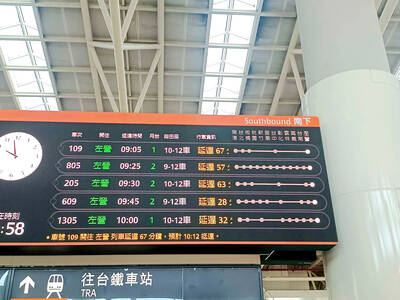
The nation’s usually punctual high-speed rail system yesterday was hit by major disruptions after all scheduled services were canceled and replaced with three hourly trains offering only non-reserved seating, affecting more than 200,000 passengers. Preliminary findings indicate the disruption was caused by a faulty power module in a track switch control cabinet, Taiwan High-Speed Rail Corp (THSRC) said, adding that as a full system inspection could only be conducted after operations end for the day, a decision on whether normal service would resume today would be announced before the first train departs. During a routine inspection early yesterday, a switch signal abnormality


 RSS
RSS