


The Ministry of National Defense (MND) yesterday confirmed reports that it had won the case it filed with the international commercial arbitration court in the scandal-plagued Lafayette frigate deal. The French company Thales has been ordered to repay Taiwan’s government around US$861 million.
In the ruling on Monday, the Paris-based court said the money was to make up for unauthorized commissions that had been paid to help Thomson-CSF (now known as Thales) win a deal to sell six Lafayette frigates to Taiwan for US$2.5 billion in 1991.
The Navy filed the arbitration petition with the court in 2001, requesting the repayment of US$520 million in unlawful kickbacks from Thales.
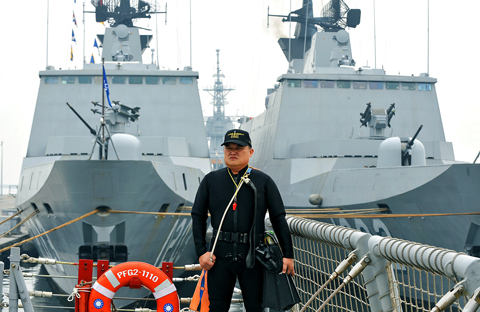
PHOTO: SAM YEH, AFP
Deputy Minister of National Defense Chao Shih-chang (趙世璋) told a press conference yesterday that the ministry hoped that Thales would now repay the money and if the company refused, the Navy would apply to the French court for compulsory enforcement.
Navy attorney Vivian Lee (李孟融) told the press conference that the court ruled that Thales repay US$591 million in unlawful kickbacks, US$250 million in interest and US$20 million in legal expenses, totaling US$861 million.
The ruling was final, she said.
“Thales has been ordered to pay damages and interest,” a company spokesman said, adding that the group was “contesting the very basis of this ruling” and would appeal.
Under Article 18 of the contract, the French company was prohibited from paying any kind of commission and it was stipulated that any illicit commissions would have to be repaid to Taiwan.
The contract also said that any dispute would be settled by a panel of arbitrators.
Prosecutor-General Huang Shih-ming (黃世銘) said Taiwanese prosecutors have not yet completed their investigations into the Lafayette case and they would continue to look into any involvement of former government officials and politicians in the case.
Taiwanese investigators said Thompson-CSF paid US$495 million to Andrew Wang (汪傳浦) and US$25 million to Alfred Sirven, a former vice chairman of the French oil firm Elf-Aquitaine. Sirven is alleged to have played the role of money launderer and allocator of the kickbacks in the transaction.
Wang fled Taiwan in late 1993 following the death of Navy Captain Yin Ching-feng (尹清楓), whose body was found in the sea off the east coast of Taiwan.
Yin is believed to have been ready to blow the whistle on colleagues who had allegedly received kickbacks from the Lafayette deal.
Wang has been wanted in connection with Yin’s death since September 2000.
A French judicial probe opened in 2001 to investigate claims that much of the money paid by Taiwan a decade earlier went toward commissions to middlemen, politicians and military officers in Taiwan, China and France.
In 2001, the Control Yuan ruled that as much as US$400 million in kickbacks may have been paid over the course of the deal.
Thales spearheaded the sale, but the main stake in the contract was held by the French state-owned shipbuilder DCN. Several sources said the French state would have to pay 70 percent of the penalty.
President Ma Ying-jeou (馬英九) expressed gratification over the ruling.
Presidential Office Spokesman Lo Chih-chiang (羅智強) said Ma’s position on the matter was clear and that he supported the ministry’s position that the case should not be settled out of court.
Lo said the legal triumph strengthened the administration’s resolve to build a clean government and military.
Lo declined to comment on whether Ma would accept an offer by the French government to exchange the compensation for the upgrade of existing munitions or additional weaponry, saying it was a hypothetical question.
At a press conference held by the Chinese Nationalist Party (KMT) caucus, KMT Legislator Lin Yu-fang (林郁方) of the Foreign and National Defense Committee described the result as “belated justice.” Lin said he the nation should receive NT$40 billion in compensation rather than NT$20 billion as reported by the media.
Democratic Progressive Party (DPP) legislators said the ruling showed that military officials were also guilty in handing out and receiving kickbacks and asked the defense ministry to publish the names of those involved.
DPP Legislator Chai Trong-rong (蔡同榮) asked the government to redouble its efforts in tracking down escaped fugitive arms dealer Wang, the key suspect in the kickback scandal.
Wang — who also holds a Dominican Republic passport — is ranked No. 4 on a list of Taiwan’s most wanted.
ADDTIONAL REPORTING BY AFP, VINCENT Y. CHAO AND FLORA WANG

Tropical Storm Gaemi strengthened into a typhoon at 2pm yesterday, and could make landfall in Yilan County tomorrow, the Central Weather Administration (CWA) said yesterday. The agency was scheduled to issue a sea warning at 11:30pm yesterday, and could issue a land warning later today. Gaemi was moving north-northwest at 4kph, carrying maximum sustained winds near its center of up to 118.8kph and gusts of 154.8kph. The circumference is forecast to reach eastern Taiwan tomorrow morning, with the center making landfall in Yilan County later that night before departing from the north coast, CWA weather forecaster Kuan Shin-ping (官欣平) said yesterday. Uncertainty remains and

SEA WARNING LIKELY: The storm, named Gaemi, could become a moderate typhoon on Wednesday or Thursday, with the Taipei City Government preparing for flooding A tropical depression east of the Philippines developed into a tropical storm named Gaemi at 2pm yesterday, and was moving toward eastern Taiwan, the Central Weather Administration (CWA) said. Gaemi could begin to affect Taiwan proper on Tuesday, lasting until Friday, and could develop into a moderate typhoon on Wednesday or Thursday, it said. A sea warning for Gaemi could be issued as early as Tuesday morning, it added. Gaemi, the third tropical storm in the Pacific Ocean this typhoon season, is projected to begin moving northwest today, and be closest to Taiwan on Wednesday or Thursday, the agency said. Today, there would likely

DISRUPTIONS: The high-speed rail is to operate as normal, while several airlines either canceled flights or announced early departures or late arrivals Schools and offices in 15 cities and counties are to be closed today due to Typhoon Gaemi, local governments announced last night. The 15 are: Taipei, New Taipei City, Taoyuan, Tainan, Keelung, Hsinchu and Kaohsiung, as well as Yilan, Hualien, Hsinchu, Miaoli, Chiayi, Pingtung, Penghu and Lienchiang counties. People should brace for torrential rainfall brought by the storm, with its center forecast to make landfall on the east coast between tonight and tomorrow morning, the Central Weather Administration (CWA) said. The agency issued a sea warning for the typhoon at 11:30pm on Monday, followed by a land warning at 11:30am yesterday. As of

CASUALTY: A 70-year-old woman was killed by a falling tree in Kaohsiung as the premier warned all government agencies to remain on high alert for the next 24 hours Schools and offices nationwide are to be closed for a second day today as Typhoon Gaemi crosses over the nation, bringing torrential rain and whipping winds. Gaemi was forecast to make landfall late last night. From Tuesday night, its outer band brought substantial rainfall and strong winds to the nation. As of 6:15pm last night, the typhoon’s center was 20km southeast of Hualien County, Central Weather Administration (CWA) data showed. It was moving at 19kph and had a radius of 250km. As of 3pm yesterday, one woman had died, while 58 people were injured, the Central Emergency Operation Center said. The 70-year-old


 RSS
RSS