


The odds of President Ma Ying-jeou (馬英九) being re-elected in 2012 yesterday fell below 50 percent for the first time since May, according to a university prediction market.
Prediction markets are speculative exchanges, with the value of an asset meant to reflect the likelihood of a future event.
On a scale from NT$0 to NT$100, the probability of Ma winning a re-election bid was, according to bidders, NT$48.40, the Center for Prediction Market at National Chengchi University said.
The center has market predictions on topics including politics, the economy, international affairs, sports and entertainment. Members can tender virtual bids on the events, with the bidding price meant to reflect probability.
The re-election market had attracted 860,000 trading entries as of yesterday. It was launched in April to The prediction center was launched in July 2006.
The center said the figure slipped 2.3 percentage points yesterday from a day earlier, when Ma conceded that his party did not fare as well as hoped in the “three-in-one” elections.
The Chinese Nationalist Party (KMT) won 12 of Saturday’s 17 mayor and commissioner elections, but its total percentage of votes fell 2 percentage points from 2005 to 47.88 percent of votes nationwide.
The Democratic Progressive Party (DPP) won just four of the races, but received 45.32 percent of the ballots, or a 7.2 percentage-point increase from 2005.
Since the center opened the trading on Ma’s re-election chances on April 11, prices have largely hovered around NT$60, but jumped to NT$70 in mid-June. The figure then fell to NT$51.80 in August after Typhoon Morakot lashed Taiwan, killing hundreds.
After then-premier Liu Chao-shiuan (劉兆玄) resigned in September, the price returned to NT$63.2 and remained at around NT$60 for the following two months, the center said.
Since Ma took over as KMT chairman, the center said the number had steadily declined from NT$58 on Nov. 18 to NT$50.80 on Dec. 5. After Saturday’s elections, the figure fell below NT$50.
The center said the outcome yesterday would likely affect next year’s elections for the five special municipalities, as well as the next presidential election.
It also said the probability of Taipei Mayor Hau Lung-bin (郝龍斌) winning re-election was 72 percent, while the chances of Taipei County Commissioner Chou Hsi-wei (周錫瑋) winning again were 20 percent.

The nation’s fastest supercomputer, Nano 4 (晶創26), is scheduled to be launched in the third quarter, and would be used to train large language models in finance and national defense sectors, the National Center for High-Performance Computing (NCHC) said. The supercomputer, which would operate at about 86.05 petaflops, is being tested at a new cloud computing center in the Southern Taiwan Science Park in Tainan. The exterior of the server cabinet features chip circuitry patterns overlaid with a map of Taiwan, highlighting the nation’s central position in the semiconductor industry. The center also houses Taiwania 2, Taiwania 3, Forerunner 1 and
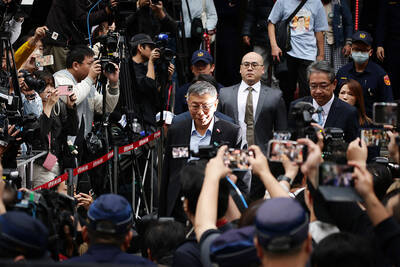
FIRST TRIAL: Ko’s lawyers sought reduced bail and other concessions, as did other defendants, but the bail judge denied their requests, citing the severity of the sentences Former Taipei mayor Ko Wen-je (柯文哲) was yesterday sentenced to 17 years in prison and had his civil rights suspended for six years over corruption, embezzlement and other charges. Taipei prosecutors in December last year asked the Taipei District Court for a combined 28-year, six-month sentence for the four cases against Ko, who founded the Taiwan People’s Party (TPP). The cases were linked to the Core Pacific City (京華城購物中心) redevelopment project and the mismanagement of political donations. Other defendants convicted on separate charges included Chinese Nationalist Party (KMT) Taipei City Councilor Angela Ying (應曉薇), who was handed a 15-year, six-month sentence; Core Pacific
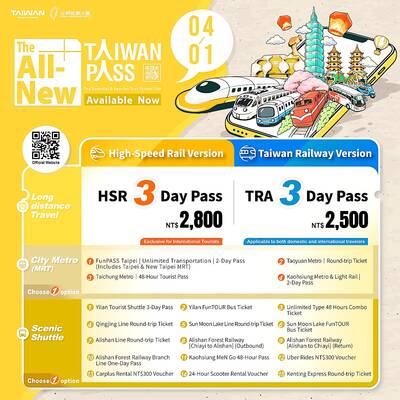
MORE POPULAR: Taiwan Pass sales increased by 59 percent during the first quarter compared with the same period last year, the Tourism Administration said The Tourism Administration yesterday said that it has streamlined the Taiwan Pass, with two versions available for purchase beginning today. The tourism agency has made the pass available to international tourists since 2024, allowing them to access the high-speed rail, Taiwan Railway Corp services, four MRT systems and four Taiwan Tourist Shuttles. Previously, five types of Taiwan Pass were available, but some tourists have said that the offerings were too complicated. The agency said only two types of Taiwan Pass would be available, starting from a three-day pass with the high-speed rail and a three-day pass with Taiwan Railway Corp. The former costs NT$2,800
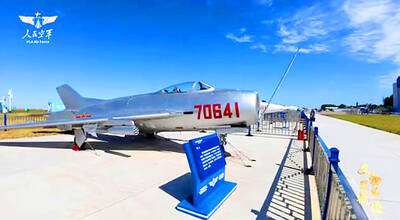
J-6 REMODEL: The converted drones are part of Beijing’s expanding mix of airpower weapons, including bombers with stand-off missiles and UAV swarms, the report said China has stationed obsolete supersonic fighters converted to attack drones at six air bases close to the Taiwan Strait, a report published this month by the Arlington, Virginia-based Mitchell Institute for Aerospace Studies said. Satellite imagery of the airfields from the institute’s “China Airpower Tracker” shows what appear to be lines of stubby, swept-winged aircraft matching the shape of J-6 fighters that first flew with the Chinese People’s Liberation Army (PLA) Air Force in the 1960s. Since their conversion to drones, the aircraft have been identified at five bases in China’s Fujian Province and one in Guangdong Province, the report said. J.


 RSS
RSS