


A storm moving toward the northeast of the Philippines weakened yesterday, but hundreds of people fled coastal areas, fearing for their lives after powerful typhoons in recent weeks killed hundreds.
The UN said it would raise additional international aid to feed and shelter tens of thousands of people displaced by the two typhoons that also destroyed about 30 billion pesos (US$643 million) worth of crops and infrastructure.
The army, police and coast guard were using several means, including trucks, boats and helicopters, to move people out of danger zones in the northeast, said Lieutenant-Colonel Ernesto Torres of the national disaster agency.

PHOTO: EPA
“We continue to move people in coastal villages to much safer areas in the north because of this stormy weather,” Torres told reporters, adding that Typhoon Lupit had started to dump rain although it had weakened.
Prisco Nilo, head of the Philippine weather bureau, said Lupit had shifted its track northward toward Taiwan.
“The expected landfall in Cagayan province would no longer happen unless there is another change in its track,” he said.
“We cannot say that the northern Philippines has been spared because things can still change,” he said. “Lupit could still trigger landslides as lands are still saturated from the previous storms.”
Lupit, which means “fierce” in Filipino and packing center winds of 105kph and gusts of up to 135kph, was almost stationary 110km northeast of extreme northern Luzon. It is expected to make landfall by tomorrow.
Television images showed people tying boats to trees and strengthening their homes against strong winds. Other residents were sandbagging their homes, hoping to protect them against storm-generated waves that could rise to 3m.
The UN World Food Programme (WFP) said relief work in the areas ravaged by the typhoons since Sept. 26 would continue up to six months because farmlands were still heavily flooded, which could delay the planting season.
“We need the help now,” WFP executive director, Josette Sheeran, told reporters after touring flooded areas near Manila.
“Currently, we are making an assessment to determine what help is still needed,” she said.
The WFP has been distributing 5,000 tonnes of rice and 17 million packs of biscuits to about 1 million people in communities without power and safe drinking water.
Also See: Lupit floods Yilan schools, roads
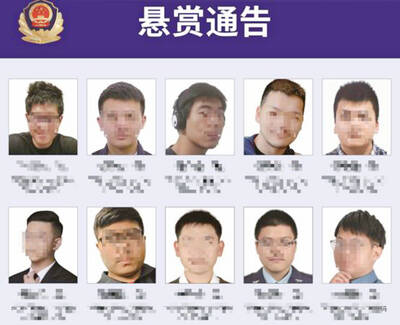
Taiwan yesterday denied Chinese allegations that its military was behind a cyberattack on a technology company in Guangzhou, after city authorities issued warrants for 20 suspects. The Guangzhou Municipal Public Security Bureau earlier yesterday issued warrants for 20 people it identified as members of the Information, Communications and Electronic Force Command (ICEFCOM). The bureau alleged they were behind a May 20 cyberattack targeting the backend system of a self-service facility at the company. “ICEFCOM, under Taiwan’s ruling Democratic Progressive Party, directed the illegal attack,” the warrant says. The bureau placed a bounty of 10,000 yuan (US$1,392) on each of the 20 people named in

The High Court yesterday found a New Taipei City woman guilty of charges related to helping Beijing secure surrender agreements from military service members. Lee Huei-hsin (李慧馨) was sentenced to six years and eight months in prison for breaching the National Security Act (國家安全法), making illegal compacts with government employees and bribery, the court said. The verdict is final. Lee, the manager of a temple in the city’s Lujhou District (蘆洲), was accused of arranging for eight service members to make surrender pledges to the Chinese People’s Liberation Army in exchange for money, the court said. The pledges, which required them to provide identification

Nine retired generals from Taiwan, Japan and the US have been invited to participate in a tabletop exercise hosted by the Taipei School of Economics and Political Science Foundation tomorrow and Wednesday that simulates a potential Chinese invasion of Taiwan in 2030, the foundation said yesterday. The five retired Taiwanese generals would include retired admiral Lee Hsi-min (李喜明), joined by retired US Navy admiral Michael Mullen and former chief of staff of the Japan Self-Defense Forces general Shigeru Iwasaki, it said. The simulation aims to offer strategic insights into regional security and peace in the Taiwan Strait, it added. Foundation chair Huang Huang-hsiung

’DISTORTION’: Beijing’s assertion that the US agreed with its position on Taiwan is a recurring tactic it uses to falsely reinforce its sovereignty claims, MOFA said The Ministry of Foreign Affairs (MOFA) yesterday said Chinese state media deliberately distorted Taiwan’s sovereign status, following reports that US President Donald Trump agreed to uphold the “one China” policy in a phone call with Chinese President Xi Jinping (習近平). During the more than one-hour-long call, Xi urged Trump to retreat from trade measures that roiled the global economy and cautioned him against threatening steps on Taiwan, a Chinese government summary of the call said. China’s official Xinhua news agency quoted Xi as saying that the US should handle the Taiwan issue cautiously and avoid the two countries being drawn into dangerous


 RSS
RSS