


Taiwan’s Ho Chiu-mei (何秋美) and Ho Chiu-hsiang (何秋香) settled for silver medals in women’s doubles tennis at the Deaflympics yesterday, while An Ching-lung (安慶隆) took home the bronze in the decathlon.
The “Golden Girls” lost to their German opponents 6-2, 2-6, 1-6 at the Rainbow Riverside Sports Park.
The battle was tough, as the elder sister, Ho Chiu-hsiang, had cramps in both legs by the third set. The two lost one game when the match referee ruled that they had delayed the proceedings too long.

PHOTO: CNA
Both decided to continue the fight, with Ho Chiu-mei handling the attack from their opponents and her elder sister playing the ball while stationary on the court whenever she could.
Despite the crisis, the two managed to win one game in the third set.
When their opponents threatened with four match points, the sisters broke three before finally handing the Germans the victory.

PHOTO: SUN CHUNG-TA, TAIPEI TIMES
Ho Chiu-hsiang was later sent to the emergency room for treatment.
“I asked her if she wanted to continue,” Ho Chiu-mei told reporters.
“I said we’d quit if she could not handle the game anymore. She said she could carry on. We thought: ‘We’re competing in the Deaflympics in Taipei, in Taiwan, in a championship match. We should do everything we can to fight until the end,’” Ho Chiu-mei said.
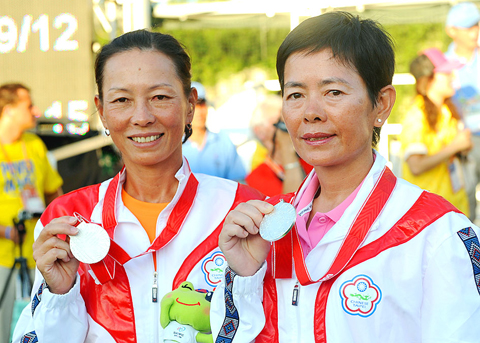
PHOTO: CHIEN JUNG-FONG, TAIPEI TIMES
Their coach, Chang Yue-han (張約翰), said that Ho Chiu-hsiang was hoping to take down her opponents by moving quickly around the court.
“Chiu-hsiang is 50, and Amei [Ho Chiu-mei] is 47, the two oldest athletes in tennis,” Chang said.
“When you add up the ages of our opponents, it’s pretty much equal to the age of either one of them. What she [Ho Chiu-hsiang] considered the best strategy became the key to their failure,” Chang said.
In the decathlon at Taipei Municipal Stadium, An Ching-lung won the bronze medal after scoring a total of 6,106 points. Russian Kirill Tsybizov secured the gold with a total of 6,500 points, while Craig Saafeld from the US nailed the silver by gaining 6,381 points.
“He is the pride of the Amis Tribe, the pride of the Aborigines and the pride of Taiwan,” said An’s coach, Wang Wen-hsiang (王文祥).
An finished third in the 110m hurdles and secured fifth in the discus category. He ranked second in the pole vault after clearing 4.2m and then threw the javelin 48.31m. When he finished sixth in the 1,500m, An lay on the ground and pointed his fingers to the sky, which he said was a gesture to thank God.
Though he won the gold in 2001 and a silver in 2005, An said the bronze medal meant more to him than his previous medals because this had been the highest score he has attained. An scored 5,613 points at the 2005 Deaflympics in Melbourne, Australia.
Wang said An had done his best in the competition, noting that An was 10 years older than the average age of the decathletes.
Meanwhile, the nation failed in its bid to win another gold in table tennis as the two men’s doubles teams were eliminated in the second round of the preliminaries and in the quarter-finals yesterday.
Wen Chih-hsuan (溫智璇) and Yang Jung-Tsung (楊榮宗), the champions at the 2005 Deaflympics, lost to China’s Li Yunnan and Wang Cong. Their teammates, Chiang Feng-ming (江豐明) and Kuo Yueh-tung (郭岳東), managed to get to the quarter-finals, where they were soon eliminated by Andrii Gnatiuk Gennadii Zakladnyi of Ukraine.
Taiwan’s men’s and women’s badminton doubles pairings were also eliminated in the quarter-final.
In the women’s singles, Fan Jung-yu (范榮玉) failed to make the quarter-finals when she lost to Lithuania’s Kristina Dovydaityte.
Also See: DEAFLYMPICS TAIPEI 2009: Ukraine, Russia to battle for final gold

The National Chungshan Institute of Science and Technology yesterday showcased its locally developed variants of the Vision 60 robotic patrol dog, which it plans to deploy on the nation’s outlying territories in the South China Sea. The variants were produced under the Joint Lab project — created by the institute and domestic companies — and assembled with domestically produced motors, lenses and artificial intelligence (AI) systems alongside licensed tech from the US, Missile and Rocket Systems Research Division deputy director Jen Kuo-kang (任國光) told the media event at a military base in Taipei’s Dazhi (大直) area. Taiwan has built up its strengths

RIGHT DIRECTION: Taiwan’s efforts to prevent forced labor include a proposal to ‘fully prohibit’ employers from withholding workers’ documents, an official said Taiwan is to establish a mechanism to restrict imports of goods linked to forced labor, the Executive Yuan said yesterday, after the US proposed imposing additional tariffs on Taiwanese goods over labor concerns. “The Ministry of Labor and the Ministry of Economic Affairs are to establish an interministerial review procedure,” Executive Yuan spokesperson Michelle Lee (李慧芝) said at a news briefing in Taipei. “The government is to use the Foreign Trade Act [貿易法] as the legal basis to restrict imports of goods produced with forced labor” and bring its supply chain governance more in line with international standards on human rights, resilience
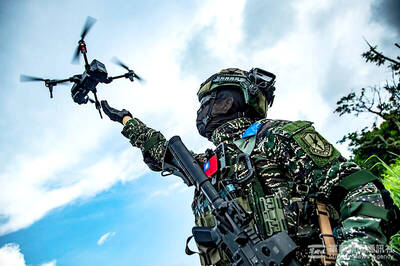
RESILIENCE: Taiwan plays a key role in semiconductors, energy, information infrastructure and advanced manufacturing, AIT Director Raymond Greene said Taiwan’s continued investment in deterrence and resilience remains vital, especially in uncrewed systems and other emerging technologies, American Institute in Taiwan (AIT) Director Raymond Greene said yesterday. Greene made the remarks at the annual National Strategic Summit on Supply Chain Resilience held by the Research Institute for Democracy, Society and Emerging Technology (DSET), a government-backed think tank. As Taiwan last year became the US’ fourth-largest trading partner and supply chain security is becoming more important, cooperation in emerging technologies continues to deepen between the two countries, he said. The US is committed to accelerating innovation, building key infrastructure, strengthening cooperation

NOT IMMEDIATE: Taiwan has a chance to appeal the proposed 10 percent tariff before it starts, while other countries face a 12.5 percent tariff from the trade office Taiwan is among 60 economies determined by the US to have failed to impose or enforce a ban on the importation of goods produced with forced labor, according to a notice released on Tuesday by the Office of the US Trade Representative (USTR), which proposed imposing an additional 10 percent or more tariff on them. The USTR in a statement said that following an investigation, it had determined under Section 301 of the Trade Act of 1974 that the failure of the 60 economies to impose and effectively enforce a prohibition on the importation of goods produced with forced labor is


 RSS
RSS