


The Presidential Office yesterday approved a visit by the Dalai Lama to Taiwan, stressing that his trip would be purely religious and would not affect cross-strait ties.
A staffer from Taiwan's representative office in India, where the Tibetan spiritual leader resides, said that the Dalai Lama had already received a visa and would arrive in Taiwan on a China Airlines flight on Sunday and leave next Friday.
The secretary-general of the Dalai Lama's office will arrive in Taiwan today to make arrangements for the trip.
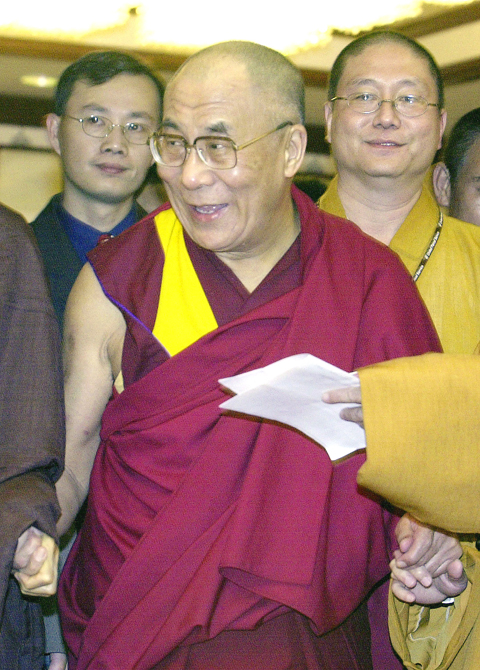
PHOTO: CHIANG YING-YING, AP
China has denounced the visit.
“No matter under what form or identity the Dalai Lama uses to enter Taiwan, we resolutely oppose this,” Xinhua news agency quoted the Taiwan Affairs Office as saying.
The invitation was extended by the chiefs of seven local governments in southern Taiwan in the wake of Typhoon Morakot, who hope the Dalai Lama's visit would console victims in the hard-hit areas.
The Tibetan government-in-exile confirmed on Wednesday that the Dalai Lama had accepted the invitation.
Presidential Office Spokesman Wang Yu-chi (王郁琦) told a press conference yesterday morning that the government's decision to authorize the visit was based on religious and humanitarian considerations.
Wang said the position of President Ma Ying-jeou's (馬英九) administration on the matter was clear — that it welcomes visits by world religious leaders to engage in religious activities.
“We welcome the Dalai Lama to come to Taiwan to perform religious rituals for the typhoon victims,” Wang said.
“We think this will not damage relations between the two sides of the Taiwan Strait,” he said.
Ma rejected a proposed trip by the Dalai Lama last December. Ma said then that the timing was “inappropriate” for a visit.
During an inspection of Nantou County's Sinyi Township (信義) yesterday morning, Ma confirmed that the government had approved the visit.
While the Presidential Office did not make the final decision until 11pm on Wednesday, Wang said officials spent hours to “understand” and “evaluate” the situation, adding that the decision had nothing to do with Beijing.
As to whether Ma would meet the Nobel Peace laureate, Wang said it was a “hypothetical” question and the Presidential Office would not deal with it until the Dalai Lama made an official request.
As to what status the government would grant the Dalai Lama, Wang said it was a “technical” question that the administration would not worry about now, adding that there were precedents to follow.
When the Dalai Lama first visited Taiwan in 1997, the then-Chinese Nationalist Party (KMT) government considered him “an overseas Republic of China national without a household registration” and granted him an “entry permit issued by the Bureau of Immigration.
For the Dalai Lama's second visit in 2001, he was recognized by the then-Democratic Progressive Party (DPP) government as a “foreign national” and was allowed to use his Identity Certificate — a travel document that the Indian government issues to Tibetans living in exile in the country — to obtain a visa to enter Taiwan.
The Dalai Lama has written to Ma in the aftermath of Morakot to express concern over the disaster.
Wang yesterday first said he did not think the president had written back but later said Ma had replied on Monday in his capacity as president.
Wang did not answer whether the Ma administration would allow the Dalai Lama to visit the north or participate in non-religious activities, only reiterating that the government welcomed him to engage in religious activities.
Legislative Speaker Wang Jin-pyng (王金平) yesterday highlighted the humanitarian and religious nature of the Dalai Lama's visit, but added: “I hope he will not participate in any political activities during his stay in Taiwan.”
“His visit will be very comforting [to the victims] ... I think we should prioritize humanitarian concerns over politics,” Wang said.
KMT Legislator Wu Yu-sheng (吳育昇) said the timing was right for the Dalai Lama to visit Taiwan, but called on the DPP to refrain from manipulating his visit for political gains.
“I have to remind the DPP that although it is good to invite the Dalai Lama to bless the victims, the DPP should not try to take advantage of his visit and trumpet Tibetan independence, Taiwanese independence and [the DPP's] political ideology or incite cross-strait conflict,” Wu said.
DPP acting spokesman Chao Tien-lin (趙天麟) said yesterday the Dalai Lama would visit to offer comfort and invoke blessings for the victims of Morakot and had no political purpose. Chao urged both governing and opposition parties to refrain from using the visit for political mudslinging.
The monk's visit is also a prime opportunity for Ma to “change his attitude” and could even benefit Ma in the long run, Chao said.
Noting that the Dalai Lama has visited Taiwan twice before, Chao said this was proof that his presence in the country had no adverse effect on cross-strait developments.
“We are pleased to see that the government has agreed to the Dalai Lama's visit. The DPP has no intention of using the visit to cause problems for anyone. The only purpose of the trip was to respect the wishes of many victims who have expressed their hopes to the local governments to receive the blessings of the Dalai Lama,” Chao said.
The Dalai Lama's visit could offer comfort the victims as well as attract the world's attention to the aftermath of the typhoon and perhaps elicit more aid from the international community, Chao said, stressing that the DPP had no ulterior motives except to give the typhoon victims spiritual nourishment.
DPP Legislator Wang Sing-nan (王幸男) said he hoped other religious groups would follow suit by holding prayer services or activities to help the victims.
Kaohsiung Mayor Chen Chu (陳菊), one of the seven local government chiefs who invited the Dalai Lama to visit, said the city government would begin to discuss the details of his trip with his office staff.
Dawa Tsering, the representative of the Tibetan government-in-exile in Taiwan, said the Dalai Lama had filed his visa application for Taiwan yesterday using his Identity Certificate.
The Ministry of Foreign Affairs said it would do all it can to ensure that the Dalai Lama has a smooth trip to Taiwan.
Dawa said the Tibetan spiritual leader will visit the disaster areas in southern Taiwan, hold a religious service in Kaohsiung and deliver speeches in Kaohsiung and Taipei, Dawa said.
Meanwhile, Chen Xiancai, deputy director of Xiamen University's Taiwan research center, said Ma's decision to allow a visit by the Dalai Lama was “unwise” and could damage ties with China.
“The Dalai Lama is not a purely religious figure. He is a political figure who is involved in splitting the motherland,” he told the by telephone. “Ma Ying-jeou has a political intention in his decision to approve this visit.”
“Ma Ying-jeou is facing a political crisis after the typhoon and the Democratic Progressive Party is posing a tough question to Ma,” he said. “Ma's decision is unwise and is lacking in political wisdom.”
“We still have to see how things develop, how Ma explains it to China, what kind of steps he will take and whether the Dalai Lama will go to Taiwan in the end,” he said.
ADDITIONAL REPORTING BY FLORA WANG AND AGENCIES

Tropical Storm Gaemi strengthened into a typhoon at 2pm yesterday, and could make landfall in Yilan County tomorrow, the Central Weather Administration (CWA) said yesterday. The agency was scheduled to issue a sea warning at 11:30pm yesterday, and could issue a land warning later today. Gaemi was moving north-northwest at 4kph, carrying maximum sustained winds near its center of up to 118.8kph and gusts of 154.8kph. The circumference is forecast to reach eastern Taiwan tomorrow morning, with the center making landfall in Yilan County later that night before departing from the north coast, CWA weather forecaster Kuan Shin-ping (官欣平) said yesterday. Uncertainty remains and

SEA WARNING LIKELY: The storm, named Gaemi, could become a moderate typhoon on Wednesday or Thursday, with the Taipei City Government preparing for flooding A tropical depression east of the Philippines developed into a tropical storm named Gaemi at 2pm yesterday, and was moving toward eastern Taiwan, the Central Weather Administration (CWA) said. Gaemi could begin to affect Taiwan proper on Tuesday, lasting until Friday, and could develop into a moderate typhoon on Wednesday or Thursday, it said. A sea warning for Gaemi could be issued as early as Tuesday morning, it added. Gaemi, the third tropical storm in the Pacific Ocean this typhoon season, is projected to begin moving northwest today, and be closest to Taiwan on Wednesday or Thursday, the agency said. Today, there would likely

DISRUPTIONS: The high-speed rail is to operate as normal, while several airlines either canceled flights or announced early departures or late arrivals Schools and offices in 15 cities and counties are to be closed today due to Typhoon Gaemi, local governments announced last night. The 15 are: Taipei, New Taipei City, Taoyuan, Tainan, Keelung, Hsinchu and Kaohsiung, as well as Yilan, Hualien, Hsinchu, Miaoli, Chiayi, Pingtung, Penghu and Lienchiang counties. People should brace for torrential rainfall brought by the storm, with its center forecast to make landfall on the east coast between tonight and tomorrow morning, the Central Weather Administration (CWA) said. The agency issued a sea warning for the typhoon at 11:30pm on Monday, followed by a land warning at 11:30am yesterday. As of

CASUALTY: A 70-year-old woman was killed by a falling tree in Kaohsiung as the premier warned all government agencies to remain on high alert for the next 24 hours Schools and offices nationwide are to be closed for a second day today as Typhoon Gaemi crosses over the nation, bringing torrential rain and whipping winds. Gaemi was forecast to make landfall late last night. From Tuesday night, its outer band brought substantial rainfall and strong winds to the nation. As of 6:15pm last night, the typhoon’s center was 20km southeast of Hualien County, Central Weather Administration (CWA) data showed. It was moving at 19kph and had a radius of 250km. As of 3pm yesterday, one woman had died, while 58 people were injured, the Central Emergency Operation Center said. The 70-year-old


 RSS
RSS