


The death toll from Typhoon Morakot will pass 500, but the real figure might never be known, government officials said yesterday.
At a national security meeting yesterday — the first since the typhoon slammed southern Taiwan, wreaking havoc in mountainous regions — President Ma Ying-jeou (馬英九) said 380 people in Xiaolin Village (小林) were buried alive, while 7,000 were left homeless.
“With 117 confirmed deaths from the typhoon and 380 people feared to have been buried alive by mudslides in Xiaolin Village, Taiwan’s death toll could rise to more than 500,” Ma said at the Presidential Office.
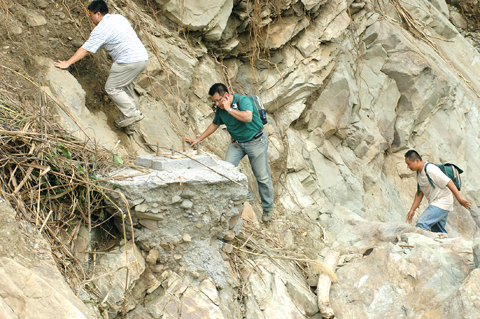
PHOTO: PATRICK LIN, AFP
“The situation is far more serious than the Aug. 7 flood that damaged Taiwan 50 years ago ... The government must take full responsibility [for the damage] and conquer all difficulties to finish the task,” he said.
The typhoon dumped more than 3m of rain, setting off flooding and mudslides that tore through houses and buildings, wiped away roads and destroyed bridges.
The scale of the crisis has overwhelmed authorities, which have been criticized for being too slow in realizing the magnitude of the crisis.

PHOTO: PETER PARKS, AFP
As anger over the government’s response mounted, Ma yesterday vowed to help victims.
“The government will overcome all obstacles in accomplishing this mission,” he said.
Ma blamed the Executive Yuan for failing to evacuate residents living in threatened villages earlier, and demanded that it present a comprehensive plan for the evacuation of residents in the event of future disasters.
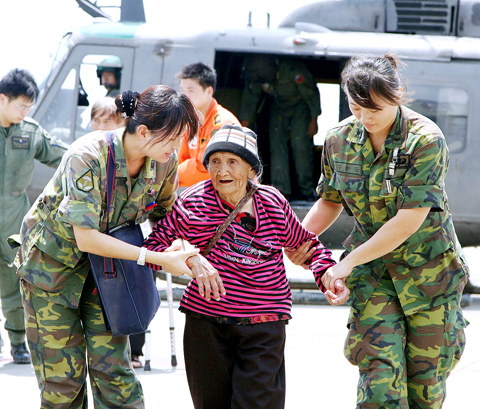
PHOTO: AP
Ma asked the Ministry of National Defense to deploy 10,000 more soldiers and police academy students to help with rescue and relief work in disaster-hit areas, and said that central and local governments should set up post-disaster committees to handle reconstruction work.
The disaster operation center should issue prompt and accurate information, and the Ministry of Economic Affairs should invest at least NT$3 billion (US$91 million) in the next two years for flood control measures, he said, while asking the government to provide transparent information and inform victims that they would be helped.
When asked by reporters for comment on the president’s refusal to initiate the national security mechanism sooner, Presidential Office Spokesman Wang Yu-chi (王郁琦) said that when Ma saw the number of deaths climbing on Thursday, he decided to convene all government bodies to discuss rescue work yesterday.
In Xiaolin Village, in Kaohsiung County’s Jiaxian Township (甲仙), as many as 169 households comprising 389 people were still unaccounted for yesterday and were feared buried under mud as deep as 15m.
To find out the exact number of people who may not have survived, the Jiaxian Township Office interviewed Xiaolin survivors and made a list of people who were in the village on Sunday, and checked it against the list of Xiaolin villagers who were rescued.
Many survivors, especially those who returned to Xiaolin, said that their families, friends and neighbors who did not make it out had no chance of survival.
Video clips broadcast by local TV news channels showed that except for two houses, most of the village had been flattened and covered by mud and rocks.
Some survivors went back to the site with incense sticks, canned drinks and food to pay respects to their loved ones.
“I don’t think it would help if we dug up the area, so I think we should just leave them [buried victims] where they are,” a Xiaolin survivor said in a video clip aired by SET-TV. “We can erect a monument here to commemorate them and we can come back here to pay our respects on special days.”
“My mother, my two sons and one daughter are gone, they’ve all been buried,” said another Xiaolin survivor, Chen Chen-jung (陳振榮). “Don’t bother them again, let them rest in peace, that’s all I want.”
In response, Kaohsiung County Commissioner Yang Chiu-hsing (楊秋興) said he would respect the villagers’ wishes.
“It may cause the villagers more distress if we dig them up because the bodies could be torn apart [by excavators], so if the villagers want to leave their families buried and turn the site into a memorial park, we’d be glad to follow their wishes,” he said.
At a hot spring resort where rescuers yesterday found bodies buried by mudslides, volunteers snaked through 18km of roads ravaged by flash floods and three half-blocked tunnels. But they said they were still prevented from getting relief supplies across to the trapped victims because of a toppled bridge.
The National Police Agency said yesterday it had notified Kaohsiung County Government offices that a total of 37 corpses or human remains had been gathered around the county to be identified.
The agency called for relatives of people who had lost contact with their families since Typhoon Morakot to have their DNA taken at police stations to facilitate the search for those who have died or gone missing.
Work began early yesterday to evacuate residents living along the Laonong River (荖濃溪) in Kaohsiung County’s Taoyuan (桃源) and Liukuei (六龜) townships out of fear that a big barrier lake created by mudslides and torrents over the past week could burst.
Rock and mudslides have created choked-up lakes of various sizes in areas along the river, with the largest one covering 6 hectares, Kaohsiung officials said.
Meanwhile, repairs to the road leading to Liukuei were partially completed late yesterday, allowing more rescue workers to enter the township.
RAGING RIVERS
More than 50,000 troops were struggling to cross raging rivers and fallen bridges to reach victims yesterday, while helicopters airlifted supplies to stranded villagers and ferried people to safety. In Meilan Village (梅蘭), Kaohsiung County, two desperate young men waved a large yellow banner that read “Government, please help the people in Meilan and Changshan,” every time a helicopter hovered above them.
One of them, surnamed Hsieh (謝), said he left his work to return to his home village to search for 270 villagers who had been missing for a week.
“The mountain here is shaking, it is going to collapse,” he said, asking why rescue teams had neglected their villages. “Taiwan is cursed. This has never happened before.”
In Nantou, 53-year-old Chang Jui-hsien (張瑞賢), a volunteer firefighter who joined the effort to search for bodies of people who fell into the Choshui River (濁水溪) when Provincial Highway No. 16 along the river collapsed on Sunday, died after falling into the river.
At about 12pm yesterday, a boat that Chang piloted capsized in the surging waters. Two passengers were quickly rescued, while Chang was washed downstream.
Chang struggled to swim to the riverbank, but he did not make it until he reached an area where the current was slower. However, he fell unconscious as soon as he reached the bank.
Chang died about four hours after he was rushed to the emergency room at a nearby hospital. The emergency operation center in Nantou confirmed yesterday that by the time Chang was sent to the hospital, he was already found to be in Stage 3 of the Glasgow Coma Scale.
A car owned by Chuen Hsin-ying (全欣穎), one of the missing people, was found by rescuers yesterday in the Choshui River. The rescuers also found two bodies in the river whose identities still needed to be verified.
Many impatient people decided to extend a helping hand.
About 80 volunteers mobilized by the Presbyterian Church in Taiwan took generators, gasoline, food and other necessities into three villages in Chiayi County’s Alishan Township (阿里山), where more than 6,000 are trapped.
“The volunteers drove the items in cars to the spot where the road is obstructed, and then continued the rest of the trip on foot,” said Hosi Yudaw, a member of the group said. “Since the government’s rescue teams aren’t doing anything to help Alishan residents, we must give them a hand.”
Hosi said that the Church has organized other volunteer teams to help out in Taitung and Kaohsiung counties.
SPECIAL FORCE
Because Highway 18 was severely damaged by landslides, the Army yesterday dispatched a special task force to deliver food supplies and other resources to residents of Fanlu Township (番路) in Chiayi County. Each of the special task force members was required to carry 40kg of supplies in his or her knapsack.
The emergency operation center in Chiayi County said it believed nearly 9,000 people remained stranded there.
In Pingtung County, more than 200 villagers in Wutai Township (霧台) — one of the hardest-hit of the county’s townships — had been airlifted to safety as of 11am, with 100 more awaiting rescue. However, about 250 residents refused to be evacuated because the weather had cleared and the rain had subsided.
In southern parts of Taitung County, more than 20,000 residents remained stranded without food or potable water. Captain Lee Lu-tai (李魯臺), commander of Fleet 151, said yesterday that naval frigates, to be loaded with heavy vehicles for transport and clean-up jobs as well as other relief supplies, would anchor off Jhihben (知本) today.
The Taitung County Government, meanwhile, yesterday rescinded the order it made overnight that approximately 500 residents in Jialan (嘉蘭), Taiho (太和) and Hsianglan (香蘭) villages evacuate after it ascertained that a barrier lake upstream on the Taimali River (太麻里溪) did not likely endanger residents because its water level was much lower than the previous day.
More than 363,000 households in the southern counties of Tainan, Kaohsiung and Pingtung were still without running water as of 10am yesterday and more than 19,000 households throughout the Chiayi, Tainan, Kaohsiung, Pingtung and Taitung regions were still suffering from power outages.
Because of road blockages and downed bridges, repair teams were still unable to enter the battered zones, Taiwan Power Co (Taipower, 台電) said. In some areas, flood water caused by heavy rains have not subsided, nor dried up enough for Taipower to resume services, it said.
ADDITIONAL REPORTING BY ELIZABETH TCHII
Also See: JOHNNY NEIHU'S NEWS WATCH: You know you’re really one of us (II)

The National Chungshan Institute of Science and Technology yesterday showcased its locally developed variants of the Vision 60 robotic patrol dog, which it plans to deploy on the nation’s outlying territories in the South China Sea. The variants were produced under the Joint Lab project — created by the institute and domestic companies — and assembled with domestically produced motors, lenses and artificial intelligence (AI) systems alongside licensed tech from the US, Missile and Rocket Systems Research Division deputy director Jen Kuo-kang (任國光) told the media event at a military base in Taipei’s Dazhi (大直) area. Taiwan has built up its strengths

RIGHT DIRECTION: Taiwan’s efforts to prevent forced labor include a proposal to ‘fully prohibit’ employers from withholding workers’ documents, an official said Taiwan is to establish a mechanism to restrict imports of goods linked to forced labor, the Executive Yuan said yesterday, after the US proposed imposing additional tariffs on Taiwanese goods over labor concerns. “The Ministry of Labor and the Ministry of Economic Affairs are to establish an interministerial review procedure,” Executive Yuan spokesperson Michelle Lee (李慧芝) said at a news briefing in Taipei. “The government is to use the Foreign Trade Act [貿易法] as the legal basis to restrict imports of goods produced with forced labor” and bring its supply chain governance more in line with international standards on human rights, resilience
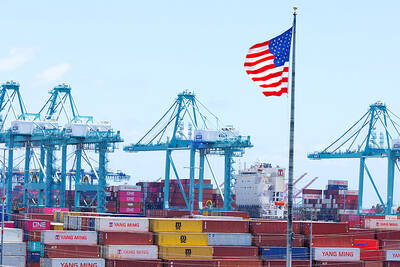
NOT IMMEDIATE: Taiwan has a chance to appeal the proposed 10 percent tariff before it starts, while other countries face a 12.5 percent tariff from the trade office Taiwan is among 60 economies determined by the US to have failed to impose or enforce a ban on the importation of goods produced with forced labor, according to a notice released on Tuesday by the Office of the US Trade Representative (USTR), which proposed imposing an additional 10 percent or more tariff on them. The USTR in a statement said that following an investigation, it had determined under Section 301 of the Trade Act of 1974 that the failure of the 60 economies to impose and effectively enforce a prohibition on the importation of goods produced with forced labor is

TIT-FOR-TAT: The US allegedly revoked the visa of a Chinese national working at Xinhua News Agency in the US in response to Beijing’s expulsion of Vivian Wang The Presidential Office yesterday condemned China for expelling a New York Times correspondent from Beijing following the newspaper’s interview with President William Lai (賴清德), saying the move highlighted Beijing’s suppression of press freedom and its threat to international news media. Taiwan has noted a series of recent incidents in which Beijing used similar tactics to “threaten and pressure international media outlets and journalists,” Presidential Office spokeswoman Karen Kuo (郭雅慧) said in a statement. “This concerns not only press freedom and freedom of expression, but also the safety of journalists, and Taiwan and relevant partners are paying close attention to the situation,” she


 RSS
RSS