


Former Philippine president Corazon Aquino, whose “People Power” revolution toppled Philippine dictator Ferdinand Marcos and restored democracy to the nation, died yesterday after a battle with colon cancer.
“Cory” Aquino was propelled into the political spotlight in 1986, leading millions of Filipinos in protests against the corrupt regime of Marcos, who jailed thousands of dissidents during his brutal 20-year regime.
As people across the Catholic nation woke to the news, Philippine President Gloria Macagapal Arroyo declared a 10-day period of mourning for Aquino, whom she praised as a “national treasure.”
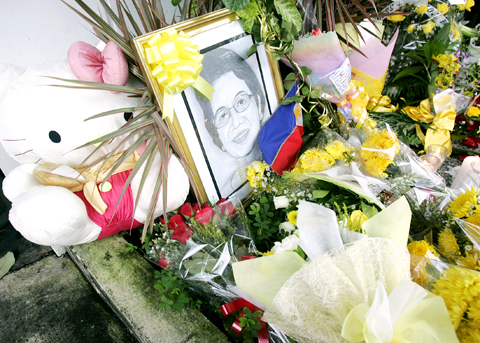
PHOTO: AP
Aquino’s family announced her death early yesterday.
“Our mother peacefully passed away at 3:18am, August 1, 2009, of cardio-respiratory arrest,” Senator Benigno Aquino Jr said in a statement outside the Makati Medical Center in Manila, where his mother had been hospitalized.
“She would have wanted us to thank each and every one of you for all the prayers and the continuous love and support,” he said.
“It was her wish for all of us to pray for one another and for the country,” the senator said.
Arroyo, in the US on an official visit, said: “Aquino led a revolution that restored democracy and the rule of law to our nation at a time of great peril.”
Former aide and press secretary Teodoro Locsin, who is also a close family friend, wept on TV.
“The purity, the nobility, never failed. She never asked for anything,” in return, Locsin said.
He said more than anything else, Aquino removed the “center of corruption in government, because she would not be corrupt.”
US President Barack Obama “was deeply saddened” by Aquino’s death, read a statement from White House Press Secretary Robert Gibbs.
“Her courage, determination, and moral leadership are an inspiration to us all and exemplify the best in the Filipino nation,” the statement said.
Tributes also came from the governments of fellow southeast Asian countries Indonesia, Singapore and Thailand, as well as from Japan and the EU representative in Manila.
In Taipei, the Ministry of Foreign Affairs yesterday expressed its condolences.
“The Foreign Ministry will send a telegram to offer our condolences on the passing of president Aquino, who made great contributions to democracy in the Philippines,” ministry spokesman Henry Chen (陳銘政) said, adding that Aquino would be remembered fondly for her courage and convictions.
Aquino’s five children have opted to bury their mother in a private ceremony next week and said they have not talked with any representatives from Arroyo’s office.
In a solemn ceremony, her casket draped in the national colors was received by a military honor guard at a Catholic school where the public will be allowed to pay their last respects later in the day.
Weeping family members and close friends showered her coffin with yellow confetti.
She will be laid to rest beside her husband, Benigno “Ninoy” Aquino at a private cemetery on Wednesday next week, the family said.
In Manila’s Makati financial district, huge posters of Aquino were displayed while neighbors left flowers at the family home. Requiem masses were held in Catholic churches nationwide.
Former first lady Imelda Marcos said her family joined the nation in mourning and praying for Aquino. She had earlier said she didn’t bear Aquino any grudges and would have visited her in hospital if she had been allowed.
A former housewife who reluctantly became president, the soft-spoken Aquino rewrote the country’s Constitution, freed all political dissidents jailed by Marcos and initiated peace talks with insurgent groups.
ADDITIONAL REPORTING BY CNA AND JENNY W. HSU

Japan has deployed long-range missiles in a southwestern region near China, the Japanese defense minister said yesterday, at a time when ties with Beijing are at their lowest in recent years. The missiles were installed in Kumamoto in the southern region of Kyushu, as Japan is attempting to shore up its military capacity as China steps up naval activity in the East China Sea. “Standoff defense capabilities enable us to counter the threat of enemy forces attempting to invade our country ... while ensuring the safety of our personnel,” Japanese Minister of Defense Shinjiro Koizumi said. “This is an extremely important initiative for
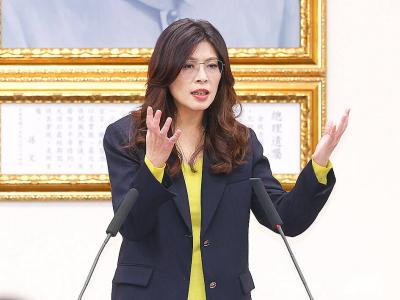
Chinese Nationalist Party (KMT) Chairwoman Cheng Li-wun (鄭麗文) today accepted an invitation from Chinese President Xi Jinping (習近平) to lead a delegation to China next month, saying she hopes to promote the peaceful development of cross-strait relations and bring stability to the Taiwan Strait. “I am grateful and happy to accept this invitation,” Cheng said in a statement from the KMT chairperson’s office. Cheng said she hopes both sides can work together to promote the peaceful development of cross-strait relations, enhance exchange and cooperation, bring stability to the Taiwan Strait and improve people’s livelihoods. At today's news conference, Cheng said any efforts to

MORE POPULAR: Taiwan Pass sales increased by 59 percent during the first quarter compared with the same period last year, the Tourism Administration said The Tourism Administration yesterday said that it has streamlined the Taiwan Pass, with two versions available for purchase beginning today. The tourism agency has made the pass available to international tourists since 2024, allowing them to access the high-speed rail, Taiwan Railway Corp services, four MRT systems and four Taiwan Tourist Shuttles. Previously, five types of Taiwan Pass were available, but some tourists have said that the offerings were too complicated. The agency said only two types of Taiwan Pass would be available, starting from a three-day pass with the high-speed rail and a three-day pass with Taiwan Railway Corp. The former costs NT$2,800

The nation’s fastest supercomputer, Nano 4 (晶創26), is scheduled to be launched in the third quarter, and would be used to train large language models in finance and national defense sectors, the National Center for High-Performance Computing (NCHC) said. The supercomputer, which would operate at about 86.05 petaflops, is being tested at a new cloud computing center in the Southern Taiwan Science Park in Tainan. The exterior of the server cabinet features chip circuitry patterns overlaid with a map of Taiwan, highlighting the nation’s central position in the semiconductor industry. The center also houses Taiwania 2, Taiwania 3, Forerunner 1 and


 RSS
RSS