


Google Inc is declaring war on Microsoft Corp by seeking to unseat the software giant’s globally dominant Windows operating system for personal computers.
Google, which already offers a suite of e-mail, Web and other software products that compete with Microsoft, said on Tuesday it would launch a new operating system for computers.
Called the Google Chrome Operating System, the new software will be in netbooks for consumers in the second half of next year, Google said in a blog post, adding that it was working with multiple manufacturers.
“It’s been part of their culture to go after and remove Microsoft as a major holder of technology, and this is part of their strategy to do it,” said Rob Enderle, principal analyst at Enderle Group. “This could be very disruptive. If they can execute, Microsoft is vulnerable to an attack like this, and they know it,” he said.
Google and Microsoft have often locked horns over the years in a variety of markets. It remains to be seen if Google can take market share away from Microsoft on its home turf, with Windows currently installed in more than 90 percent of the world’s PCs.
Key to success will be whether Google can lock in partnerships with PC makers, such as Hewlett-Packard Co and Dell Inc, which currently offer Windows on most of their product lines.
Google’s Chrome Internet browser, launched late last year, is a distant fourth in the Web browser market, with a 1.2 percent share in February, market research firm Net Applications said. Microsoft’s Internet Explorer continues to dominate, with nearly 70 percent.
The new Chrome OS will be fast and lightweight, enabling users to access the Web in a few seconds, Google said. The new OS is based on open-source Linux code, which allows third-party developers to design compatible applications.
“The operating systems that browsers run on were designed in an era where there was no web,” Sundar Pichai, vice president of product management at Google, said in the blog post. The Chrome OS is “our attempt to re-think what operating systems should be.”

Authorities have detained three former Taiwan Semiconductor Manufacturing Co (TMSC, 台積電) employees on suspicion of compromising classified technology used in making 2-nanometer chips, the Taiwan High Prosecutors’ Office said yesterday. Prosecutors are holding a former TSMC engineer surnamed Chen (陳) and two recently sacked TSMC engineers, including one person surnamed Wu (吳) in detention with restricted communication, following an investigation launched on July 25, a statement said. The announcement came a day after Nikkei Asia reported on the technology theft in an exclusive story, saying TSMC had fired two workers for contravening data rules on advanced chipmaking technology. Two-nanometer wafers are the most
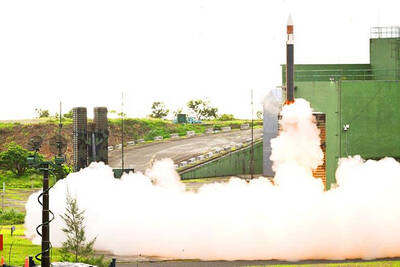
NEW GEAR: On top of the new Tien Kung IV air defense missiles, the military is expected to place orders for a new combat vehicle next year for delivery in 2028 Mass production of Tien Kung IV (Sky Bow IV) missiles is expected to start next year, with plans to order 122 pods, the Ministry of National Defense’s (MND) latest list of regulated military material showed. The document said that the armed forces would obtain 46 pods of the air defense missiles next year and 76 pods the year after that. The Tien Kung IV is designed to intercept cruise missiles and ballistic missiles to an altitude of 70km, compared with the 60km maximum altitude achieved by the Missile Segment Enhancement variant of PAC-3 systems. A defense source said yesterday that the number of

A bipartisan group of US representatives have introduced a draft US-Taiwan Defense Innovation Partnership bill, aimed at accelerating defense technology collaboration between Taiwan and the US in response to ongoing aggression by the Chinese Communist Party (CCP). The bill was introduced by US representatives Zach Nunn and Jill Tokuda, with US House Select Committee on the Chinese Communist Party Chairman John Moolenaar and US Representative Ashley Hinson joining as original cosponsors, a news release issued by Tokuda’s office on Thursday said. The draft bill “directs the US Department of Defense to work directly with Taiwan’s Ministry of National Defense through their respective
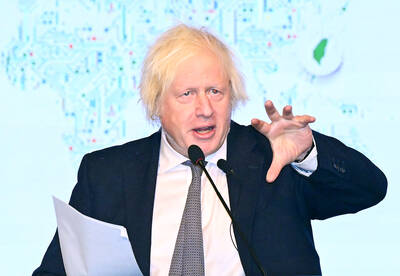
CHINA’s BULLYING: The former British prime minister said that he believes ‘Taiwan can and will’ protect its freedom and democracy, as its people are lovers of liberty Former British prime minister Boris Johnson yesterday said Western nations should have the courage to stand with and deepen their economic partnerships with Taiwan in the face of China’s intensified pressure. He made the remarks at the ninth Ketagalan Forum: 2025 Indo-Pacific Security Dialogue hosted by the Ministry of Foreign Affairs and the Prospect Foundation in Taipei. Johnson, who is visiting Taiwan for the first time, said he had seen Taiwan’s coastline on a screen on his indoor bicycle, but wanted to learn more about the nation, including its artificial intelligence (AI) development, the key technology of the 21st century. Calling himself an


 RSS
RSS