


China yesterday defended its military buildup and called for calm over North Korea as the global community looked to Beijing for a breakthrough in efforts to stop Pyongyang’s nuclear ambitions.
Lieutenant General Ma Xiaotian (馬嘯天), deputy chief of the general staff of the People’s Liberation Army (PLA), told a top-level security forum in Singapore that China would “consistently” adhere to a “military strategy of active defense.”
But he also said Beijing needed to boost its military capabilities to counter security threats and support its commitments to help ensure international peace and stability.
China’s neighbors and the US have been wary of its growing military might because of fears that Beijing might be harboring territorial and other strategic ambitions.
Ma also said China understood the concerns of immediate neighbors Japan and South Korea and that “we are resolutely opposed to nuclear proliferation.”
Dressed in his military uniform and speaking to defense chiefs, military officers, security analysts and diplomats at the Singapore conference, Ma sought to assure China’s neighbors of Beijing’s peaceful intentions.
“China steadfastly pursues a policy of building friendship and partnership with neighboring countries … [and] adheres to a defense policy which is defensive in nature and a military strategy of active defense,” he said.
China is committed to developing military ties with other countries and has been a “positive participant” in various regional security forums, he said.
Japanese Defense Minister Yasukazu Hamada said Tokyo would be transparent with its military hardware purchases in order to prevent any misunderstanding with neighbors.
“We have mentioned that North Korea is a threat because of what has happened in the past, but unless there are other countries moving to us, we will never start an action as such,” Hamada said.
“In Japan, we have various and numerous constraints and internationally, we have also made clear that we do not use force in order to resolve conflict situations,” he said.
He told the forum Tokyo was looking at a range of weapon procurements including the F-22 fifth-generation fighter aircraft but stressed these were “only for the defense of the country as such.”
Authorities have detained three former Taiwan Semiconductor Manufacturing Co (TMSC, 台積電) employees on suspicion of compromising classified technology used in making 2-nanometer chips, the Taiwan High Prosecutors’ Office said yesterday. Prosecutors are holding a former TSMC engineer surnamed Chen (陳) and two recently sacked TSMC engineers, including one person surnamed Wu (吳) in detention with restricted communication, following an investigation launched on July 25, a statement said. The announcement came a day after Nikkei Asia reported on the technology theft in an exclusive story, saying TSMC had fired two workers for contravening data rules on advanced chipmaking technology. Two-nanometer wafers are the most
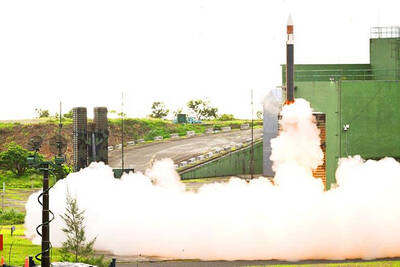
NEW GEAR: On top of the new Tien Kung IV air defense missiles, the military is expected to place orders for a new combat vehicle next year for delivery in 2028 Mass production of Tien Kung IV (Sky Bow IV) missiles is expected to start next year, with plans to order 122 pods, the Ministry of National Defense’s (MND) latest list of regulated military material showed. The document said that the armed forces would obtain 46 pods of the air defense missiles next year and 76 pods the year after that. The Tien Kung IV is designed to intercept cruise missiles and ballistic missiles to an altitude of 70km, compared with the 60km maximum altitude achieved by the Missile Segment Enhancement variant of PAC-3 systems. A defense source said yesterday that the number of

A bipartisan group of US representatives have introduced a draft US-Taiwan Defense Innovation Partnership bill, aimed at accelerating defense technology collaboration between Taiwan and the US in response to ongoing aggression by the Chinese Communist Party (CCP). The bill was introduced by US representatives Zach Nunn and Jill Tokuda, with US House Select Committee on the Chinese Communist Party Chairman John Moolenaar and US Representative Ashley Hinson joining as original cosponsors, a news release issued by Tokuda’s office on Thursday said. The draft bill “directs the US Department of Defense to work directly with Taiwan’s Ministry of National Defense through their respective
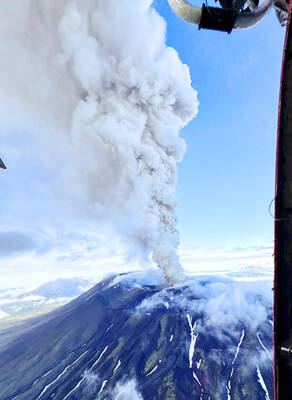
Tsunami waves were possible in three areas of Kamchatka in Russia’s Far East, the Russian Ministry for Emergency Services said yesterday after a magnitude 7.0 earthquake hit the nearby Kuril Islands. “The expected wave heights are low, but you must still move away from the shore,” the ministry said on the Telegram messaging app, after the latest seismic activity in the area. However, the Pacific Tsunami Warning System in Hawaii said there was no tsunami warning after the quake. The Russian tsunami alert was later canceled. Overnight, the Krasheninnikov volcano in Kamchatka erupted for the first time in 600 years, Russia’s RIA


 RSS
RSS