


Wearing surgical masks and displaying banners on the legislative floor, Democratic Progressive Party (DPP) legislators yesterday urged the government to disclose its intelligence and demand answers from Beijing, a day after National Security Bureau (NSB) Director Tsai Chao-ming (蔡朝明) accused China of starting the global SARS epidemic six years ago as part of a biological warfare campaign.
Tsai told a legislative committee on Monday that sources in China suspected biological warfare, but that conclusive evidence had not been found. SARS triggered a global health crisis after emerging in Guangdong Province in 2002, causing nearly 800 deaths worldwide, including 73 in Taiwan.
“The bureau listed it as a biochemical warfare agent,” Tsai said at the time in response to DPP Legislator Twu Shiing-jer (�?�) in the legislature’s Foreign and National Defense Committee. “We have evidence and we have asked UN experts to look into this.”
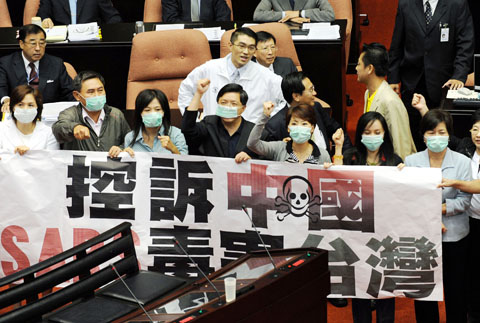
PHOTO: CNA
The NSB on Monday night issued a press statement saying that Tsai had been misunderstood. Tsai “expresses his sincere apology that his gaffe ... has caused misunderstanding and concerns,” it said.
When fielding questions from DPP lawmakers on the matter yesterday, Premier Liu Chao-shiuan (劉兆玄) said he believed Tsai simply misspoke.
“I never thought that there was a connection between SARS and biological warfare,” Liu said during the legislature’s question-and-answer session.
When asked by DPP Legislator Huang Wei-cher (黃偉哲) whether Tsai should resign if he indeed misspoke, Liu said that Tsai was not a member of the Cabinet but he would forward the opinion to President Ma Ying-jeou (馬英九).
Minister of the Department of Health Yeh Chin-chuan (葉金川) said that “there is very little chance that the SARS virus could be used as a biological weapon now.”
“It’s a different situation now than it was five years ago. As we are now 100 percent sure how to treat the SARS virus, there is very little possibility of SARS becoming an epidemic,” Yeh said.
“In the past, it took seven days to identify the SARS virus, but now we just need two hours,” he said.
Yeh’s remarks drew criticism from DPP lawmakers who accused Yeh of taking China’s side.
DPP spokesman Cheng Wen-tsang (鄭文燦) told a press conference yesterday that if the SARS virus were to be used as a bioweapon, it would cause irreparable harm to mankind. Cheng appealed to the international community and the UN to investigate the case “because the Chinese move would cause a terrible global disaster.”
At a separate setting, DPP caucus whip William Lai (賴清德) said that if the NSB had found evidence China was behind the use of the SARS virus as a biochemical weapon, the government should represent Taiwanese SARS victims by asking for compensation from China.
Meanwhile, Chinese Nationalist Party (KMT) Legislator Wu Yu-sheng (吳育昇) and Luo Shu-lei (羅淑蕾) yesterday both urged Tsai to call a press conference in person to clear up his remark.
“Just issuing press statements [as a correction] was not enough. Tsai has to step down if he fails to show evidence for his claim,” Wu said.
KMT Legislator Chang Sho-wen (張碩文) said that Tsai’s accusation was part of a DPP plot to thwart the planned visit by Association for Relations Across the Taiwan Strait (ARATS) Chairman Chen Yunlin in the near future.
ADDITIONAL REPORTING BY RICH CHANG

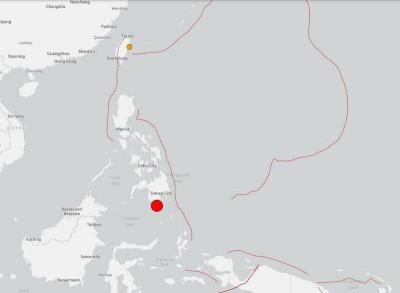
A magnitude 7.8 earthquake struck off the southern coast of Mindanao in the Philippines at 7:38am today, prompting the US Tsunami Warning System to issue an alert for neighboring countries, including Taiwan. The system issued a purple alert indicating a "tsunami threat." The potential threat zone includes Taiwan, the Philippines, Papua New Guinea, Yap and Palau. There were no immediate reports of major damage in the Philippines or Indonesia. The quake struck at a depth of 10km, said the German Research Centre for Geosciences, which had earlier pegged the earthquake at magnitude 8.2. Phivolcs, the Philippine agency, said the quake was magnitude 7 and

RESILIENCE: Taiwan plays a key role in semiconductors, energy, information infrastructure and advanced manufacturing, AIT Director Raymond Greene said Taiwan’s continued investment in deterrence and resilience remains vital, especially in uncrewed systems and other emerging technologies, American Institute in Taiwan (AIT) Director Raymond Greene said yesterday. Greene made the remarks at the annual National Strategic Summit on Supply Chain Resilience held by the Research Institute for Democracy, Society and Emerging Technology (DSET), a government-backed think tank. As Taiwan last year became the US’ fourth-largest trading partner and supply chain security is becoming more important, cooperation in emerging technologies continues to deepen between the two countries, he said. The US is committed to accelerating innovation, building key infrastructure, strengthening cooperation

The National Chungshan Institute of Science and Technology yesterday showcased its locally developed variants of the Vision 60 robotic patrol dog, which it plans to deploy on the nation’s outlying territories in the South China Sea. The variants were produced under the Joint Lab project — created by the institute and domestic companies — and assembled with domestically produced motors, lenses and artificial intelligence (AI) systems alongside licensed tech from the US, Missile and Rocket Systems Research Division deputy director Jen Kuo-kang (任國光) told the media event at a military base in Taipei’s Dazhi (大直) area. Taiwan has built up its strengths

RIGHT DIRECTION: Taiwan’s efforts to prevent forced labor include a proposal to ‘fully prohibit’ employers from withholding workers’ documents, an official said Taiwan is to establish a mechanism to restrict imports of goods linked to forced labor, the Executive Yuan said yesterday, after the US proposed imposing additional tariffs on Taiwanese goods over labor concerns. “The Ministry of Labor and the Ministry of Economic Affairs are to establish an interministerial review procedure,” Executive Yuan spokesperson Michelle Lee (李慧芝) said at a news briefing in Taipei. “The government is to use the Foreign Trade Act [貿易法] as the legal basis to restrict imports of goods produced with forced labor” and bring its supply chain governance more in line with international standards on human rights, resilience


 RSS
RSS