


US Secretary of State Condoleezza Rice pressed China’s leaders yesterday on sensitive human rights issues, but said she was encouraged by their decision to hold talks with the Dalai Lama’s envoys.
In meetings with Chinese President Hu Jintao (胡錦濤)and Premier Wen Jiabao (溫家寶) in Beijing, Rice said she raised the cases of several dissidents detained by China as well as the ruling Communist Party’s controls on the Internet.
“I think that is one of the brewing issues,” Rice said as she summarized their discussions on Internet freedoms.
“The Internet is becoming so ubiquitous. It shouldn’t be something used to constrain and limit political speech,” she said.
Differences over the international response to the political crisis in Zimbabwe were also discussed, with Rice insisting the UN Security Council had a key role to play despite China’s preference for a mainly African solution.
Rice said the talks also covered the recent progress in the long-running campaign to end North Korea’s nuclear weapons programs, problems in the international economy and climate change.
In brief comments at the start of their meeting, Hu thanked Rice for visiting China’s earthquake-hit Sichuan Province on Sunday as well as US assistance following the disaster in May that left nearly 90,000 people dead.
Rice told reporters the recent unrest in Tibet was also discussed, with the top US diplomat expressing cautious optimism over Beijing’s decision to hold further talks with envoys of the region’s spiritual leader, the Dalai Lama.
“I am encouraged that there at least will be a second round of talks,” she said.
However she repeated that the US did not accept China’s accusations that the Dalai Lama was bent on achieving independence for his Himalayan homeland, which has been ruled by China for nearly 60 years.
“The Dalai Lama is a figure of considerable moral authority. He is a figure who has rejected violence. He is a figure who talks about cultural and religious historical autonomy,” she said. “He doesn’t push for political independence.”
Her comments came as the Tibetan government-in-exile said envoys of the Dalai Lama were expected to arrive in Beijing later yesterday for two days of talks with Chinese officials.

NEXT GENERATION: The four plants in the Central Taiwan Science Park, designated Fab 25, would consist of four 1.4-nanometer wafer manufacturing plants, TSMC said Taiwan Semiconductor Manufacturing Co (TSMC, 台積電) plans to begin construction of four new plants later this year, with the aim to officially launch production of 2-nanometer semiconductor wafers by late 2028, Central Taiwan Science Park Bureau director-general Hsu Maw-shin (許茂新) said. Hsu made the announcement at an event on Friday evening celebrating the Central Taiwan Science Park’s 22nd anniversary. The second phase of the park’s expansion would commence with the initial construction of water detention ponds and other structures aimed at soil and water conservation, Hsu said. TSMC has officially leased the land, with the Central Taiwan Science Park having handed over the
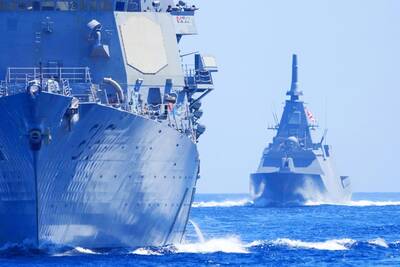
The Philippines is working behind the scenes to enhance its defensive cooperation with Taiwan, the Washington Post said in a report published on Monday. “It would be hiding from the obvious to say that Taiwan’s security will not affect us,” Philippine Secretary of National Defense Gilbert Teodoro Jr told the paper in an interview on Thursday last week. Although there has been no formal change to the Philippines’ diplomatic stance on recognizing Taiwan, Manila is increasingly concerned about Chinese encroachment in the South China Sea, the report said. The number of Chinese vessels in the seas around the Philippines, as well as Chinese

URBAN COMBAT: FIM-92 Stinger shoulder-fired missiles from the US made a rare public appearance during early-morning drills simulating an invasion of the Taipei MRT The ongoing Han Kuang military exercises entered their sixth day yesterday, simulating repelling enemy landings in Penghu County, setting up fortifications in Tainan, laying mines in waters in Kaohsiung and conducting urban combat drills in Taipei. At 5am in Penghu — part of the exercise’s first combat zone — participating units responded to a simulated rapid enemy landing on beaches, combining infantry as well as armored personnel. First Combat Zone Commander Chen Chun-yuan (陳俊源) led the combined armed troops utilizing a variety of weapons systems. Wang Keng-sheng (王鏗勝), the commander in charge of the Penghu Defense Command’s mechanized battalion, said he would give
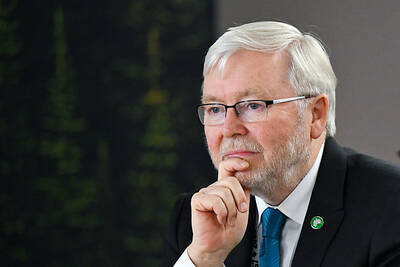
AUKUS: The Australian Ambassador to the US said his country is working with the Pentagon and he is confident that submarine issues will be resolved Australian Ambassador to the US Kevin Rudd on Friday said that if Taiwan were to fall to China’s occupation, it would unleash China’s military capacities and capabilities more broadly. He also said his country is working with the Pentagon on the US Department of Defense’s review of the AUKUS submarine project and is confident that all issues raised will be resolved. Rudd, who served as Australian prime minister from 2007 to 2010 and for three months in 2013, made the remarks at the Aspen Security Forum in Colorado and stressed the longstanding US-Australia alliance and his close relationship with the US Undersecretary


 RSS
RSS