


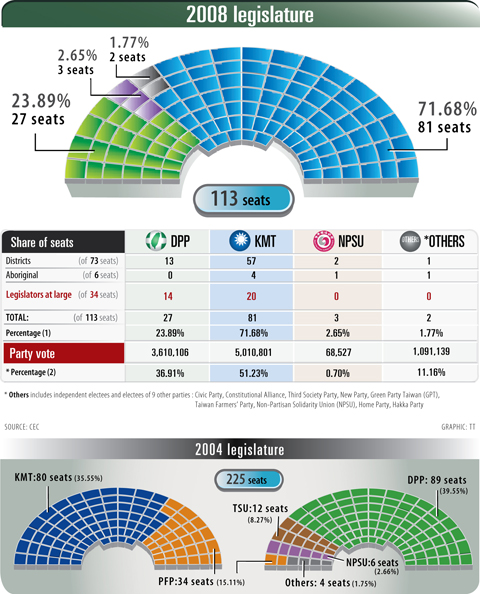
The Chinese Nationalist Party (KMT) scored a resounding victory over the Democratic Progressive Party (DPP) in yesterday's seventh legislative elections, winning 81 seats, including 61 district legislator seats, to secure a two-thirds majority that gives it extra legislative powers.
The DPP, despite winning 38.17 percent of the total vote, garnered just 13 district legislator seats.
The Non-Partisan Solidarity Union (NPSU) came in third, with three seats, the People First Party (PFP) claimed one of the six Aboriginal seats and an independent candidate secured victory in Kinmen County.
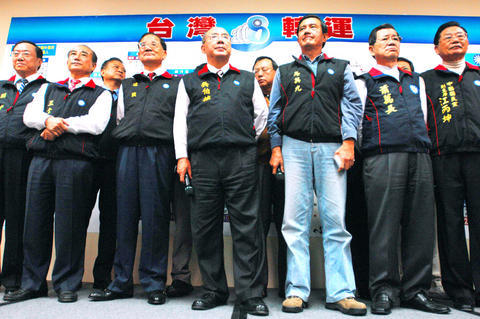
PHOTO: CNA
The other parties -- including the Taiwan Solidarity Union (TSU) and the New Party -- faired poorly, with none of them reaching the 5 percent threshold required to win legislator-at-large seats.
As a result, the 34 legislator-at-large seats were split between the two main parties, with the KMT receiving 20 seats and the DPP 14.
The Central Election Commission (CEC) said overall turnout for the district legislative poll was 58.50 percent, or 10,050,619 voters.
Both referendums held in conjunction with yesterday's vote failed to attain the 50 percent turnout required for them to pass.
The DPP's plebiscite on recovering the KMT's stolen assets attracted 26.34 percent of voters, or 4,550,881 votes. It received a total of 3,891,179 affirmative votes.
The KMT-initiated referendum on empowering the legislature to investigate corruption involving high-level government officials had a 26.08 percent turnout, with 2,304,136 affirmative votes and 1,656,890 negative votes out of a total of 4,505,927 ballots cast.
In response to the results, President Chen Shui-bian (陳水扁) stepped down as DPP chairman.
Chen, calling the election loss the "worst setback" in the history of the party, told a press conference: "I should and I am willing to shoulder all of the responsibility."
"I resign as chairman, effective immediately. I feel very sorry and I feel shamed by this election result," he said.
KMT Chairman Wu Poh-hsiung (
Wu, with other party leaders at his side, including presidential candidate Ma Ying-jeou (
"I promise we will not abuse the power of the majority but we will use it to stabilize society and unite people, and we will respect the minority in parliament," Wu said.
The KMT's two-thirds majority would allow the party to impeach the president in its own right. In addition, with support from four other legislators, the KMT would have a three-quarters majority and could put constitutional amendments to a referendum.
"It is clear that people are yearning for change after eight years of suffering," Ma said.
He said "a more difficult task" lies ahead -- securing the presidency.
The KMT swept all eight seats in Taipei City, a goal it had dubbed "Sending Eight Immortals Across the Ocean" (
It marked only the second time since 1983 that all of the party's candidates for Taipei City had been elected, the city's Election Commission said.
The DPP had hoped legislative candidates Tuan Yi-kang (段宜康) and Wang Shih-Cheng (王世堅), in particular, could upset their KMT opponents.
Tuan declared defeat at about 6:48pm after trailing KMT opponent Lin Yu-fang (
"I will move on after reflecting deeply. What is more disappointing was the defeat of the DPP overall. There may be a lot of reasons for our defeat, but we will shoulder the responsibility together," Tuan said at his campaign headquarters.
The KMT also won all six seats in Taoyuan County, with all its candidates declaring victory before the official results were announced.
In Taipei County, the KMT won 10 of 12 seats, though DPP candidate and singer/actor Yu Tian (余天) won for the DPP in Sanchong (三重) -- a pan-green stronghold -- defeating his KMT opponent Chu Chun-hsiao (朱俊曉) by just 2,000 votes.
Both Yu and Chu Chun-hsiao declared victory before the Sanchong City Office announced Yu's victory, sparking concern over the result.
Police were dispatched to prevent conflict as supporters of candidates converged on the area.
As expected, KMT Legislator Wu Yu-sheng (
The KMT won 19 of the 21 legislative seats in Miaoli County, Taichung County, Taichung City, Changhua County, Nantou County, Yunlin County, Chiayi County and Chiayi City, losing only Taichung County's second constituency and the second constituency of Chiayi County.
In Changhua County, the KMT took all four seats, with Cheng Ju-fen (
In Chiayi City, the KMT's Chiang Yi-hsiung (
In southern Taiwan, a DPP stronghold, the party lost its dominance in two of the five cities and counties.
The KMT prevailed in three of five districts in Kaohsiung City, with incumbent DPP Legislator Kuan Bi-ling (
The KMT also won three out of the four seats in Kaohsiung County, with only DPP Legislator Chen Chi-yu (
Three-term KMT Legislator Lin Yi-shih (
The KMT's performance in Kaohsiung County was extraordinary, as in the legislative poll in 2004, the pan-green camp garnered 55.73 percent of the vote in Kaohsiung County while the pan-blue camp won only 39.76 percent of ballots.
The DPP managed to win two seats in Tainan City by narrow margins and two out of the three seats in Pingtung County.

SECURITY: As China is ‘reshaping’ Hong Kong’s population, Taiwan must raise the eligibility threshold for applications from Hong Kongers, Chiu Chui-cheng said When Hong Kong and Macau citizens apply for residency in Taiwan, it would be under a new category that includes a “national security observation period,” Mainland Affairs Council (MAC) Minister Chiu Chui-cheng (邱垂正) said yesterday. President William Lai (賴清德) on March 13 announced 17 strategies to counter China’s aggression toward Taiwan, including incorporating national security considerations into the review process for residency applications from Hong Kong and Macau citizens. The situation in Hong Kong is constantly changing, Chiu said to media yesterday on the sidelines of the Taipei Technology Run hosted by the Taipei Neihu Technology Park Development Association. With

CARROT AND STICK: While unrelenting in its military threats, China attracted nearly 40,000 Taiwanese to over 400 business events last year Nearly 40,000 Taiwanese last year joined industry events in China, such as conferences and trade fairs, supported by the Chinese government, a study showed yesterday, as Beijing ramps up a charm offensive toward Taipei alongside military pressure. China has long taken a carrot-and-stick approach to Taiwan, threatening it with the prospect of military action while reaching out to those it believes are amenable to Beijing’s point of view. Taiwanese security officials are wary of what they see as Beijing’s influence campaigns to sway public opinion after Taipei and Beijing gradually resumed travel links halted by the COVID-19 pandemic, but the scale of
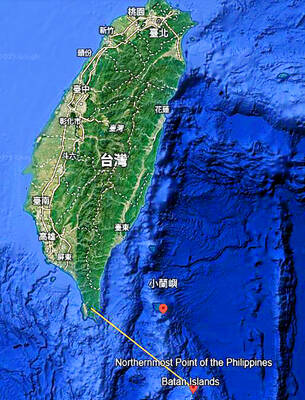
A US Marine Corps regiment equipped with Naval Strike Missiles (NSM) is set to participate in the upcoming Balikatan 25 exercise in the Luzon Strait, marking the system’s first-ever deployment in the Philippines. US and Philippine officials have separately confirmed that the Navy Marine Expeditionary Ship Interdiction System (NMESIS) — the mobile launch platform for the Naval Strike Missile — would take part in the joint exercise. The missiles are being deployed to “a strategic first island chain chokepoint” in the waters between Taiwan proper and the Philippines, US-based Naval News reported. “The Luzon Strait and Bashi Channel represent a critical access
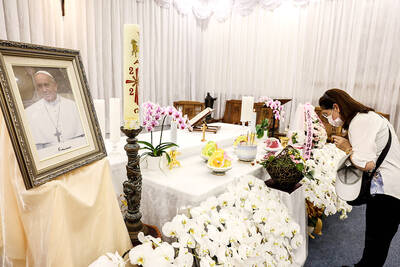
Pope Francis is be laid to rest on Saturday after lying in state for three days in St Peter’s Basilica, where the faithful are expected to flock to pay their respects to history’s first Latin American pontiff. The cardinals met yesterday in the Vatican’s synod hall to chart the next steps before a conclave begins to choose Francis’ successor, as condolences poured in from around the world. According to current norms, the conclave must begin between May 5 and 10. The cardinals set the funeral for Saturday at 10am in St Peter’s Square, to be celebrated by the dean of the College


 RSS
RSS