


The dictator is losing his place in the sun, at least on military bases.
The Ministry of National Defense (MND) has promised to remove all statues of dictator Chiang Kai-shek (
Democratic Progressive Party (DPP) Legislator Hsueh Ling (薛凌) told a press conference yesterday that the ministry had promised to store all of the statues in indoor facilities in response to a proposal from the party last weekend.
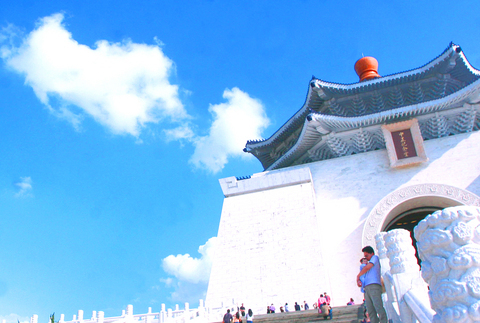
PHOTO: CNA
Hsueh was accompanied by DPP legislators Chai Trong-rong (
"This [proposal] conforms to the basic principle of democracy," Hsueh said. "Names of places such as the Chiang Kai-shek International Airport have also been changed [to Taiwan Taoyuan International Airport]. This is a world trend, because we are in a democratic era now, not an authoritarian one."
Hsueh said removing Chiang's statutes was a way to help the military get rid of the symbolic influence of the dictator, who controlled the military with an iron grip.
Chai said in a press release that since an investigative report published by the 228 Incident Memorial Foundation last year concluded that Chiang should be held responsible for the incident, which took place in 1947, his statutes located in every part of the nation should be removed.
In the 228 Incident, conflict between anti-contraband officers and local people led to clashes.
Thereafter military forces were called in from China, escalating into an islandwide crackdown during which tens of thousands of people were arrested and killed.
DPP Legislator Gao Jyh-peng (
Gao said that the Provisions Governing the Organization of the CKS Memorial Hall Administration Office (
After relocation, the current site could be used to honor the nation's democratic development, he said.
Meanwhile, ministry spokesman Rear-Admiral Wu Chi-fang (
"Because the military has been proceeding with a downsizing of the army ... the ministry last year began implementing the proposal of removing statues of Chiang Kai-shek along with the reshuffling of military bases, and is arranging that the statues are moved to proper places, such as existing monuments relating to Chiang Kai-shek nationwide," Wu said.
He said the statues standing outside military bases were being eroded and stained by their exposure to the elements.
"The military honors the late president's contribution to the country and the military, and we honor history, but times have changed and it is now a democratic age," Wu said.
He said that the proposal would not change the training of soldiers.
"We educate the military to love our country, but we have never educated the military to love Chiang Kai-shek," he said.
Wu said that the removal of the statues was nearing completion.
Chinese Nationalist Party (KMT) lawmakers yesterday called a press conference at which they accused the government and DPP lawmakers of thinking only of pleasing pan-green supporters.
"Blaming Chiang for the 228 Incident is a distortion of history. His statues should be kept in public places," KMT Legislator Hsu Shao-ping (
Meanwhile, KMT Legislator Lai Shyh-bao (賴士葆) said that changing the names of state-owned firms would be a waste of money.
The Ministry of Economic Affairs recently said that the state-run Chinese Petroleum Corp (CPC) and China Shipbuilding Corp would soon be renamed to include "Taiwan" in their company titles.
"I think that CPC and China Shipbuilding would need at least NT$3 billion [US$91 million] to change their names, an amount that could be used to subsidize 35,000 low-income families," Lai said.
The KMT lawmakers threatened to cut the budget of state-owned enterprises in the next legislative session if the Ministry of Economic Affairs refused to suspend the name change.

Tropical Storm Gaemi strengthened into a typhoon at 2pm yesterday, and could make landfall in Yilan County tomorrow, the Central Weather Administration (CWA) said yesterday. The agency was scheduled to issue a sea warning at 11:30pm yesterday, and could issue a land warning later today. Gaemi was moving north-northwest at 4kph, carrying maximum sustained winds near its center of up to 118.8kph and gusts of 154.8kph. The circumference is forecast to reach eastern Taiwan tomorrow morning, with the center making landfall in Yilan County later that night before departing from the north coast, CWA weather forecaster Kuan Shin-ping (官欣平) said yesterday. Uncertainty remains and

SEA WARNING LIKELY: The storm, named Gaemi, could become a moderate typhoon on Wednesday or Thursday, with the Taipei City Government preparing for flooding A tropical depression east of the Philippines developed into a tropical storm named Gaemi at 2pm yesterday, and was moving toward eastern Taiwan, the Central Weather Administration (CWA) said. Gaemi could begin to affect Taiwan proper on Tuesday, lasting until Friday, and could develop into a moderate typhoon on Wednesday or Thursday, it said. A sea warning for Gaemi could be issued as early as Tuesday morning, it added. Gaemi, the third tropical storm in the Pacific Ocean this typhoon season, is projected to begin moving northwest today, and be closest to Taiwan on Wednesday or Thursday, the agency said. Today, there would likely

DISRUPTIONS: The high-speed rail is to operate as normal, while several airlines either canceled flights or announced early departures or late arrivals Schools and offices in 15 cities and counties are to be closed today due to Typhoon Gaemi, local governments announced last night. The 15 are: Taipei, New Taipei City, Taoyuan, Tainan, Keelung, Hsinchu and Kaohsiung, as well as Yilan, Hualien, Hsinchu, Miaoli, Chiayi, Pingtung, Penghu and Lienchiang counties. People should brace for torrential rainfall brought by the storm, with its center forecast to make landfall on the east coast between tonight and tomorrow morning, the Central Weather Administration (CWA) said. The agency issued a sea warning for the typhoon at 11:30pm on Monday, followed by a land warning at 11:30am yesterday. As of

CASUALTY: A 70-year-old woman was killed by a falling tree in Kaohsiung as the premier warned all government agencies to remain on high alert for the next 24 hours Schools and offices nationwide are to be closed for a second day today as Typhoon Gaemi crosses over the nation, bringing torrential rain and whipping winds. Gaemi was forecast to make landfall late last night. From Tuesday night, its outer band brought substantial rainfall and strong winds to the nation. As of 6:15pm last night, the typhoon’s center was 20km southeast of Hualien County, Central Weather Administration (CWA) data showed. It was moving at 19kph and had a radius of 250km. As of 3pm yesterday, one woman had died, while 58 people were injured, the Central Emergency Operation Center said. The 70-year-old


 RSS
RSS