

The nation's top military leader said yesterday that the US has suspended military talks with Taiwan because of a contentious arms procurement deal that has been stalled in the legislature.
"The US informed us in writing that it would suspend an arms exchange meeting with Taiwan, and [the resumption of the meeting] depends on how the arms budget goes," Minister of National Defense Lee Jye (李傑) said.
Lee was answering a query from Democratic Progressive Party (DPP) Legislator Shan Fa-hui (沈發惠) during a meeting of the legislature's National Defense Committee.
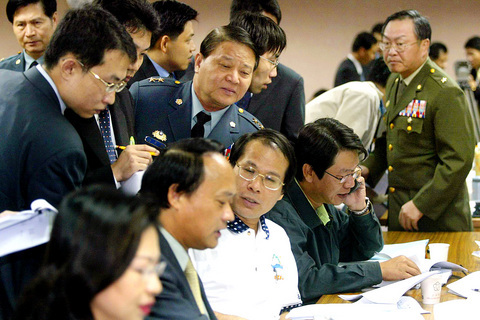
PHOTO: LIN CHENG-KUN, TAIPEI TIMES
Later in the day, Ministry of National Defense Spokesman Admiral Wu Chi-fang (
Wu told the Taipei Times by telephone that an annual meeting in which officials from the ministry's Armaments Bureau travel to the US for exchanges with the US military had been suspended.
A ministry source, speaking on condition of anonymity, told the Liberty Times, (the Taipei Times' sister newspaper), that the ministry had tried to salvage the situation, but was told that the decision had been made by a high-ranking official in the White House.
A US defense source, also speaking on condition of anonymity, said he believed Lee's assertion that the talks had been suspended was a "slight exaggeration," and added that he was personally aware "of a number of ongoing dialogues."
During the meeting, Lee urged lawmakers to review the long-stalled arms procurement budget, but added that recent comments from American Institute in Taiwan Director Stephen Young had made it even harder to get the legislature to agree on the deal.
"His comments have left the situation in disarray and brought us to a deadlock, making the passage of the arms bill even more difficult," Lee said in response to a question from Chinese Nationalist Party (KMT) Legislator Lin Te-fu (林德福).
Young last Thursday called a press conference in which he urged the legislature to pass the bill by the end of this fall.
Pan-blue legislators lashed out at Young for his remarks again during yesterday's meeting.
"We don't oppose arms procurement as long as it is reasonable, but we will not pass the bill because of [Young's] threats and intimidation," Lin said.
People First Party (PFP) Legislator Chao Liang-yen (
"Taiwan is not a colony of the US, and our president is not the US' puppet emperor. What Young did was threaten legislators, and it was outrageous," Chao said.
Meanwhile, DPP Legislator Lee Wen-chung (李文忠) said that pan-blue leaders should take responsibility for the decline in US-Taiwan relations because of the delay.
"Former KMT chairman Lien Chan (
In related news, the legislature's Foreign and Overseas Chinese Affairs Committee passed a resolution asking the US Department of State to create measures restraining its diplomats' remarks in Taiwan, saying that Young's statement had violated diplomatic courtesy and could be interpreted as interference with Taiwan's internal affairs.
The resolution said that it was designed to prevent US diplomats from hurting the feelings of the people of Taiwan and harming Taiwan's democracy.
The resolution was proposed by KMT legislators Justin Chou (
DPP Legislator Huang Wei-cher (
Additional reporting by Mac William Bishop
also see story:
Editorial: Stephen Young plays the blues
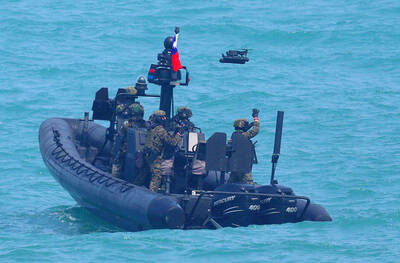
‘UNITED FRONT’ TACTICS: Beijing is pressuring Taiwanese politicians to block the Executive Yuan’s proposed special act to fund military uncrewed vehicles, a source said The Legislative Yuan is slated to hold cross-caucus negotiations on 14 versions of a draft uncrewed vehicle act on Thursday, amid rumors that Beijing is pressuring some Taiwanese politicians to block passage of a special bill proposed by the Ministry of National Defense to procure military drones and uncrewed vessels. A source in Beijing said the Chinese Communist Party has been using its United Front Work Department and Taiwan Affairs Office to pressure Taiwanese politicians who are friendly toward Beijing, pushing them to block the Executive Yuan’s proposed special act to fund military uncrewed vehicles. The proposed legislation would allocate
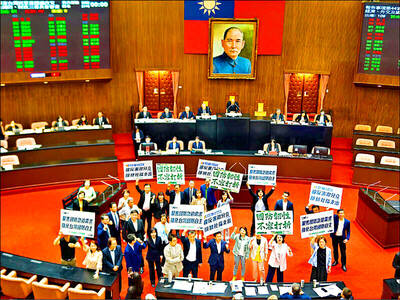
The Chinese Nationalist Party (KMT) and other opposition politicians are “taking Taiwan’s democracy hostage” for selfish gain, The Economist said in a column published online on Tuesday. “Taiwan’s freedoms should be a strength, raising the costs to China of a takeover. Shamefully, they are being betrayed from within,” the British news magazine said. While a lot of countries have toxic politicians, Taiwan’s stand out as particularly irresponsible, and “the blame is not evenly distributed,” it said. Although President William Lai (賴清德) is stubborn and, unlike his predecessor, does not consult KMT moderates, the opposition has triggered a “rolling constitutional crisis,”

CHINESE INFLUENCE? The TPP denied any knowledge that the Chinese immigrant had been reporting to Beijing or that she had participated in the party’s decisionmaking The New Taipei District Court yesterday sentenced Chinese immigrant Xu Chunying (徐春鶯) to seven years in prison for fraud, helping Chinese nationals illegally enter Taiwan and acting at Beijing’s direction to influence Taiwanese politics. The New Taipei District Prosecutors’ Office said it found that Xu and Cross-Strait Marriage Harmony Promotion Association chairman Chung Chin-ming (鍾錦明) had maintained long-term contact with Yang Wentao (楊文濤), director of the Cross-Strait Marriage and Family Service Center, and Sun Xian (孫憲), vice director of the Shanghai China Council for the Promotion of Peaceful National Reunification. Prosecutors accused Xu and Chung of accepting instructions to campaign for certain
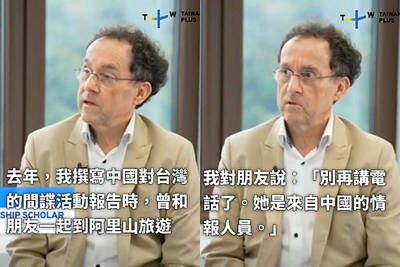
A German veteran journalist and author said the Ministry of Justice Investigation Bureau (MJIB) has confirmed his suspicion that he was followed by a Chinese spy on Alishan (阿里山) last year. Jurgen Kremb, who has long researched Chinese intelligence agencies, Asian geopolitics and cross-strait relations, made the comment during an interview with Taiwan Plus on Sunday. A video of the interview was subsequently shared by the Canadian Trade Office in Taipei on its Facebook page. Kremb said that last year, while writing a report on Chinese espionage activities targeting Taiwan, he traveled to Alishan with friends. A young Asian woman approached them and


 RSS
RSS