


Kaohsiung Harbor officials yesterday discovered a large amount of ivory in cargo that had originated in Tanzania.
The Kaohsiung Customs Office found an estimated 350 tusks in two containers, weighing around 2,500kg and valued at more than NT$100 million (US$3,100,775).
"The two containers entered Kaohsiung Harbor on June 11 and June 15, respectively, from Tanzania. They were to be transported to Manila on a smaller ship later this month," Ko Shih-hsien (郭世賢), an official with the Kao-hsiung Customs Office, said at a press conference.
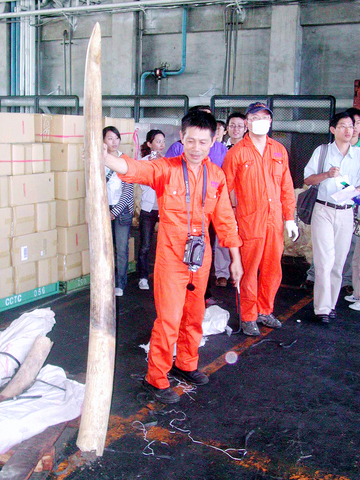
PHOTO: CNA
The ivory was discovered in 18 wooden boxes when customs officials were checking suspicious cargo yesterday morning, he said.
The two containers were listed as containing sisal fiber, he added.
Sisal fiber is used to make such items as ropes or rugs. Tanzania is one of the world's main producers of sisal fiber.
Taiwan banned ivory imports in 1990, with the exception of items that have obtained an export permit from ivory-producing countries, to prove they do not violate the UN Convention on International Trade in Endangered Species.
As the cargo would have headed for the Philippines if it had not been discovered, the official said the bureau had launched an investigation regarding the Philippine importer.
He added that the bureau would contact and cooperate with international conservation organizations to probe the matter.
Some expressed fears that a large herd of as many as 400 elephants had been slaughtered by an ivory smuggling ring in order to harvest the tusks.
The tusks will be handed over to the Council of Agriculture to decide whether to destroy them or to reserve them for academic research.
Officials displayed the tusks at the harbor yesterday.
The official said the tusks were mostly from full-grown elephants, with a longest one being 180cm in length.
Wu Yu-chi (
Wu added that brown-colored ivory with bloodstains would indicate the tusks were from recently killed elephants.
Ivory trading is outlawed, but in some countries ivory is used to make high-priced jewelry and seals, Wu said.
The last time the country seized a large amount of smuggled ivory was in May 2000, when Kaohsiung Harbor discovered 332 tusks, weighing 2160kg.

Tropical Storm Gaemi strengthened into a typhoon at 2pm yesterday, and could make landfall in Yilan County tomorrow, the Central Weather Administration (CWA) said yesterday. The agency was scheduled to issue a sea warning at 11:30pm yesterday, and could issue a land warning later today. Gaemi was moving north-northwest at 4kph, carrying maximum sustained winds near its center of up to 118.8kph and gusts of 154.8kph. The circumference is forecast to reach eastern Taiwan tomorrow morning, with the center making landfall in Yilan County later that night before departing from the north coast, CWA weather forecaster Kuan Shin-ping (官欣平) said yesterday. Uncertainty remains and

SEA WARNING LIKELY: The storm, named Gaemi, could become a moderate typhoon on Wednesday or Thursday, with the Taipei City Government preparing for flooding A tropical depression east of the Philippines developed into a tropical storm named Gaemi at 2pm yesterday, and was moving toward eastern Taiwan, the Central Weather Administration (CWA) said. Gaemi could begin to affect Taiwan proper on Tuesday, lasting until Friday, and could develop into a moderate typhoon on Wednesday or Thursday, it said. A sea warning for Gaemi could be issued as early as Tuesday morning, it added. Gaemi, the third tropical storm in the Pacific Ocean this typhoon season, is projected to begin moving northwest today, and be closest to Taiwan on Wednesday or Thursday, the agency said. Today, there would likely

DISRUPTIONS: The high-speed rail is to operate as normal, while several airlines either canceled flights or announced early departures or late arrivals Schools and offices in 15 cities and counties are to be closed today due to Typhoon Gaemi, local governments announced last night. The 15 are: Taipei, New Taipei City, Taoyuan, Tainan, Keelung, Hsinchu and Kaohsiung, as well as Yilan, Hualien, Hsinchu, Miaoli, Chiayi, Pingtung, Penghu and Lienchiang counties. People should brace for torrential rainfall brought by the storm, with its center forecast to make landfall on the east coast between tonight and tomorrow morning, the Central Weather Administration (CWA) said. The agency issued a sea warning for the typhoon at 11:30pm on Monday, followed by a land warning at 11:30am yesterday. As of

CASUALTY: A 70-year-old woman was killed by a falling tree in Kaohsiung as the premier warned all government agencies to remain on high alert for the next 24 hours Schools and offices nationwide are to be closed for a second day today as Typhoon Gaemi crosses over the nation, bringing torrential rain and whipping winds. Gaemi was forecast to make landfall late last night. From Tuesday night, its outer band brought substantial rainfall and strong winds to the nation. As of 6:15pm last night, the typhoon’s center was 20km southeast of Hualien County, Central Weather Administration (CWA) data showed. It was moving at 19kph and had a radius of 250km. As of 3pm yesterday, one woman had died, while 58 people were injured, the Central Emergency Operation Center said. The 70-year-old


 RSS
RSS