


China yesterday launched major annual war games in Inner Mongolia pitting 16,000 troops against each other in a spontaneous mock battle observed by military officers from a record 24 nations.
Code-named "North Sword 2005," the exercise was being held at the sprawling Zhurihe training base amid dry grasslands about 500km northeast of Beijing, the Shanghai Daily newspaper and other official media reported.
Now in at least their fourth year, the exercises mark a major push toward integrated training involving the army, air force and other branches of the military in battlefield conditions.
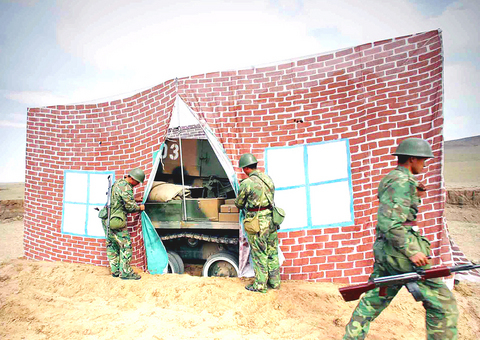
PHOTO: AP
The Xinhua News Agency said the exercises posed a "blue army" engaging in a lightening two-pronged attack on a "red army." The mock assault involved hundreds of tanks and armored vehicles, more than 100 artillery pieces and a helicopter squadron, it said.
It called the exercise an "unrehearsed experimental confrontation drill" involving airborne and armored brigades with no preordained outcome.
"What the foreign observers see and hear is entirely the actual situation on the People's Liberation Army's exercise field," it said.
Forty foreign military personnel were on hand for the exercise, Xinhua said, saying they represented the largest number of nations invited to observe the war games since Beijing began allowing foreign observers in 2002.
They included officers from the US, Britain, France, Germany and Australia, Chinese Foreign Ministry spokesman Qin Gang (
"It will help our practical exchanges, and enhance our mutual understanding, friendship and cooperation between China's military and foreign militaries in terms of military training," Qin said at a regular briefing.
Zhurihe is the main integrated unit training base for the Beijing Military Region, reportedly covering more than 1,000km2.
With the settling of border disputes with Russia and the Central Asian states, Beijing has been able to save money and manpower formerly deployed on its northern and eastern flanks and focus on its coastal regions.
Rapid economic growth in recent years has also led to double-digit increases in budgets for the People's Liberation Army, meaning more money for weapons and training, especially integrated maneuvers.
The military has been steadily trimming its vast but poorly trained troops and has ditched Mao Zedong's (
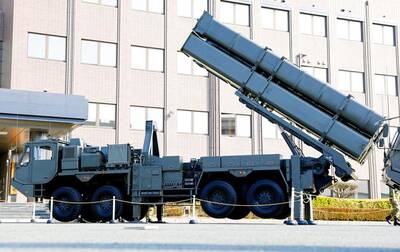
Japan has deployed long-range missiles in a southwestern region near China, the Japanese defense minister said yesterday, at a time when ties with Beijing are at their lowest in recent years. The missiles were installed in Kumamoto in the southern region of Kyushu, as Japan is attempting to shore up its military capacity as China steps up naval activity in the East China Sea. “Standoff defense capabilities enable us to counter the threat of enemy forces attempting to invade our country ... while ensuring the safety of our personnel,” Japanese Minister of Defense Shinjiro Koizumi said. “This is an extremely important initiative for

Chinese Nationalist Party (KMT) Chairwoman Cheng Li-wun (鄭麗文) today accepted an invitation from Chinese President Xi Jinping (習近平) to lead a delegation to China next month, saying she hopes to promote the peaceful development of cross-strait relations and bring stability to the Taiwan Strait. “I am grateful and happy to accept this invitation,” Cheng said in a statement from the KMT chairperson’s office. Cheng said she hopes both sides can work together to promote the peaceful development of cross-strait relations, enhance exchange and cooperation, bring stability to the Taiwan Strait and improve people’s livelihoods. At today's news conference, Cheng said any efforts to
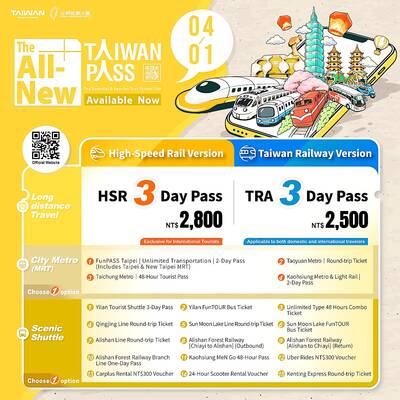
MORE POPULAR: Taiwan Pass sales increased by 59 percent during the first quarter compared with the same period last year, the Tourism Administration said The Tourism Administration yesterday said that it has streamlined the Taiwan Pass, with two versions available for purchase beginning today. The tourism agency has made the pass available to international tourists since 2024, allowing them to access the high-speed rail, Taiwan Railway Corp services, four MRT systems and four Taiwan Tourist Shuttles. Previously, five types of Taiwan Pass were available, but some tourists have said that the offerings were too complicated. The agency said only two types of Taiwan Pass would be available, starting from a three-day pass with the high-speed rail and a three-day pass with Taiwan Railway Corp. The former costs NT$2,800

The nation’s fastest supercomputer, Nano 4 (晶創26), is scheduled to be launched in the third quarter, and would be used to train large language models in finance and national defense sectors, the National Center for High-Performance Computing (NCHC) said. The supercomputer, which would operate at about 86.05 petaflops, is being tested at a new cloud computing center in the Southern Taiwan Science Park in Tainan. The exterior of the server cabinet features chip circuitry patterns overlaid with a map of Taiwan, highlighting the nation’s central position in the semiconductor industry. The center also houses Taiwania 2, Taiwania 3, Forerunner 1 and


 RSS
RSS