


President Chen Shui-bian (陳水扁) yesterday invited Chinese President Hu Jintao (胡錦濤) to visit Taiwan to experience democracy and freedom and to see "if Taiwan is a country with independent sovereignty."
China reacted coolly to Chen's invitation, however, rejecting any official contact until the Democratic Progressive Party (DPP) dropped a clause in its charter calling for formal independence.
"Conditions for dialogue and consultations between us and Chen Shui-bian as well as the Democratic Progressive Party is recognition of the 1992 consensus, which embodies the `one China' principle, giving up the Taiwan independence party constitution of the DPP, as well as putting an end to splittist activities,'' said Wang Zaixi (王在希), an official at the Chinese Communist Party's Taiwan Work Office.
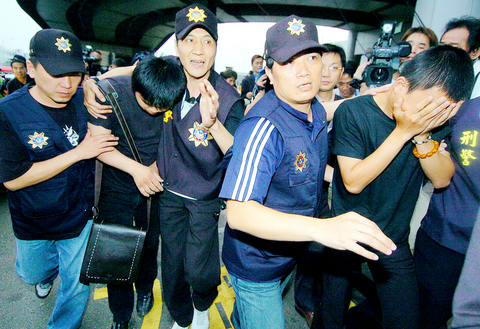
PHOTO: LIAO CHENG-HUI, TAIPEI TIMES
"So long as these conditions are met, we can resume dialogue and consultations with Chen Shui-bian and the DPP," Wang said.
Speaking hours before the return of Chinese Nationalist Party (KMT) Chairman Lien Chan (連戰) to Taipei from China, Chen said he also wanted Hu to consider whether the "1992 consensus" actually existed.
"If there is not such a thing, I would like the Chinese leaders not to mention it anymore," he said.
Chen said the purported consensus between envoys from Beijing and Taipei -- preparing for talks between late Straits Exchange Foundation chairman Koo Chen-fu (辜振甫) and his counterpart, Wang Daohan (汪道涵) -- was not recognized by Taipei.
"The `1992 consensus' is a term created by former Mainland Affairs Council chairman Su Chi (
Chen said the Chinese leadership did not understand Taiwan and had been invited on more than one occasion to visit Taiwan.
"I am not worried if he [Hu] comes. I am only concerned that he might refuse to come. If he visits Taiwan, Hu will understand what 23 million Taiwanese people really want," he said.
Chen was responding to reporters' questions on whether he would ask People First Party (PFP) Chairman James Soong (
On the third day of his trip to the Marshall Islands, Kiribati and Tuvalu, Chen said he had invited Chinese leaders to visit Taiwan many times since he took office in 2000.
Taiwan is a free country, Chen said, adding that Hu could ask any questions he liked and conduct surveys on what the public thinks if he came.
But Chen yesterday urged the public not to worry about the recent pro-China sentiments of pan-blue camp leaders and their visits to China. He instead asked the Taiwanese people to vote for their preferred National Assembly candidates on May 14.
But during the press conference, the trips to China by Lien and Soong were the focus.
"Again, I would urge my fellow Taiwanese to relax, because they do not have to worry about Lien and Soong or any other politicians' possible trips to China," he said. "Those pro-China people are not my worry. What I really worry about is the election on May 14."
Chen urged the public to support the DPP so that the National Assembly could cut in half the number of legislative seats, reform voting structures and ultimately replace the assembly with referendums.
Chen said these three goals were negotiated and agreed to by all the major parties. However, he said, "some of these parties" changed their minds after the legislative elections in December.
"If a political party reneges and changes its policy just like that, then this means it will also cheat voters just as easily," Chen said. "I have not changed my policies since I took my oath of office in 2000 ... nothing will change and our goals will not be realized if people do not care about the election. This worries me a lot."
Speaking again on cross-strait matters, Chen said that he was not worried because he has good communication with Lien and Soong.
On the first day of his trip, Chen told reporters that he had asked Soong to "deliver some messages" to Chinese officials when he visits China. When asked what messages he gave Soong, Chen replied that it was not proper for him to make them public.
Chen said the conversation between him and Soong was also private and that he intended to keep it that way.
"Regardless of what I told him, my bottom line never changes. Taiwan's sovereignty must be recognized and respected." Chen said.

NO-LIMITS PARTNERSHIP: ‘The bottom line’ is that if the US were to have a conflict with China or Russia it would likely open up a second front with the other, a US senator said Beijing and Moscow could cooperate in a conflict over Taiwan, the top US intelligence chief told the US Senate this week. “We see China and Russia, for the first time, exercising together in relation to Taiwan and recognizing that this is a place where China definitely wants Russia to be working with them, and we see no reason why they wouldn’t,” US Director of National Intelligence Avril Haines told a US Senate Committee on Armed Services hearing on Thursday. US Senator Mike Rounds asked Haines about such a potential scenario. He also asked US Defense Intelligence Agency Director Lieutenant General Jeffrey Kruse

FAST RELEASE: The council lauded the developer for completing model testing in only four days and releasing a commercial version for use by academia and industry The National Science and Technology Council (NSTC) yesterday released the latest artificial intelligence (AI) language model in traditional Chinese embedded with Taiwanese cultural values. The council launched the Trustworthy AI Dialogue Engine (TAIDE) program in April last year to develop and train traditional Chinese-language models based on LLaMA, the open-source AI language model released by Meta. The program aims to tackle the information bias that is often present in international large-scale language models and take Taiwanese culture and values into consideration, it said. Llama 3-TAIDE-LX-8B-Chat-Alpha1, released yesterday, is the latest large language model in traditional Chinese. It was trained based on Meta’s Llama-3-8B

STUMPED: KMT and TPP lawmakers approved a resolution to suspend the rate hike, which the government said was unavoidable in view of rising global energy costs The Ministry of Economic Affairs yesterday said it has a mandate to raise electricity prices as planned after the legislature passed a non-binding resolution along partisan lines to freeze rates. Chinese Nationalist Party (KMT) lawmakers proposed the resolution to suspend the price hike, which passed by a 59-50 vote. The Taiwan People’s Party (TPP) voted with the KMT. Legislative Speaker Han Kuo-yu (韓國瑜) of the KMT said the resolution is a mandate for the “immediate suspension of electricity price hikes” and for the Executive Yuan to review its energy policy and propose supplementary measures. A government-organized electricity price evaluation board in March

NOVEL METHODS: The PLA has adopted new approaches and recently conducted three combat readiness drills at night which included aircraft and ships, an official said Taiwan is monitoring China’s People’s Liberation Army (PLA) exercises for changes in their size or pattern as the nation prepares for president-elect William Lai’s (賴清德) inauguration on May 20, National Security Bureau (NSB) Director-General Tsai Ming-yen (蔡明彥) said yesterday. Tsai made the comment at a meeting of the Legislative Yuan’s Foreign Affairs and National Defense Committee, in response to Democratic Progressive Party (DPP) Legislator Wang Ting-yu’s (王定宇) questions. China continues to employ a carrot-and-stick approach, in which it applies pressure with “gray zone” tactics, while attempting to entice Taiwanese with perks, Tsai said. These actions aim to help Beijing look like it has


 RSS
RSS