


The Chinese Nationalist Party (KMT) delegation that has traveled to China to push for cooperation and reconciliation with the Chinese Communist Party (CCP) is "seemingly deranged with regard to space and time," President Chen Shui-bian (
"It is unimaginable that this could happen at this time, when Taiwan is already implementing democratic and Constitutional rule. What [accord] could possibly be achieved through KMT-CCP co-operation?" Chen asked. His remarks yesterday were his first public comments about the KMT delegation's visit to China.
Headed by KMT Vice Chairman Chiang Pin-kun (
In reference to Chiang's trip, Chen said "recently `someone' has traveled to the other side of the Strait to push for `reconciliation between the KMT and the Chinese Communist Party' ... the situation seems to be out of place and time, as if they had turned the clock back 60 to 80 years ago, when the two parties were trying to find common ground."
"It is now 2005. We have entered the 21st century, and a country can only progress by moving forward and not backpedalling. Is it right then to go back to 1945, 1935 or 1925?" Chen asked rhetorically, alluding to previous periods of KMT-CCP cooperation in the 1920s and during World War II.
"Taiwan has implemented democratic and constitutional rule. Can we now put a party above the nation?" Chen said in a speech delivered at the inauguration of an educational institute hosted by the National Youth Commission (青輔會) "Is it possible that we are supposed to return to the old days and do what the Chinese Communist Party still does: Let a party keep an iron grip on the government and the military?"
Chen said that "placing our hope in the people and upholding the principle of `Taiwan first' are the correct and best choices to make."
Chen told the audience of young people that the biggest difference between the two sides of the Strait was not about governments, but about different lifestyles and social systems, saying that it boiled down to "democracy versus communism and peace versus threats."
"Like a divided house that cannot stand, if we can't unite among ourselves, we are then a divided country," Chen said.
"If we can't unite but continue to stay divided in a dichotomy of pan-blues and pan-greens, do we need more of the Anti-Secession Law? Our own country will fall apart first, even without the Anti-Secession Law," the president said. He added that "only a united Taiwan can stabilize cross-strait relations."
Touching upon last Saturday's demonstration denouncing the enactment of the Anti-Secession Law, the president took the opportunity to explain the significance of the march, in which hundreds of thousands of people took to the streets.
The march was significant because the motivation behind the event was the people and not politicians, Chen said, adding that political figures, including himself and Premier Frank Hsieh (
"The 326 March for Democracy and Peace was a bona fide international press conference, not my own nor any person's press conference," Chen said. "A million people marched in the streets and, via their action, showed the world their determination to safeguard Taiwan's democracy and peace, as well as their opposition to Beijing's law."
"It was the best international press conference and the entire international media saw, heard and reported it," he said.
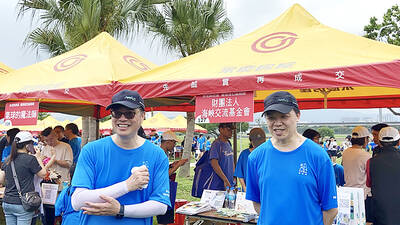
SECURITY: As China is ‘reshaping’ Hong Kong’s population, Taiwan must raise the eligibility threshold for applications from Hong Kongers, Chiu Chui-cheng said When Hong Kong and Macau citizens apply for residency in Taiwan, it would be under a new category that includes a “national security observation period,” Mainland Affairs Council (MAC) Minister Chiu Chui-cheng (邱垂正) said yesterday. President William Lai (賴清德) on March 13 announced 17 strategies to counter China’s aggression toward Taiwan, including incorporating national security considerations into the review process for residency applications from Hong Kong and Macau citizens. The situation in Hong Kong is constantly changing, Chiu said to media yesterday on the sidelines of the Taipei Technology Run hosted by the Taipei Neihu Technology Park Development Association. With

CARROT AND STICK: While unrelenting in its military threats, China attracted nearly 40,000 Taiwanese to over 400 business events last year Nearly 40,000 Taiwanese last year joined industry events in China, such as conferences and trade fairs, supported by the Chinese government, a study showed yesterday, as Beijing ramps up a charm offensive toward Taipei alongside military pressure. China has long taken a carrot-and-stick approach to Taiwan, threatening it with the prospect of military action while reaching out to those it believes are amenable to Beijing’s point of view. Taiwanese security officials are wary of what they see as Beijing’s influence campaigns to sway public opinion after Taipei and Beijing gradually resumed travel links halted by the COVID-19 pandemic, but the scale of
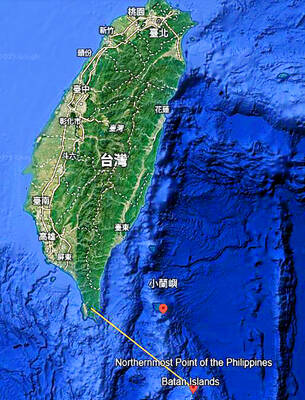
A US Marine Corps regiment equipped with Naval Strike Missiles (NSM) is set to participate in the upcoming Balikatan 25 exercise in the Luzon Strait, marking the system’s first-ever deployment in the Philippines. US and Philippine officials have separately confirmed that the Navy Marine Expeditionary Ship Interdiction System (NMESIS) — the mobile launch platform for the Naval Strike Missile — would take part in the joint exercise. The missiles are being deployed to “a strategic first island chain chokepoint” in the waters between Taiwan proper and the Philippines, US-based Naval News reported. “The Luzon Strait and Bashi Channel represent a critical access
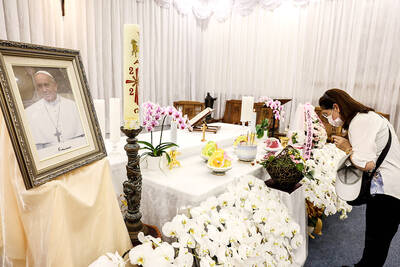
Pope Francis is be laid to rest on Saturday after lying in state for three days in St Peter’s Basilica, where the faithful are expected to flock to pay their respects to history’s first Latin American pontiff. The cardinals met yesterday in the Vatican’s synod hall to chart the next steps before a conclave begins to choose Francis’ successor, as condolences poured in from around the world. According to current norms, the conclave must begin between May 5 and 10. The cardinals set the funeral for Saturday at 10am in St Peter’s Square, to be celebrated by the dean of the College


 RSS
RSS