


Palestinian President Yasser Arafat died yesterday at the French military hospital where he was being treated.
In a brief statement, Percy military hospital spokesman Christian Estripeau said the 75-year-old Arafat had passed away.
"A big heart has stopped beating," Arafat's secretary, Tayeb Abdel Rahim, said in Ramallah, fighting back tears.
He said Arafat has shown boundless love for the Palestinian people, who he wanted to lead to an independent state.
Some hours later, and in accordance with Palestinian law, Palestinian Legislative Council Speaker Rawhi Fattouh was sworn in as Arafat's interim successor for 60 days, until new elections are held.
He promised to continue "the road the symbol" had taken and reaffirmed his commitment to the peace process "until a just and lasting peace is achieved."
Arafat's body will now be transported to Cairo for a state funeral service expected today before he is buried in his headquarters compound in Ramallah.
Palestinians said Arafat would be buried in earth brought especially from Jerusalem. Arafat had expressed the wish to be buried in Jerusalem, but the Israeli government emphatically ruled this out.
Arafat was admitted to the Percy Military Training Hospital, southwest of Paris, on Oct. 29 suffering from a mysterious blood disorder.
He slipped into a coma on November 3 and his condition continued to deteriorate. On Tuesday, a Palestinian spokesman said that he had suffered a brain haemorrhage and that doctors were trying to stop the bleeding.
Despite treating and examining Arafat for more than a week, doctors were never able to provide a diagnosis of his ailment.
Palestinian deputy foreign minister Ilan Halevi, told LCI television in France that there had been "no decision to disconnect Arafat's life support system. His death simply came," Halevi said.
He added that he had "no proof that the Israelis poisoned Arafat, as many Palestinians believe."
Meanwhile, Palestinian militants angry over Yasser Arafat's death attacked a Jewish settlement in the Gaza Strip yesterday in what they said signaled the start of a new round of clashes against Israel.
Israeli soldiers killed one of the gunmen, who launched a multi-pronged attack against the heavily fortified Netzarim settlement in the Gaza Strip shortly after news of Arafat's death reached the territory, medics said.
The gunmen opened fire at the settlement, detonated a bomb and attempted to fire a rocket-propelled grenade, an army spokeswoman said. She said there had been an exchange of fire with troops and five gunmen had been hit.
Abu Qusai, a spokesman for the al-Aqsa Martyrs Brigades, an armed group in the late Palestinian leader's Fatah faction, said it held Israel responsible for Arafat's death, adding:
"Our groups together with brothers from other factions took to the battlefield with the enemy to make it pay the price ... The next days will witness violent clashes with the Zionists everywhere."
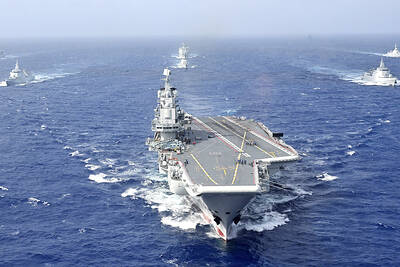
A Chinese aircraft carrier group entered Japan’s economic waters over the weekend, before exiting to conduct drills involving fighter jets, the Japanese Ministry of Defense said yesterday. The Liaoning aircraft carrier, two missile destroyers and one fast combat supply ship sailed about 300km southwest of Japan’s easternmost island of Minamitori on Saturday, a ministry statement said. It was the first time a Chinese aircraft carrier had entered that part of Japan’s exclusive economic zone (EEZ), a ministry spokesman said. “We think the Chinese military is trying to improve its operational capability and ability to conduct operations in distant areas,” the spokesman said. China’s growing
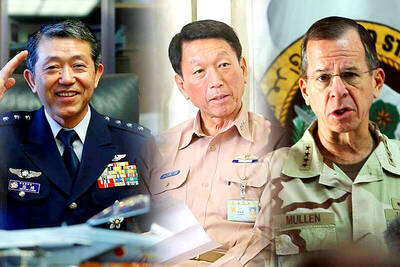
Nine retired generals from Taiwan, Japan and the US have been invited to participate in a tabletop exercise hosted by the Taipei School of Economics and Political Science Foundation tomorrow and Wednesday that simulates a potential Chinese invasion of Taiwan in 2030, the foundation said yesterday. The five retired Taiwanese generals would include retired admiral Lee Hsi-min (李喜明), joined by retired US Navy admiral Michael Mullen and former chief of staff of the Japan Self-Defense Forces general Shigeru Iwasaki, it said. The simulation aims to offer strategic insights into regional security and peace in the Taiwan Strait, it added. Foundation chair Huang Huang-hsiung
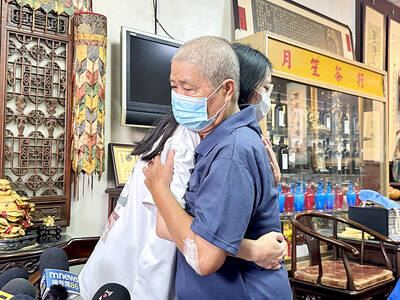
PUBLIC WARNING: The two students had been tricked into going to Hong Kong for a ‘high-paying’ job, which sent them to a scam center in Cambodia Police warned the public not to trust job advertisements touting high pay abroad following the return of two college students over the weekend who had been trafficked and forced to work at a cyberscam center in Cambodia. The two victims, surnamed Lee (李), 18, and Lin (林), 19, were interviewed by police after landing in Taiwan on Saturday. Taichung’s Chingshui Police Precinct said in a statement yesterday that the two students are good friends, and Lin had suspended her studies after seeing the ad promising good pay to work in Hong Kong. Lee’s grandfather on Thursday reported to police that Lee had sent
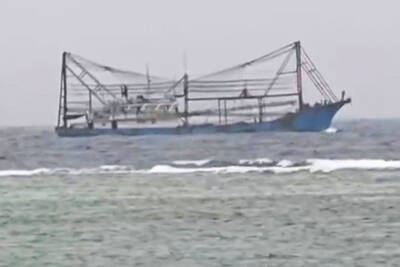
A Chinese ship ran aground in stormy weather in shallow waters off a Philippines-controlled island in the disputed South China Sea, prompting Filipino forces to go on alert, Philippine military officials said yesterday. When Philippine forces assessed that the Chinese fishing vessel appeared to have run aground in the shallows east of Thitu Island (Jhongye Island, 中業島) on Saturday due to bad weather, Philippine military and coast guard personnel deployed to provide help, but later saw that the ship had been extricated, Philippine navy regional spokesperson Ellaine Rose Collado said. No other details were immediately available, including if there were injuries among


 RSS
RSS