


Hamas secretly appointed a new Gaza Strip chief early yesterday, but refused to reveal his identity after Israel assassinated two Hamas leaders in less than a month.
Israel assassinated Hamas leader Abdel Aziz Rantisi in a missile strike on his car on Saturday, part of its declared campaign to wipe out the Islamic militant group's leadership ahead of a planned Israeli withdrawal from the Gaza Strip. Two of Rantisi's bodyguards were also killed in the attack.
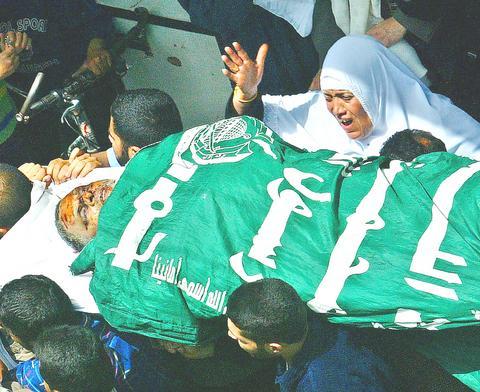
PHOTO: AP
Hamas posted a statement on its Web site pledging "100 unique retaliations" that will shake Israel. It said it had declared a state of emergency in the West Bank and Gaza Strip until revenge was complete.
"Yesterday they said that they killed Rantisi to weaken Hamas. They are dreaming. Every time a martyr falls, Hamas is strengthened," Ismail Haniyeh, a Hamas leader, told more than 70,000 mourners gathered at the city's largest mosque for the funeral. "Hamas might have a crisis at hand after losing its leaders, but it will not be defeated."
Palestinians demonstrated Sunday throughout the Gaza Strip and West Bank calling for attacks to retaliate for the assassination. In the West Bank city of Ramallah, Israeli soldiers shot and killed a 14-year-old Palestinian boy in a riot against the killing, hospital officials said.
Tens of thousands of Palestinians thronged the streets of Gaza City yesterday in Rantisi's funeral procession. Hamas supporters chanting "God is great" and "revenge, revenge," threw flowers at the three men's stretchers as they carried them from the hospital.
About 200 armed Hamas militants lined both sides of the road and gave the bodies a military salute as they approached a large blue and green mourning tent set up outside Rantisi's house. Armed men fired into the air and many in the gathered crowd raised their fists in anger.
Green Hamas flags and black mourning flags hung from nearby homes.
"Hamas will move ahead and will continue the resistance march," said local Hamas leader Ahmad Sahar, a friend of Rantisi's.
Rantisi was killed less than a month after Israel assassinated Hamas spiritual leader Sheik Ahmed Yassin. The group's Damascus-based leader Khaled Mashaal reportedly instructed the group to keep the name of its new Gaza leader secret.
Israel has targeted Hamas and its leaders in advance of Prime Minister Ariel Sharon's proposed withdrawal from all of the Gaza Strip and a few West Bank settlements.
Sharon vowed to continue hunting down Hamas leaders.
"This policy of making an effort on the one hand to advance a political process and on the other hand to hit the terror organizations and their leaders will continue," Sharon said at the start of his weekly Cabinet meeting yesterday.
Sharon returned from Washington Friday with strong US backing for his plan, as well as unprecedented US support for Israel to hold on to parts of the West Bank under a final peace deal.
Sharon has called for a May 2 referendum on his plan in his hardline Likud Party, and polls show the proposal garnering a slim majority of the party's 200,000 voters.
Two key Israeli Cabinet ministers, Finance Minister Benjamin Netanyahu and Education Minister Limor Livnat, decided yesterday to back the plan, giving Sharon a Cabinet majority and the support of influential Likud members.
Vice Premier Ehud Olmert denied there was a connection between the referendum and Rantisi's assassination. But the killing underscored Israel's commitment to continue fighting terrorism and hunting down militant leaders even after a pullout, he said.
Israeli Cabinet minister Gideon Ezra said Mashaal -- the overall Hamas leader who Israel tried unsuccessfully to kill in the past -- was also marked for death.
"The fate of Khaled Mashaal is the fate of Rantisi. The minute we have the operational opportunity we will do this," Ezra said.
The Bush administration declined to criticize Rantisi's killing, saying instead that Israel has the right to defend itself from terrorist attacks and urging Palestinians to use restraint in responding.
"The United States strongly urges Israel to consider carefully the consequences of its actions," White House press secretary Scott McClellan said
Arab officials and Muslim leaders called the assassination "state terrorism" that proved Israel was intent on sabotaging peace hopes and suggested American support for such killings, an accusation Israel and the US denied. Earlier in the week, a taped message attributed to Osama bin Laden vowed revenge against America for the Israeli killing of Yassin.
Israeli security forces went on high alert after Rantisi was killed, fearing reprisal bombings. Palestinian leader Yasser Arafat condemned the killing as a "brutal assassination."
Black smoke from burning tires billowed over Gaza and fresh graffiti promising fierce revenge decorated the walls of the crowded coastal strip. Streets remained empty and stores shuttered as Gazans marked the first of a three-day mourning period for Rantisi. Children stayed home from school.

The National Chungshan Institute of Science and Technology yesterday showcased its locally developed variants of the Vision 60 robotic patrol dog, which it plans to deploy on the nation’s outlying territories in the South China Sea. The variants were produced under the Joint Lab project — created by the institute and domestic companies — and assembled with domestically produced motors, lenses and artificial intelligence (AI) systems alongside licensed tech from the US, Missile and Rocket Systems Research Division deputy director Jen Kuo-kang (任國光) told the media event at a military base in Taipei’s Dazhi (大直) area. Taiwan has built up its strengths

RIGHT DIRECTION: Taiwan’s efforts to prevent forced labor include a proposal to ‘fully prohibit’ employers from withholding workers’ documents, an official said Taiwan is to establish a mechanism to restrict imports of goods linked to forced labor, the Executive Yuan said yesterday, after the US proposed imposing additional tariffs on Taiwanese goods over labor concerns. “The Ministry of Labor and the Ministry of Economic Affairs are to establish an interministerial review procedure,” Executive Yuan spokesperson Michelle Lee (李慧芝) said at a news briefing in Taipei. “The government is to use the Foreign Trade Act [貿易法] as the legal basis to restrict imports of goods produced with forced labor” and bring its supply chain governance more in line with international standards on human rights, resilience

NOT IMMEDIATE: Taiwan has a chance to appeal the proposed 10 percent tariff before it starts, while other countries face a 12.5 percent tariff from the trade office Taiwan is among 60 economies determined by the US to have failed to impose or enforce a ban on the importation of goods produced with forced labor, according to a notice released on Tuesday by the Office of the US Trade Representative (USTR), which proposed imposing an additional 10 percent or more tariff on them. The USTR in a statement said that following an investigation, it had determined under Section 301 of the Trade Act of 1974 that the failure of the 60 economies to impose and effectively enforce a prohibition on the importation of goods produced with forced labor is

TIT-FOR-TAT: The US allegedly revoked the visa of a Chinese national working at Xinhua News Agency in the US in response to Beijing’s expulsion of Vivian Wang The Presidential Office yesterday condemned China for expelling a New York Times correspondent from Beijing following the newspaper’s interview with President William Lai (賴清德), saying the move highlighted Beijing’s suppression of press freedom and its threat to international news media. Taiwan has noted a series of recent incidents in which Beijing used similar tactics to “threaten and pressure international media outlets and journalists,” Presidential Office spokeswoman Karen Kuo (郭雅慧) said in a statement. “This concerns not only press freedom and freedom of expression, but also the safety of journalists, and Taiwan and relevant partners are paying close attention to the situation,” she


 RSS
RSS