


The Democratic Progressive Party (DPP) yesterday published a booklet detailing how Chinese Nationalist Party (KMT) Chairman Lien Chan (連戰) and his father, Lien Chen-tung (連震東), a high-ranking official of the former KMT administration, had abused their power to accumulate family wealth.
The booklet, 500,000 copies of which will be distributed around the country during the next 10 days, details the dubious process by which Lien and his father acquired various tracts of land, which are now used for commercial purposes.
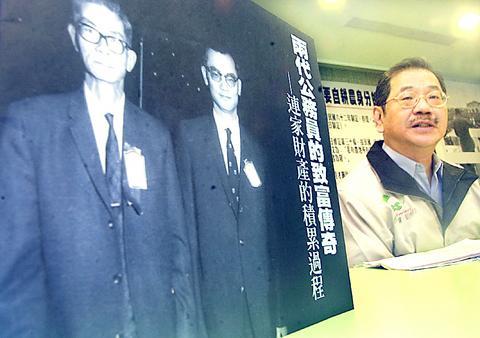
PHOTO: CHEN TSE-MING, TAIPEI TIMES
The booklet starts with Lien Chen-tung's rise from a poor civil servant to the seventh wealthiest man in Taipei within 11 years of the KMT's settlement in Taiwan in 1949.
The Lien family has said many times that the family had no property. Lien once wrote in a Hong Kong newspaper that "the Lien family has long lived in Tainan City and all the family assets were confiscated after the Japanese occupied Taiwan" in 1895.
Using land purchase certificates as evidence, the booklet says that the first piece of land Lien Chen-tung bought in 1949 is now the site of the second hall of the Idee Department Store on Taipei's Nanjing West Road.
The documents show that Lien Chen-tung bought the land in 1949, a year before official records show that the KMT government nationalized the property in 1950. Another document shows that the land was transferred to Lien in 1951.
"This piece of land should have belonged to the government. But actually Lien bought it before the government nationalized the land," DPP campaign headquarters spokesperson Wu Nai-jen (
Wu said the land was involved in a series of scandals as it was once used for a karaoke bar, which burned down in 1995 because of lax fire-prevention facilities, and then a video game parlor, which was closed in 1996 following a crackdown instigated by former Chen Shui-bian (
In addition to the unjust way in which it obtained the government-owned property, the Lien family also illegally bought farming land and put it to commercial uses.
Wu yesterday said Lien Chan bought land as a farmer in Taipei City's Shihlin District in 1959 when he studied in the US. The land was made available for commercial uses a year later.
In 1961, Lien Chen-tung used the same method to buy another piece of land in the same area and completed the land recategorization five years later.
Lien's eldest daughter, Lien Hui-hsin (
Wu yesterday said although the Agricultural Development Act (ADA,
Wu yesterday dismissed KMT Secretary General Lin Feng-cheng's (林豐正) defense that the ADA was not applicable and therefore the Lien family was not breaking the law in conducting such deals.
"Lin's defense was utter lies. The law said clearly that even before 1973, only those who are able to cultivate the land are eligible for owning farming land," Wu said.
Not to be outdone, the KMT is running TV commercials targeting Chen Shui-bian's family wealth.
Also see story:

AIR SUPPORT: The Ministry of National Defense thanked the US for the delivery, adding that it was an indicator of the White House’s commitment to the Taiwan Relations Act Deputy Minister of National Defense Po Horng-huei (柏鴻輝) and Representative to the US Alexander Yui on Friday attended a delivery ceremony for the first of Taiwan’s long-awaited 66 F-16C/D Block 70 jets at a Lockheed Martin Corp factory in Greenville, South Carolina. “We are so proud to be the global home of the F-16 and to support Taiwan’s air defense capabilities,” US Representative William Timmons wrote on X, alongside a photograph of Taiwanese and US officials at the event. The F-16C/D Block 70 jets Taiwan ordered have the same capabilities as aircraft that had been upgraded to F-16Vs. The batch of Lockheed Martin
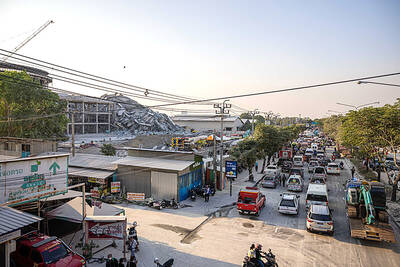
GRIDLOCK: The National Fire Agency’s Special Search and Rescue team is on standby to travel to the countries to help out with the rescue effort A powerful earthquake rocked Myanmar and neighboring Thailand yesterday, killing at least three people in Bangkok and burying dozens when a high-rise building under construction collapsed. Footage shared on social media from Myanmar’s second-largest city showed widespread destruction, raising fears that many were trapped under the rubble or killed. The magnitude 7.7 earthquake, with an epicenter near Mandalay in Myanmar, struck at midday and was followed by a strong magnitude 6.4 aftershock. The extent of death, injury and destruction — especially in Myanmar, which is embroiled in a civil war and where information is tightly controlled at the best of times —
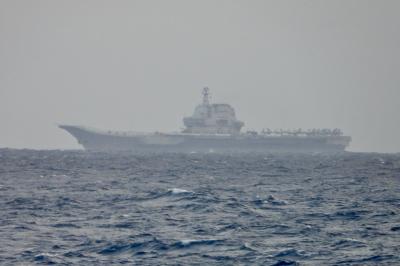
China's military today said it began joint army, navy and rocket force exercises around Taiwan to "serve as a stern warning and powerful deterrent against Taiwanese independence," calling President William Lai (賴清德) a "parasite." The exercises come after Lai called Beijing a "foreign hostile force" last month. More than 10 Chinese military ships approached close to Taiwan's 24 nautical mile (44.4km) contiguous zone this morning and Taiwan sent its own warships to respond, two senior Taiwanese officials said. Taiwan has not yet detected any live fire by the Chinese military so far, one of the officials said. The drills took place after US Secretary

THUGGISH BEHAVIOR: Encouraging people to report independence supporters is another intimidation tactic that threatens cross-strait peace, the state department said China setting up an online system for reporting “Taiwanese independence” advocates is an “irresponsible and reprehensible” act, a US government spokesperson said on Friday. “China’s call for private individuals to report on alleged ‘persecution or suppression’ by supposed ‘Taiwan independence henchmen and accomplices’ is irresponsible and reprehensible,” an unnamed US Department of State spokesperson told the Central News Agency in an e-mail. The move is part of Beijing’s “intimidation campaign” against Taiwan and its supporters, and is “threatening free speech around the world, destabilizing the Indo-Pacific region, and deliberately eroding the cross-strait status quo,” the spokesperson said. The Chinese Communist Party’s “threats


 RSS
RSS