


Lin Wang (林旺), Taipei City Zoo's star elephant, decorated World War II veteran and the world's oldest Asian elephant in captivity, died early yesterday morning at the zoo at the grand old age of 86.
"Lin Wang was found dead by his pool at 2:30am yesterday. He died with dignity from extreme weakness due to old age," said Lin Hua-ching (林華慶), a city zoo section chief.
An autopsy later determined that he died from cardiopulmonary failure.
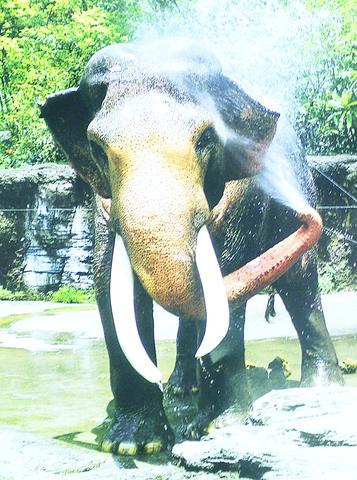
PHOTO: REUTERS
Lin Wang showed signs of frailty after the Lunar New Year holiday early this month, moving slowly and eating less.
The zookeeper said the elephant had been observed spending unusually long periods of time in the pool by his enclosure, known as the White House, since last Friday.
"Though we knew his health was deteriorating, we're still surprised that he has died so soon. But we take solace from the dignified way in which he died -- the fact that he didn't experience a lot of pain," Lin said.
The zoo plans to have the body of the pachyderm stuffed and displayed at the zoo, together with a reconstruction of his skeleton, an undertaking that will require around NT$5 million.
"We hope local businesses will donate the necessary funds for the project," Lin said.
The octogenarian had lived in Taiwan for more than five decades. Known as "Granddaddy Lin Wang," the elephant was an icon to many Taiwanese, young and old.
President Chen Shui-bian (陳水扁) yesterday sent wreathes to the zoo yesterday, bearing the inscription, "For Lin Wang, a friend forever."
Taipei City Mayor Ma Ying-jeou (馬英九) said: "The average life expectancy of Asian elephants is 50 years. Lin Wang had exceeded that period by so long that he had become an icon to four generations of people in Taiwan. When I was a child, my parents took me to see Lin Wang at the zoo. When I became a father, I took my daughters to see him. We watched him grow old, but he also accompanied us as we grew up."
Ma said the city government had originally planned to allow the nation's students and children to visit the zoo for free to wish the elephant well for three days starting Friday, knowing that he was weakening.
The activity will still proceed as planned, but for the purposes of conveying condolences.
"We didn't expect him to die so soon. But the activity will go ahead as scheduled," Ma said.
Lin Wang's extraordinary story began in 1943 when the ROC military acquired the elephant from Japanese prisoners of war in Burma during World War II. At the time, Lin Wang was about 26 years old.
He was used for carrying military supplies during the war and was honored later for his contributions to the war effort.
In 1947, he was transported to Kaohsiung and was transferred to Taipei City Zoo in 1954, where he lived with his long-term companion Malan.
Malan died last October at the age of 54 due to a malignant tumor on her foot.

NO HUMAN ERROR: After the incident, the Coast Guard Administration said it would obtain uncrewed aerial vehicles and vessels to boost its detection capacity Authorities would improve border control to prevent unlawful entry into Taiwan’s waters and safeguard national security, the Mainland Affairs Council (MAC) said yesterday after a Chinese man reached the nation’s coast on an inflatable boat, saying he “defected to freedom.” The man was found on a rubber boat when he was about to set foot on Taiwan at the estuary of Houkeng River (後坑溪) near Taiping Borough (太平) in New Taipei City’s Linkou District (林口), authorities said. The Coast Guard Administration’s (CGA) northern branch said it received a report at 6:30am yesterday morning from the New Taipei City Fire Department about a

IN BEIJING’S FAVOR: A China Coast Guard spokesperson said that the Chinese maritime police would continue to carry out law enforcement activities in waters it claims The Philippines withdrew its coast guard vessel from a South China Sea shoal that has recently been at the center of tensions with Beijing. BRP Teresa Magbanua “was compelled to return to port” from Sabina Shoal (Xianbin Shoal, 仙濱暗沙) due to bad weather, depleted supplies and the need to evacuate personnel requiring medical care, the Philippine Coast Guard (PCG) spokesman Jay Tarriela said yesterday in a post on X. The Philippine vessel “will be in tiptop shape to resume her mission” after it has been resupplied and repaired, Philippine Executive Secretary Lucas Bersamin, who heads the nation’s maritime council, said

REGIONAL STABILITY: Taipei thanked the Biden administration for authorizing its 16th sale of military goods and services to uphold Taiwan’s defense and safety The US Department of State has approved the sale of US$228 million of military goods and services to Taiwan, the US Department of Defense said on Monday. The state department “made a determination approving a possible Foreign Military Sale” to the Taipei Economic and Cultural Representative Office in the US for “return, repair and reshipment of spare parts and related equipment,” the defense department’s Defense Security Cooperation Agency said in a news release. Taiwan had requested the purchase of items and services which include the “return, repair and reshipment of classified and unclassified spare parts for aircraft and related equipment; US Government

More than 500 people on Saturday marched in New York in support of Taiwan’s entry to the UN, significantly more people than previous years. The march, coinciding with the ongoing 79th session of the UN General Assembly, comes close on the heels of growing international discourse regarding the meaning of UN Resolution 2758. Resolution 2758, adopted by the UN General Assembly in 1971, recognizes the People’s Republic of China (PRC) as the “only lawful representative of China.” It resulted in the Republic of China (ROC) losing its seat at the UN to the PRC. Taiwan has since been excluded from


 RSS
RSS