


Rescuers said yesterday they had pulled 60 bodies, including those of four foreigners, from the smoking ruins of an office block in Vietnam's commercial capital and warned that the death toll could rise.
Some 500 people were inside Ho Chi Minh City's seven-storey Saigon International Business Center, home to many foreign companies, when the fire broke out on Tuesday, and scores are still missing.
Diplomats said that at least two Britons, one American and a Croatian were among the dead, and other foreign nationals were feared to be among the missing.
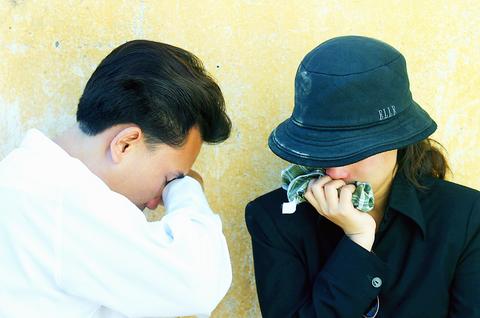
PHOTO: AP
Eyewitnesses described how terrified workers leapt to their deaths from the roof to escape the searing heat as the city's firefighters battled in vain to bring the fire under control.
The Ho Chi Minh City-based Tuoi Tre newspaper and the Lao Dong daily said more than 100 people were killed in the blaze, a figure disputed by city officials.
Nguyen Thien Nhan, vice chairman of the city's People's Committee, told reporters 102 people had been injured and that the official death toll stood at 60. However, he conceded the number of victims was expected to rise.
He said the building had been partitioned into scores of separate offices, and that the dividing walls had collapsed and trapped many people inside.
"We think there are still many bodies trapped under these collapsed walls," Nguyen Phien Nhan said. "It is a tragedy of great human suffering."
Communist Party General Secretary Nong Duc Manh and Vu Khoan, deputy prime minister, flew down from Hanoi to assess the situation and pass on their condolences to the families of the bereaved, foreign ministry sources said.
Investigators and rescue workers could be seen sifting through the charred hulk of the building in the center of the booming southern city, which has become a magnet for foreign investment.
Local residents said the fire was triggered by an electrical fault, but officials in the city formerly known as Saigon said more time was needed before they could identify the cause.
"At the moment it is likely this is an accident. There are no signs of sabotage or terrorism," said Nhan.
Phan Xuan Bien, a senior Communist Party official, said that initial reports described "green flames which could indicate it was caused by gas for the air-conditioning system."
Tran Minh Chinh, a shoe repairman, said people flung themselves from windows to escape the flames.
"It was horrible. People were jumping from both sides of the building. I saw many of them lying on the ground burnt and bloody," he said.
"I saw people standing on the roof screaming down to us below to help them. The flames were upon them but we could do nothing to help, nor could the firefighters, who did not have ladders that were long enough."
The city's deputy fire chief, Lam Tan Buu, said 64 fire trucks had been scrambled to fight the blaze -- including some military vehicles and others from Tan Son Nhat International Airport.
He said firefighters had been prevented from entering parts of the building, the ground floor of which houses around 90 shops, because of the intense heat of the smouldering debris.
However, Buu said he hoped to finish the search and recovery mission by the end of the day.
The fire raged for more than five hours before firefighters brought it under control.

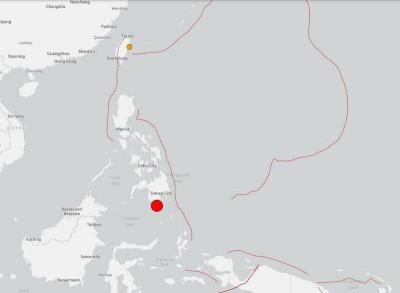
A magnitude 7.8 earthquake struck off the southern coast of Mindanao in the Philippines at 7:38am today, prompting the US Tsunami Warning System to issue an alert for neighboring countries, including Taiwan. The system issued a purple alert indicating a "tsunami threat." The potential threat zone includes Taiwan, the Philippines, Papua New Guinea, Yap and Palau. There were no immediate reports of major damage in the Philippines or Indonesia. The quake struck at a depth of 10km, said the German Research Centre for Geosciences, which had earlier pegged the earthquake at magnitude 8.2. Phivolcs, the Philippine agency, said the quake was magnitude 7 and
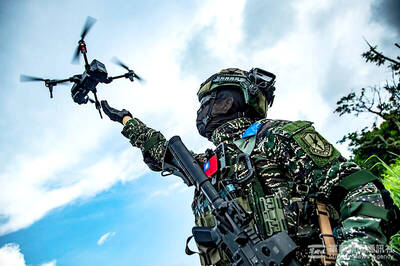
RESILIENCE: Taiwan plays a key role in semiconductors, energy, information infrastructure and advanced manufacturing, AIT Director Raymond Greene said Taiwan’s continued investment in deterrence and resilience remains vital, especially in uncrewed systems and other emerging technologies, American Institute in Taiwan (AIT) Director Raymond Greene said yesterday. Greene made the remarks at the annual National Strategic Summit on Supply Chain Resilience held by the Research Institute for Democracy, Society and Emerging Technology (DSET), a government-backed think tank. As Taiwan last year became the US’ fourth-largest trading partner and supply chain security is becoming more important, cooperation in emerging technologies continues to deepen between the two countries, he said. The US is committed to accelerating innovation, building key infrastructure, strengthening cooperation

The National Chungshan Institute of Science and Technology yesterday showcased its locally developed variants of the Vision 60 robotic patrol dog, which it plans to deploy on the nation’s outlying territories in the South China Sea. The variants were produced under the Joint Lab project — created by the institute and domestic companies — and assembled with domestically produced motors, lenses and artificial intelligence (AI) systems alongside licensed tech from the US, Missile and Rocket Systems Research Division deputy director Jen Kuo-kang (任國光) told the media event at a military base in Taipei’s Dazhi (大直) area. Taiwan has built up its strengths

RIGHT DIRECTION: Taiwan’s efforts to prevent forced labor include a proposal to ‘fully prohibit’ employers from withholding workers’ documents, an official said Taiwan is to establish a mechanism to restrict imports of goods linked to forced labor, the Executive Yuan said yesterday, after the US proposed imposing additional tariffs on Taiwanese goods over labor concerns. “The Ministry of Labor and the Ministry of Economic Affairs are to establish an interministerial review procedure,” Executive Yuan spokesperson Michelle Lee (李慧芝) said at a news briefing in Taipei. “The government is to use the Foreign Trade Act [貿易法] as the legal basis to restrict imports of goods produced with forced labor” and bring its supply chain governance more in line with international standards on human rights, resilience


 RSS
RSS