


Hungarian Imre Kertesz, whose novels often focused on his time in a Nazi concentration camp, won the Nobel Prize in literature yesterday for exploring how individuals can survive when subjected to "barbaric" social forces.
Kertesz, 72, who was born in Budapest, was deported to Auschwitz in 1944, then to Buchenwald, where he was liberated in 1945.
"For him Auschwitz is not an exceptional occurrence," the Swe-dish Academy said. "It is the ultimate truth about human degradation in modern experience."
The award is worth 10 million kronor (US$1 million).
The citation singled out his first novel in 1975 Sorstalansag, (Fateless) in which he writes about a young man who is arrested and taken to a concentration camp but conforms and survives.
"The refusal to compromise in Kertesz's stance can be perceived clearly in his style, which is reminiscent of a thickset hawthorn hedge, dense and thorny for unsuspecting visitors," the academy said.
Kertesz said yesterday he was surprised and happy to have won the prize and that it should be help writers from eastern Europe.
"It was a mixture of surprise and joy," Kertesz told reporters at the Ernst Reuter Scientific Institute in Berlin, where he is doing research and writing a new book.
"This should bring something to the countries in eastern Europe," he said.
The 18 lifetime members of the 216-year-old Swedish Academy make the annual selection in deep secrecy at one of their weekly meetings and do not even reveal the date of the announcement until two days beforehand.
Nominees are not revealed publicly for 50 years, leaving the literary world to only guess about who was in the running. However, many of the same critically acclaimed authors are believed to be on the short list every year.
Last year's award went to perennial favorite V.S. Naipaul, a British novelist and essayist born in Trinidad to parents of Indian descent.
The Nobel Peace Prize winner will be named today in Oslo, Norway, the only Nobel not awarded in Sweden.
EUROPEAN TARGETS: The planned Munich center would support TSMC’s European customers to design high-performance, energy-efficient chips, an executive said Taiwan Semiconductor Manufacturing Co (TSMC, 台積電), the world’s largest contract chipmaker, yesterday said that it plans to launch a new research-and-development (R&D) center in Munich, Germany, next quarter to assist customers with chip design. TSMC Europe president Paul de Bot made the announcement during a technology symposium in Amsterdam on Tuesday, the chipmaker said. The new Munich center would be the firm’s first chip designing center in Europe, it said. The chipmaker has set up a major R&D center at its base of operations in Hsinchu and plans to create a new one in the US to provide services for major US customers,
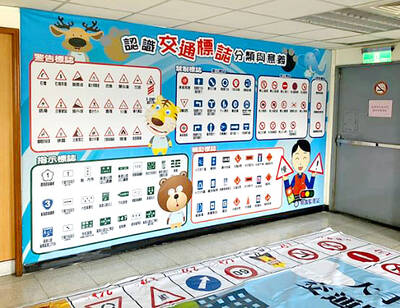
The Ministry of Transportation and Communications yesterday said that it would redesign the written portion of the driver’s license exam to make it more rigorous. “We hope that the exam can assess drivers’ understanding of traffic rules, particularly those who take the driver’s license test for the first time. In the past, drivers only needed to cram a book of test questions to pass the written exam,” Minister of Transportation and Communications Chen Shih-kai (陳世凱) told a news conference at the Taoyuan Motor Vehicle Office. “In the future, they would not be able to pass the test unless they study traffic regulations
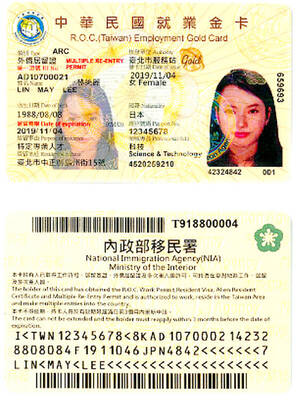
GAINING STEAM: The scheme initially failed to gather much attention, with only 188 cards issued in its first year, but gained popularity amid the COVID-19 pandemic Applications for the Employment Gold Card have increased in the past few years, with the card having been issued to a total of 13,191 people from 101 countries since its introduction in 2018, the National Development Council (NDC) said yesterday. Those who have received the card have included celebrities, such as former NBA star Dwight Howard and Australian-South Korean cheerleader Dahye Lee, the NDC said. The four-in-one Employment Gold Card combines a work permit, resident visa, Alien Resident Certificate (ARC) and re-entry permit. It was first introduced in February 2018 through the Act Governing Recruitment and Employment of Foreign Professionals (外國專業人才延攬及雇用法),

‘A SURVIVAL QUESTION’: US officials have been urging the opposition KMT and TPP not to block defense spending, especially the special defense budget, an official said The US plans to ramp up weapons sales to Taiwan to a level exceeding US President Donald Trump’s first term as part of an effort to deter China as it intensifies military pressure on the nation, two US officials said on condition of anonymity. If US arms sales do accelerate, it could ease worries about the extent of Trump’s commitment to Taiwan. It would also add new friction to the tense US-China relationship. The officials said they expect US approvals for weapons sales to Taiwan over the next four years to surpass those in Trump’s first term, with one of them saying


 RSS
RSS