


After the World Cup opening-game party came the hangover for French fans yesterday, following their team's 1-0 defeat against Senegal.
There was no sign of them at the Seoul World Cup Stadium campsite -- where many of them had been staying -- even though the French team remained at its headquarters at Champions Park Practice Stadium near Seoul.
The French team was also lying low and a scheduled press conference at 11am didn't materialize.
France's next game is on Thursday in Busan against Uruguay, where victory is a must.
Meanwhile, China's coach Bora Milutinovic said yesterday in Seogwipo that he was taking comfort from the France-Senegal match.
"It's the best opening game that I've ever seen. The Senegalese team was excellent. We learned the lesson that any team can have a good result if does its best throughout the game."
Striker Yu Genwei agreed, saying, "The Senegalese squad excelled in individual ability, teamwork and skill."
As a result, he said, he was upbeat about China's chances against Brazil, which it takes on next Thursday.
"In mental power the team doesn't lag behind any team, but in skill it may do."
China's veteran defender Fan Zhiyi then said that reports of a dustup with Hao Haidong were untrue.
"That's not the case. Such a report causes a negative effect on the morale of our team, so I'd like to ask reporters not to publish certain stories."
No sooner said than done.
But there's much more going on in Seoul than just soccer. There are hundreds of events taking place during the World Cup and flag-making is just one of them.
Outside the Seoul World Cup Stadium yesterday, thousands of South Koreans turned up to walk in the five parks surrounding the venue.
Ballroom dancing, a concert, organized exercising and impromptu drumming gave the whole area a festive air.
The ballroom dancing featured diminutive South Korean children and flamboyant teens, who gave performances by the subway entrance to the stadium.
To celebrate what engineer and part-time translator Dr. Lee Young-no called "5,000 years of our history and unique flag culture" was the 2002 Flag Art Festival: Poetry of the Winds.
He pointed out a huge display of colored strips of material hanging from trees and lines and said it was an ancient tradition to hang up strips of cloth on boats before going fishing to bring luck.
The flag festival was divided into two zones. The first area displayed the banners of the World Cup competing nations, along with the works of domestic artists and more than 500 artists from 45 countries.
The other area featured a program for the public to create their own flags by cutting out paper, sticking it on card and then getting it pressed on a white silk square.
"This will bring luck for the World Cup and the country." Lee said.
"This is a once in a lifetime opportunity. It could be another hundred years before the World Cup comes back to Korea."
English-language teachers everywhere
A US English-language teacher in Seoul recommended the South Korean experience in Seoul yesterday.
Andrea, who is from the US but did not want to give her second name, said she had been in the country three months and had been treated well.
She said her employers had set her up with an apartment and even went shopping with her when she first arrived.
"It's been cool. My boss bought me food, set up a bank account and cellphone for me, everything I needed."
But she cautioned that there were horror stories.
"Anything bad can happen. I heard about someone who came over and had no apartment [which was promised] and no paycheck at the end of the month. It's a gamble."
Andrea said she was paid US$1,600 a month, got free housing, airfare voucher and some free medical care.
She also warned that teaching illegally was practically impossible in South Korea and even doing private lessons was likely to lead to a heavy fine and even deportation.
Another teacher said the "English-language police" went to schools and asked children if they had private tuition in order to catch out teachers giving lessons.
Tickets, please
South Korean soccer bosses are understandably worried about empty stadiums for World Cup matches, since they want the tournament to be an unqualified success.
While demand for opening-game tickets has been strong, tickets for some of the less popular games are still unsold.
As a result, hundreds of volunteers have been sent out over the city of Seoul and around the country where matches are being held to drum up support.
Teams of volunteers can be found at subway stations and on the trains, dispensing match schedules.
An official at the temporary FIFA headquarters in Seoul explained that attendances so far had been good and the South Korean football association wanted to maintain this record. Hence the volunteers.
Ticket touts were in evidence at the French game. Tickets for Brazil against Costa Rica were going for 100,000 South Korean won (US$77).

The CIA has a message for Chinese government officials worried about their place in Chinese President Xi Jinping’s (習近平) government: Come work with us. The agency released two Mandarin-language videos on social media on Thursday inviting disgruntled officials to contact the CIA. The recruitment videos posted on YouTube and X racked up more than 5 million views combined in their first day. The outreach comes as CIA Director John Ratcliffe has vowed to boost the agency’s use of intelligence from human sources and its focus on China, which has recently targeted US officials with its own espionage operations. The videos are “aimed at
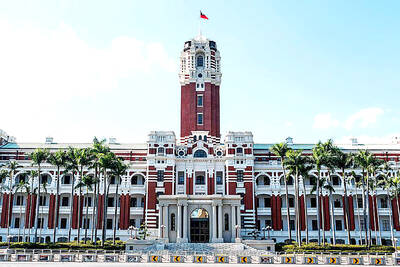
STEADFAST FRIEND: The bills encourage increased Taiwan-US engagement and address China’s distortion of UN Resolution 2758 to isolate Taiwan internationally The Presidential Office yesterday thanked the US House of Representatives for unanimously passing two Taiwan-related bills highlighting its solid support for Taiwan’s democracy and global participation, and for deepening bilateral relations. One of the bills, the Taiwan Assurance Implementation Act, requires the US Department of State to periodically review its guidelines for engagement with Taiwan, and report to the US Congress on the guidelines and plans to lift self-imposed limitations on US-Taiwan engagement. The other bill is the Taiwan International Solidarity Act, which clarifies that UN Resolution 2758 does not address the issue of the representation of Taiwan or its people in
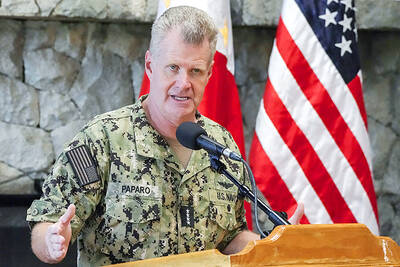
US Indo-Pacific Commander Admiral Samuel Paparo on Friday expressed concern over the rate at which China is diversifying its military exercises, the Financial Times (FT) reported on Saturday. “The rates of change on the depth and breadth of their exercises is the one non-linear effect that I’ve seen in the last year that wakes me up at night or keeps me up at night,” Paparo was quoted by FT as saying while attending the annual Sedona Forum at the McCain Institute in Arizona. Paparo also expressed concern over the speed with which China was expanding its military. While the US
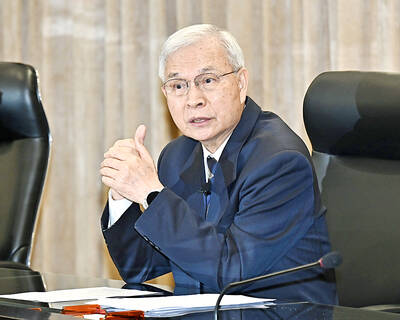
SHIFT: Taiwan’s better-than-expected first-quarter GDP and signs of weakness in the US have driven global capital back to emerging markets, the central bank head said The central bank yesterday blamed market speculation for the steep rise in the local currency, and urged exporters and financial institutions to stay calm and stop panic sell-offs to avoid hurting their own profitability. The nation’s top monetary policymaker said that it would step in, if necessary, to maintain order and stability in the foreign exchange market. The remarks came as the NT dollar yesterday closed up NT$0.919 to NT$30.145 against the US dollar in Taipei trading, after rising as high as NT$29.59 in intraday trading. The local currency has surged 5.85 percent against the greenback over the past two sessions, central


 RSS
RSS