


Runaway National Security Bureau (NSB) official Colonel Liu Kuan-chun (劉冠軍) is not the only person behind the recent leak of classified NSB documents to the press, the NSB said yesterday.
Liu, who has fled abroad, was probably helped by someone, or even a group of people, who may or may not have links to the NSB, DPP lawmaker Chen Chung-hsin (陳忠信) quoted NSB Director Tsai Tsao-ming (蔡朝明) as saying.
"The NSB came to its conclusion on the grounds that Liu did not have enough experience using computer applications," Chen said. "Liu alone would not have been able to produce the computer disk that contained the top-secret documents that he leaked to the press."
Chen made the remarks yesterday to the press after completing an inspection tour of the NSB office on Yangmingshan -- along with dozens of other lawmakers, mainly members of the legisla-ture's Defense Committee.
Another DPP lawmaker, Li Wen-chung (李文忠), who was also on the tour, said that Tsai said the NSB was still trying to find out who might have helped Liu.
"Anyone could have done it," Liu said.
The lawmakers also said the NSB had discovered where Liu was hiding. Liu fled the country in 2000 after it was discovered that he had pocketed money from a secret fund of the NSB.
But the NSB is still refusing to reveal which country Liu is hiding in. Some lawmakers said they hoped the NSB would be willing to say more about Liu's whereabouts next week at the legislature.
A Chinese-language newspaper, quoting anonymous sources, reported yesterday that Liu was hiding in Canada and was being watched by NSB agents. Liu had allegedly chosen to hide in Canada because he has a brother living there.
Lawmakers from the TSU, who have accused the PFP of being behind the leaks to the media, said they had been shown evidence of a link with China.
"Director Tsai confirmed that foreign forces, China in particular, are definitely involved in this incident," TSU lawmaker Lo Chih-ming (羅志明) said after his visit to the NSB yesterday. "First, titles of the files in question are written in simplified characters. Moreover, the terminology used in the disks is believed to be Chinese."
The lawmakers described a scenario of how the classified information could have been copied, leaked and exposed, based on reports from NSB officials.
They said it was Liu who copied the information but that "foreign forces" had helped put it onto a disk. The TSU lawmakers, once again alluding to the alleged involvement of the PFP in the case, said that after the disk was brought back to Taiwan, a "certain party" decoded the disk and sent it to the media.
PFP lawmakers have acknowledged that they had received a copy of the disk -- and used special decoding programs from the Internet to read it.
According to NSB officials, the copy in possession of the PFP is the exactly same as the ones obtained by the media.
Sources confirmed that the documents sent to the China Times and Next magazine were no longer coded, suggesting that PFP operatives were the ones who had decoded the disk and gave the information to the media, the TSU lawmakers said.
"The PFP has to explain how it obtained the disk," they said.
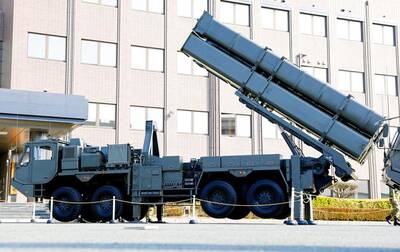
Japan has deployed long-range missiles in a southwestern region near China, the Japanese defense minister said yesterday, at a time when ties with Beijing are at their lowest in recent years. The missiles were installed in Kumamoto in the southern region of Kyushu, as Japan is attempting to shore up its military capacity as China steps up naval activity in the East China Sea. “Standoff defense capabilities enable us to counter the threat of enemy forces attempting to invade our country ... while ensuring the safety of our personnel,” Japanese Minister of Defense Shinjiro Koizumi said. “This is an extremely important initiative for
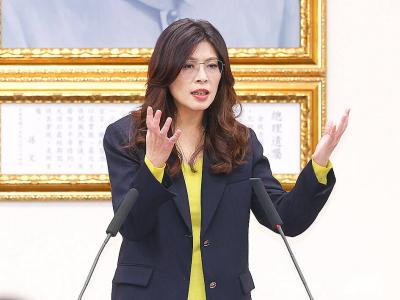
Chinese Nationalist Party (KMT) Chairwoman Cheng Li-wun (鄭麗文) today accepted an invitation from Chinese President Xi Jinping (習近平) to lead a delegation to China next month, saying she hopes to promote the peaceful development of cross-strait relations and bring stability to the Taiwan Strait. “I am grateful and happy to accept this invitation,” Cheng said in a statement from the KMT chairperson’s office. Cheng said she hopes both sides can work together to promote the peaceful development of cross-strait relations, enhance exchange and cooperation, bring stability to the Taiwan Strait and improve people’s livelihoods. At today's news conference, Cheng said any efforts to
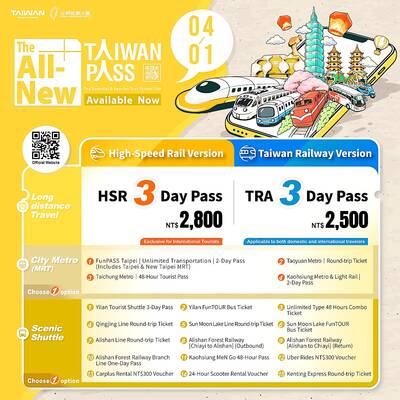
MORE POPULAR: Taiwan Pass sales increased by 59 percent during the first quarter compared with the same period last year, the Tourism Administration said The Tourism Administration yesterday said that it has streamlined the Taiwan Pass, with two versions available for purchase beginning today. The tourism agency has made the pass available to international tourists since 2024, allowing them to access the high-speed rail, Taiwan Railway Corp services, four MRT systems and four Taiwan Tourist Shuttles. Previously, five types of Taiwan Pass were available, but some tourists have said that the offerings were too complicated. The agency said only two types of Taiwan Pass would be available, starting from a three-day pass with the high-speed rail and a three-day pass with Taiwan Railway Corp. The former costs NT$2,800

The nation’s fastest supercomputer, Nano 4 (晶創26), is scheduled to be launched in the third quarter, and would be used to train large language models in finance and national defense sectors, the National Center for High-Performance Computing (NCHC) said. The supercomputer, which would operate at about 86.05 petaflops, is being tested at a new cloud computing center in the Southern Taiwan Science Park in Tainan. The exterior of the server cabinet features chip circuitry patterns overlaid with a map of Taiwan, highlighting the nation’s central position in the semiconductor industry. The center also houses Taiwania 2, Taiwania 3, Forerunner 1 and


 RSS
RSS