


With many families spring cleaning their homes in the lead-up to Chinese New Year, environmental officials are urging residents to take advantage of free recycling services for electronic and consumer appliances.
The program is run by the Environmental Protection Administration (EPA). In March 1998 the agency began to recycle old TV sets, washing machines, refrigerators and heating and air-conditioning units.
By the end of last year, according to EPA officials, more than 1.85 million electronic appliances had been treated at six recycling plants contracted by the EPA's Recyclable Resources Foundation.
EPA officials said that the recycling rate for TV sets, washing machines, refrigerators and heating and air-conditioning units was exceeding 80 percent.
From the old appliances, the recycling program has retrieved 4,900 tonnes of metals, 1,530 tonnes of plastics and 750 tonnes of glass, which can be turned into 91 million beer cans, 28 million PET bottles and 30,000 20-inch TV screens.
"We have to recycle these electronic appliances -- which are mainly composed of metals, plastics and some hazardous components -- because they can not be treated appropriately in landfills or incinerators," said Chang Juu-en (
Chang said that recycling consumer appliances would not only take pressure off landfills, it would also prevent potential environmental pollution caused by the leakage of toxic materials.
When visiting the Perfect Recycling Company last week -- a recycling facility in Kaohsiung County's Tafa Industrial Complex that's equipped with imported Germany technology -- Chang was met by Chen Wen-sheng (
According to Chen, before consumer appliances can be recycled, closed work-rooms must be used to extract refrigerants, which often contain chlorofluorocarbons, from refrigerators or fluorescent powders and graphite from TV monitors.
Recycled materials -- such as copper, iron, aluminum and glass -- are sent to smelters for further treatment and purified refrigerants can be reused. It's estimated that 2kg of refrigerant can be extracted from each refrigerator.
As for collected hazardous materials -- such as fluorescent powders and graphite -- Chen said they would be eventually treated by qualified waste handlers.
Roughly 1.5 tonnes of hazardous fluorescent powders are being stored temporarily at the Perfect Recycling Company.
"Highly efficient facilities here make it possible to recycle 82.5 percent of the materials," Chen said.
He said that in 2000 and last year, the company recycled 40,000 tonnes of electronic appliances, which included 470,000 TV sets, 250,000 washing machines, 300,000 refrigerators and 100,000 heating and air-conditioning units.
This year, Chen said, the company would adopt European technology to treat fluorescent tubes. Since January, the EPA has recycled waste fluorescent tubes, which were sent to landfills in the past.
Mercury and hazardous chemical compounds from the waste tubes would often leak and contaminate the environment.
As Chinese New Year is approaching, the EPA's deputy administrator Chang said residents can easily dispose of unwanted electronic appliances through diverse channels, such as electronic appliance retailers and local garbage collection teams.
The EPA's free service hotline can be reached at 0800-085-717.

The nation’s fastest supercomputer, Nano 4 (晶創26), is scheduled to be launched in the third quarter, and would be used to train large language models in finance and national defense sectors, the National Center for High-Performance Computing (NCHC) said. The supercomputer, which would operate at about 86.05 petaflops, is being tested at a new cloud computing center in the Southern Taiwan Science Park in Tainan. The exterior of the server cabinet features chip circuitry patterns overlaid with a map of Taiwan, highlighting the nation’s central position in the semiconductor industry. The center also houses Taiwania 2, Taiwania 3, Forerunner 1 and
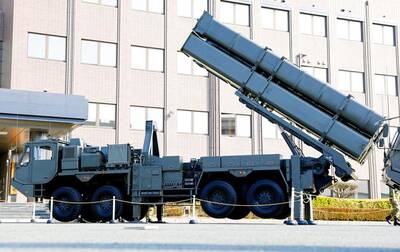
Japan has deployed long-range missiles in a southwestern region near China, the Japanese defense minister said yesterday, at a time when ties with Beijing are at their lowest in recent years. The missiles were installed in Kumamoto in the southern region of Kyushu, as Japan is attempting to shore up its military capacity as China steps up naval activity in the East China Sea. “Standoff defense capabilities enable us to counter the threat of enemy forces attempting to invade our country ... while ensuring the safety of our personnel,” Japanese Minister of Defense Shinjiro Koizumi said. “This is an extremely important initiative for
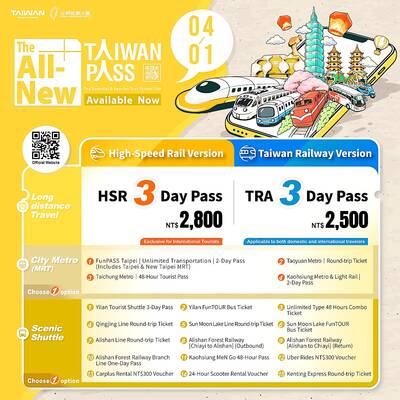
MORE POPULAR: Taiwan Pass sales increased by 59 percent during the first quarter compared with the same period last year, the Tourism Administration said The Tourism Administration yesterday said that it has streamlined the Taiwan Pass, with two versions available for purchase beginning today. The tourism agency has made the pass available to international tourists since 2024, allowing them to access the high-speed rail, Taiwan Railway Corp services, four MRT systems and four Taiwan Tourist Shuttles. Previously, five types of Taiwan Pass were available, but some tourists have said that the offerings were too complicated. The agency said only two types of Taiwan Pass would be available, starting from a three-day pass with the high-speed rail and a three-day pass with Taiwan Railway Corp. The former costs NT$2,800
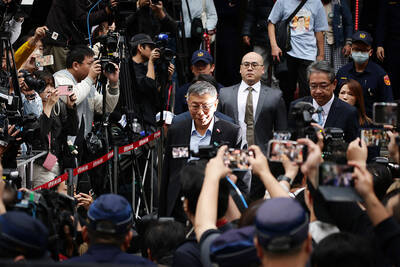
FIRST TRIAL: Ko’s lawyers sought reduced bail and other concessions, as did other defendants, but the bail judge denied their requests, citing the severity of the sentences Former Taipei mayor Ko Wen-je (柯文哲) was yesterday sentenced to 17 years in prison and had his civil rights suspended for six years over corruption, embezzlement and other charges. Taipei prosecutors in December last year asked the Taipei District Court for a combined 28-year, six-month sentence for the four cases against Ko, who founded the Taiwan People’s Party (TPP). The cases were linked to the Core Pacific City (京華城購物中心) redevelopment project and the mismanagement of political donations. Other defendants convicted on separate charges included Chinese Nationalist Party (KMT) Taipei City Councilor Angela Ying (應曉薇), who was handed a 15-year, six-month sentence; Core Pacific


 RSS
RSS