


A chilling videotape of an alleged member of al-Qaeda, cradling a rifle, eyes closed, is among videos and photos of five suspects delivering what authorities call "martyrdom messages from suicide terrorists."
Attorney General John Ashcroft released the videos and photos Thursday, urging the public to help "identify, locate and incapacitate terrorists who are suspected of planning additional attacks against innocent civilians."
One of those depicted was an associate of hijacking ringleader Mohammed Atta. Authorities believe the man intended to take part in the Sept. 11 attacks.
Ashcroft said the videotapes had been recovered recently from the rubble of the home of Mohammad Atef, believed to have been Osama bin Laden's military chief. Officials say Atef was killed by a US airstrike in November.
The sound was left out of the released versions to guard against the possibility that the messages contained signals for other terrorists, officials said.
In one video a man buries his head in his arms for moment. The next image is of the same man, eyes closed, hugging a rifle. He leans his face close to the barrel, his lips appearing to touch it. He then looks up and smiles.
The strap of the rifle is inscribed with Arabic writing that the man seems to be showing off. Officials did not transcribe the message.
The videos were shown without sound. Ashcroft said preliminary translations of statements from the men indicated they may have been trained and prepared for attacks.
"The videotapes depict young men delivering what appear to be martyrdom messages from suicide terrorists," said Ashcroft.
Authorities don't know where the men are; there is no evidence they ever entered the US.
"These men could be anywhere in the world," Ashcroft said, urging viewers to call the FBI or an American consulate if they think they've seen any of the five men.
He said the government had tentatively identified four of the five men depicted in the video as: Abd Al-Rahim, Muhammad Sa'id Ali Hasan, Khalid Ibn Muhammad Al-Juhani and Ramzi Binalshibh. The fifth man's identify is not known.
Ashcroft said little was known of the five except Binalshibh, a Yemeni whom officials allege was an associate of the Sept. 11 suicide hijacker Atta.
In the indictment handed down in December against Zacarias Moussaoui, Binalshibh was named along with Atta and the 18 other hijackers as an unindicted conspirator.
At a news conference, Ashcroft showed 30-second videos of Hasan, Al-Rahim and Al-Juhani. There were technical problems with the videos of the other two men; for them, the government released only still photos taken from the tapes. Photos shot from the tapes were also released for the other three.
Ashcroft said investigators were still translating the tapes; a decision about releasing the sound or a translation would be made after weighing security concerns, he said, adding that the department may decide not to release the sound.
"The portions we released today we felt were safe for release and we didn't believe they contained any surreptitious messages or coded signals that would be designed to alert parts of the terrorist network," Ashcroft said.
In the tapes, Hasan speaks, eyes cast down; he appears to be reading but only his face is shown. He wears a black and white scarf around his head.
Al-Rahim is shown seated, talking and gesturing rapidly, at one point holding fingers up as if listing off various points.
Al-Juhani is shown seated in front of a colorful curtain taking a red and white scarf off his head and burying his head in his arms.
Ashcroft said the release of the video footage and photos was part of an effort to help "freedom-loving people become the best line of self-defense."
As for the attack that he said was called for in the video, Ashcroft said: "Whether or not the attack would be imminent or not is something we can't determine."
FBI Director Robert Mueller said the videos came "from a trove of valuable information" discovered within Afghanistan. He said the tapes are still being analyzed to determine when they were made. He said there was no evidence any of the men had entered the US, although at least one had tried.
"Every piece of information is potentially valuable," he said. "The principle is simple: An informed and enlightened public works."
Mueller said that as the US military action goes forward, "it continues in ways that I think supports what we and the CIA are engaged in, which is identifying terrorists and preventing future attacks."

The CIA has a message for Chinese government officials worried about their place in Chinese President Xi Jinping’s (習近平) government: Come work with us. The agency released two Mandarin-language videos on social media on Thursday inviting disgruntled officials to contact the CIA. The recruitment videos posted on YouTube and X racked up more than 5 million views combined in their first day. The outreach comes as CIA Director John Ratcliffe has vowed to boost the agency’s use of intelligence from human sources and its focus on China, which has recently targeted US officials with its own espionage operations. The videos are “aimed at

STEADFAST FRIEND: The bills encourage increased Taiwan-US engagement and address China’s distortion of UN Resolution 2758 to isolate Taiwan internationally The Presidential Office yesterday thanked the US House of Representatives for unanimously passing two Taiwan-related bills highlighting its solid support for Taiwan’s democracy and global participation, and for deepening bilateral relations. One of the bills, the Taiwan Assurance Implementation Act, requires the US Department of State to periodically review its guidelines for engagement with Taiwan, and report to the US Congress on the guidelines and plans to lift self-imposed limitations on US-Taiwan engagement. The other bill is the Taiwan International Solidarity Act, which clarifies that UN Resolution 2758 does not address the issue of the representation of Taiwan or its people in
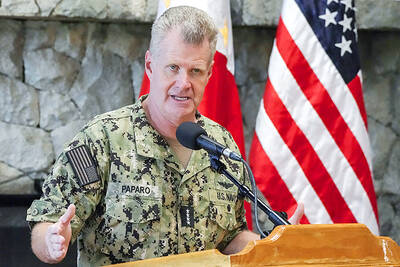
US Indo-Pacific Commander Admiral Samuel Paparo on Friday expressed concern over the rate at which China is diversifying its military exercises, the Financial Times (FT) reported on Saturday. “The rates of change on the depth and breadth of their exercises is the one non-linear effect that I’ve seen in the last year that wakes me up at night or keeps me up at night,” Paparo was quoted by FT as saying while attending the annual Sedona Forum at the McCain Institute in Arizona. Paparo also expressed concern over the speed with which China was expanding its military. While the US
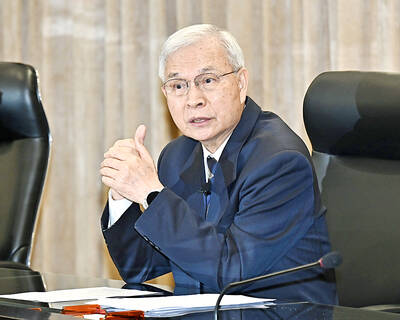
SHIFT: Taiwan’s better-than-expected first-quarter GDP and signs of weakness in the US have driven global capital back to emerging markets, the central bank head said The central bank yesterday blamed market speculation for the steep rise in the local currency, and urged exporters and financial institutions to stay calm and stop panic sell-offs to avoid hurting their own profitability. The nation’s top monetary policymaker said that it would step in, if necessary, to maintain order and stability in the foreign exchange market. The remarks came as the NT dollar yesterday closed up NT$0.919 to NT$30.145 against the US dollar in Taipei trading, after rising as high as NT$29.59 in intraday trading. The local currency has surged 5.85 percent against the greenback over the past two sessions, central


 RSS
RSS