


The DPP yesterday defended using images of Adolf Hitler in its new TV advertisement, saying those who oppose it "lack an understanding of the commercial's context." The party also ruled out canceling the advertising campaign.
"It's regrettable that some Jewish organizations and the Israel Economic and Cultural Office in Taipei distorted and misunderstood the film's intention," DPP spokesperson Phoenix Cheng (
The DPP, he said, absolutely empathizes with the past suffering of Jewish people because "Tai-wanese suffered from great oppression as well."
Cheng also accused the commercial's detractors of not actually having seen the ad for themselves.
"Even if they had done so, they cannot understand the context in which we put Hitler due to the language barrier," he said.
"There is nothing wrong with the film but it contains messages that foreigners cannot under-stand," Cheng said.
"The film was made for local Mandarin-speaking viewers who would never object to it as they have sufficient understanding of what we are trying to promote," he said.
But while the DPP was busy explaining itself, negative reaction to the commercial was rapidly spreading.
In New York, the Anti-Defamation League called the commercial ``outrageous and shocking'' and urged the DPP to withdraw it.
The private group, devoted to fighting prejudice and bigotry, also accused the DPP of a ``woeful lapse in judgment.''
The Los Angeles-based Simon Wiesenthal Center, a Jewish human rights group, said it lodged a protest with Taiwan's representative to Washington.
"In the era of globalization, this historic and cultural insensitivity is no longer acceptable and damages the image of Taiwan," Rabbi Abraham Cooper, associate dean of the center, said in a statement.
The party yesterday reversed its earlier explanation for using Hitler's image.
Originally, the DPP's information and culture department, along with the youth department, said that figures in the film were chosen because of "their daringness to speak up without fear of confrontation," an ideal which the party said it urged the nation's youth to follow.
Other political figures who appear in the commercial include former president Lee Teng-hui (
However, no explanation of what the images should mean is given in the commercial.
Tien Hsin (
"The commercial is designed to tell the youth that it is their time to speak up, rather than let outdated political figures speak for them," he said.
Cheng said yesterday that the commercial "intends to give viewers an idea that the false political stance of Hitler and Castro and that of Lee and Kennedy, are of two different extremes."
Juan Chao-hsiung (
The party also argued yesterday that if members of the Jewish community had communicated with them before reacting, the "misunderstanding would never have occurred."
Cheng said that the German Cultural Center in Taipei, to which the party had spoken, fully understood the DPP's argument and did not subsequently file a complaint.
However Sabine Hagemann-Unlusoy, the center's director, said she was never offered an explanation such as the one the DPP gave yesterday.
She added that some Germans have watched the commercial and failed to find the contrast that the party said it intended to present.
"Besides, Hitler's negative characteristics can never be clearly explained in such a short commercial," she said.
E.F. Einhorn, a Polish rabbi residing in Taipei, said the DPP was merely trying to assign explanations to get out of trouble, which is a "normal defensive reaction."
Einhorn said after watching such a film, young people would only group Hitler with "sound" political figures like Kennedy and Lee, while ignoring any positive messages the party wanted to convey.

The nation’s fastest supercomputer, Nano 4 (晶創26), is scheduled to be launched in the third quarter, and would be used to train large language models in finance and national defense sectors, the National Center for High-Performance Computing (NCHC) said. The supercomputer, which would operate at about 86.05 petaflops, is being tested at a new cloud computing center in the Southern Taiwan Science Park in Tainan. The exterior of the server cabinet features chip circuitry patterns overlaid with a map of Taiwan, highlighting the nation’s central position in the semiconductor industry. The center also houses Taiwania 2, Taiwania 3, Forerunner 1 and
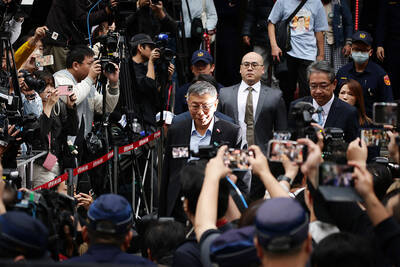
FIRST TRIAL: Ko’s lawyers sought reduced bail and other concessions, as did other defendants, but the bail judge denied their requests, citing the severity of the sentences Former Taipei mayor Ko Wen-je (柯文哲) was yesterday sentenced to 17 years in prison and had his civil rights suspended for six years over corruption, embezzlement and other charges. Taipei prosecutors in December last year asked the Taipei District Court for a combined 28-year, six-month sentence for the four cases against Ko, who founded the Taiwan People’s Party (TPP). The cases were linked to the Core Pacific City (京華城購物中心) redevelopment project and the mismanagement of political donations. Other defendants convicted on separate charges included Chinese Nationalist Party (KMT) Taipei City Councilor Angela Ying (應曉薇), who was handed a 15-year, six-month sentence; Core Pacific
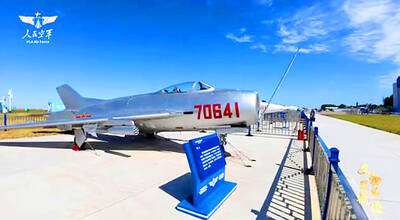
J-6 REMODEL: The converted drones are part of Beijing’s expanding mix of airpower weapons, including bombers with stand-off missiles and UAV swarms, the report said China has stationed obsolete supersonic fighters converted to attack drones at six air bases close to the Taiwan Strait, a report published this month by the Arlington, Virginia-based Mitchell Institute for Aerospace Studies said. Satellite imagery of the airfields from the institute’s “China Airpower Tracker” shows what appear to be lines of stubby, swept-winged aircraft matching the shape of J-6 fighters that first flew with the Chinese People’s Liberation Army (PLA) Air Force in the 1960s. Since their conversion to drones, the aircraft have been identified at five bases in China’s Fujian Province and one in Guangdong Province, the report said. J.
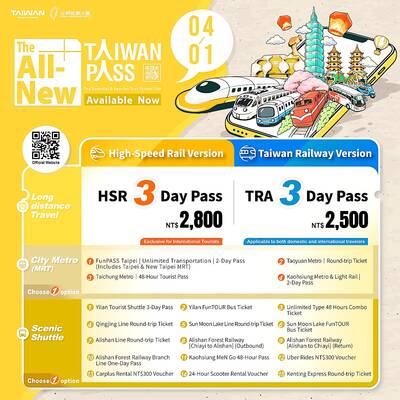
MORE POPULAR: Taiwan Pass sales increased by 59 percent during the first quarter compared with the same period last year, the Tourism Administration said The Tourism Administration yesterday said that it has streamlined the Taiwan Pass, with two versions available for purchase beginning today. The tourism agency has made the pass available to international tourists since 2024, allowing them to access the high-speed rail, Taiwan Railway Corp services, four MRT systems and four Taiwan Tourist Shuttles. Previously, five types of Taiwan Pass were available, but some tourists have said that the offerings were too complicated. The agency said only two types of Taiwan Pass would be available, starting from a three-day pass with the high-speed rail and a three-day pass with Taiwan Railway Corp. The former costs NT$2,800


 RSS
RSS