


Down under last night, Sydney let it all hang out at the closing ceremony celebration for the 2000 Olympic Games.
Millions partied from Homebush Bay, the location of Olympic Park, to the Sydney Opera House, in celebration of the conclusion of the 2000 Olympic Games.
For the past few days this city, which has put its heart and soul into preparing for the Games, has been holding its breath in anticipation of the praise that would come last night for a job well done.
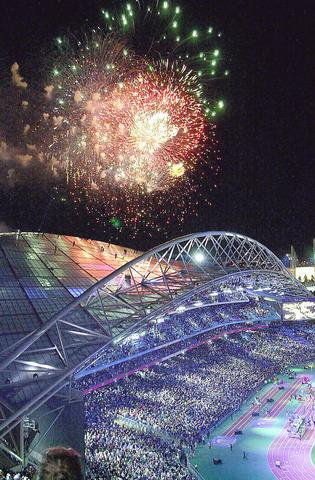
PHOTO: LIN CHENG-KUNG, TAIPEI TIMES
A comment from Australian actor and comedian Paul Hogan -- better known for his role in the movie Crocodile Dundee -- as he entered the Olympic Stadium before the ceremony was a reflection of the tension this city was feeling.
"If that Juan Samaranch guy doesn't say it was the best, he's a dunce," Hogan said.
Apparently he's not, or maybe he heard Hogan's comment.
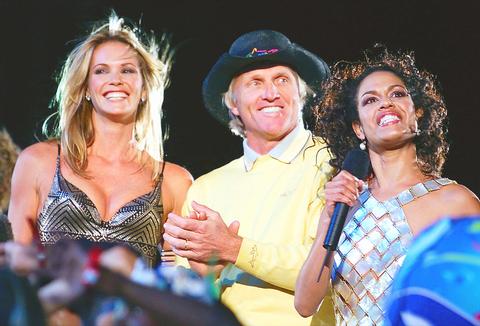
PHOTO: REUTERS
In his last formal address at the Olympics, the soon-to-retire president of the International Olympic Committee, Juan Antonio Samar-anch had nothing but praise for Australia.
"Seven years ago I said, `and the winner is ... Sydney.' What can I say now?" he asked rhetorically. "Maybe with my Spanish accent, I can say `Aussie! Aussie! Aussie!,' to which the crowd responded `Oi! Oi! Oi!'"
And then he said the words this town has been longing to hear.
These were "the best Olympic Games ever."
Most of the ceremony was a wild ruckus of energy, dancing, and singing. That is, aside from a short, more somber moment, when the Olympic Flag was handed over to the mayor of Athens, the host city of the 2004 Olympics. Afterwards Australia's budding young star Nikki Webster, who floated through the air like an angel during the opening ceremony, sang her heart out as the Olympic flame was doused.
True to form, the Australians, who are serious about what they do, but don't take themselves too seriously, kicked off the whole ceremony extravaganza with a comic skit last night.
Before it had all begun, a lone man on a ride-on lawnmower wreaked havoc on a marching band, blazing around the track like a rally car driver. He screamed through back halls below the stadium, nearly running over a few people and clearing out the photographers' stand next to the track, but was eventually surrounded. He was left with nothing but his handlebars and a glum look on his face.
But just as much as the closing ceremony was a celebration of the Olympic spirit, it was also a celebration of Australia. It was a chance for this island to strut its stuff.
The show included performances from bands like INXS, Men at Work -- who sang Australia's theme song "Down Under" -- and pop star Vanessa Amorosi. All of Australia's pop-icons were rolled out of the closet, with appearances made by Paul Hogan, golfer Greg Norman and supermodel Elle McPherson.
Midnight Oil, a hard-rocking band with a strong social conscience and the pride of many Australians, didn't waste their performance opportunity. They made a bold statement about the need for reconciliation with the island's oldest inhabitants, the Aborigines.
All members of the band were dressed in black sweat suits with one word printed in white on them: "sorry."
They sang their late 80s hit "Beds are Burning." Although the song was popular over 10 years ago, lyrics like "the time has come to say fair's fair to pay the rent, to pay our share," still carries meaning today for Australians. The Aboriginal band Yothu Yindi followed Midnight Oil.
These two performances were very much an echo of one message Australia has been trying to send to its own people during the Olympics about the relations between whites and indigenous people here. Much like the decision to use Aboriginal athlete Cathy Freeman to light the Olympic torch, they were symbols of the need for reconciliation.
At the end of the ceremony Slim Dusty sang Australia's unofficial national anthem "Waltzing Matilda" as a globe above the center of the stage raised the words "Bye from Oz" high for the crowd to see.
But that wasn't the end of the festivities. It was time for "the river of fire, a 13.5km display which stretched from Homebush Bay to Sydney Harbor Bridge, which sits right next to another of the most famous landmarks in the world, the Sydney Opera House.
It was said that one million spectators had poured into Sydney yesterday to catch a Harbor-side view of what was believed to be the largest fireworks display in the world.
The display required 20 shipping cartons full of pyrotechnics and featured 8,000 different varieties. But it was worth it. The display lit up Sydney like a Christmas tree.
Despite past criticism of the Olympics -- over-commercialization, charges of corruption in the IOC and doping by athletes -- this celebration, and the 16 days that preceded them, symbolized the true spirit of the Games.
Maybe with more effort in the future, the words and ideals of Olympic founder Pierre de Coubertin, will once again ring true.
"We must remember that the Games are not the property of any country or any race, and they cannot be monopolized by any group whatsoever," he told the Olympic Congress in Prague in 1925. "They belong to the world; all nations must be admitted without discussion and all sports must be treated on the basis of equality, without any regard to the whims of public opinion."
For Taiwan's sake, let's hope it does.

‘NO SECURITY RISK’: The Railway Bureau reassured the public that the technicians’ activities were limited to technical guidance and did not involve sensitive systems The Railway Bureau yesterday said it had invited eight Chinese technicians to assist with an airport MRT construction project. The bureau issued the confirmation after an Internet user said Chinese nationals had entered the construction zone of Taiwan Taoyuan International Airport’s Terminal 3 project. They asked why “individuals from an enemy state” were allowed access to such a major national infrastructure project, which raised serious concerns over Taiwan’s industrial safety, sensitive systems and information security. The bureau’s Northern Region Engineering Branch Office said subcontractor Taiwan Handle Industrial Co (台灣手把工業) of the Taoyuan airport MRT’s “Contract No. CU05 Project A14 Station Civil, MEP &

The National Chungshan Institute of Science and Technology yesterday showcased its locally developed variants of the Vision 60 robotic patrol dog, which it plans to deploy on the nation’s outlying territories in the South China Sea. The variants were produced under the Joint Lab project — created by the institute and domestic companies — and assembled with domestically produced motors, lenses and artificial intelligence (AI) systems alongside licensed tech from the US, Missile and Rocket Systems Research Division deputy director Jen Kuo-kang (任國光) told the media event at a military base in Taipei’s Dazhi (大直) area. Taiwan has built up its strengths

TIT-FOR-TAT: The US allegedly revoked the visa of a Chinese national working at Xinhua News Agency in the US in response to Beijing’s expulsion of Vivian Wang The Presidential Office yesterday condemned China for expelling a New York Times correspondent from Beijing following the newspaper’s interview with President William Lai (賴清德), saying the move highlighted Beijing’s suppression of press freedom and its threat to international news media. Taiwan has noted a series of recent incidents in which Beijing used similar tactics to “threaten and pressure international media outlets and journalists,” Presidential Office spokeswoman Karen Kuo (郭雅慧) said in a statement. “This concerns not only press freedom and freedom of expression, but also the safety of journalists, and Taiwan and relevant partners are paying close attention to the situation,” she

NOT IMMEDIATE: Taiwan has a chance to appeal the proposed 10 percent tariff before it starts, while other countries face a 12.5 percent tariff from the trade office Taiwan is among 60 economies determined by the US to have failed to impose or enforce a ban on the importation of goods produced with forced labor, according to a notice released on Tuesday by the Office of the US Trade Representative (USTR), which proposed imposing an additional 10 percent or more tariff on them. The USTR in a statement said that following an investigation, it had determined under Section 301 of the Trade Act of 1974 that the failure of the 60 economies to impose and effectively enforce a prohibition on the importation of goods produced with forced labor is


 RSS
RSS