


Three DPP legislators called yesterday for an investigation into the unlawful trip to China of a retired intelligence official, saying he might threaten Taiwan's national security.
Pan Hsi-hsien (潘希賢), the just-retired Director of Personnel and General Affairs at the National Security Bureau, visited China on June 4, only seventy-two hours after retiring. Though it is unknown whether he is still in China, information from Taiwan businessmen in China confirms that the former senior official has been seen in Guangdong.
According to Taiwan regulations, any individual who has held an official post involving national security -- including defense, intelligence, and security agencies -- is required to get government approval before traveling to China up to three years after retirement.
Pan, whose China trip was disclosed only last Wednesday by a KMT legislator, left Taiwan before the NSB had informed immigration authorities of his retirement. As a result, the immigration authorities were unable to prevent the trip.
DPP legislators Chang Ching-fang (張清芳), Wang Hsing-nan (王幸男), and Wang Li-ping (王麗萍), visited the Control Yuan yesterday, requesting the official watchdog carry out an investigation into Pan's breach of security regulations.
The legislators said they were worried that Pan, with his extensive knowledge of the nation's secret files, might leak information about Taiwan's intelligence operations.
"He knows exactly who's who among the country's intelligence agents, and where, both in Taiwan and China, they're deployed. If by any chance he leaks such information to China, the consequences will be disastrous," Wang said, underlining the seriousness of Pan's unlawful actions to Control Yuan member Frank Liao (廖健男).
Regulations concerning visits to China by Taiwan nationals were amended as recently as March this year to lay down rules applying to those whose work involves national security.
The responsible authority, the Ministry of the Interior, should have informed other government agencies of the changes following the passing of the amendments. NSB officials, however, said they have still not received notification from the ministry.
The legislators said former Minister of the Interior Huang Chu-wen (黃主文) was to blame for this, and requested that the Control Yuan investigate his "negligence."
They said that it was a matter of concern that Pan had apparently entered China with ease as the Chinese authorities often seek to prevent the entry of retired Taiwan government officials, suspecting that they might be on intelligence-gathering missions.
"Given his senior position in the NSB, we are even more concerned about why he is there," said Chang.
Chang also said that sources had told him that Pan had been upset about being forced to retire by his supervisor, who had discovered his involvement in an extra-marital affair.
"We're worried that he might attempt to harm the country as a consequence," Chang said.

The Tourism Administration yesterday announced that it would reward repeat international visitors with incentives of up to NT$8,000 to boost inbound tourism. The incentives are available to all international tourists, it said, adding that repeat visitors would be rewarded with NT$5,000 and would receive an additional NT$3,000 if they bring travel companions. The nation received 2,990,657 inbound visitors during the first quarter, marking a 3.8 percent increase from the same period last year, agency data showed. Japanese nationals are among groups visiting Taiwan the most. About 1.48 million Japanese tourists arrived last year, a year-on-year increase of more than 12

66 FIGHTER JETS: The aircraft is likely undergoing preparations for its transfer to Taiwan — a significant step forward in the nation’s modernization program, a lawmaker said The first of Taiwan’s order of F-16V Block 70 aircraft has been sighted in Texas ahead of delivery, Democratic Progressive Party (DPP) Legislator Wang Ting-yu (王定宇) said. Taiwan’s first F-16V Block 70 two-seat aircraft, tail number 6831, was seen flying from Lockheed Martin’s production facility in Greenville, South Carolina, to Naval Air Station Joint Reserve Base Fort Worth in Texas, Wang wrote on Facebook yesterday. The plane is likely undergoing preparations for its transfer to Taiwan, marking a significant step forward in the Republic of China Air Force’s modernization program, Wang said, citing military analysts. The F-16V Block 70 is a new-build version
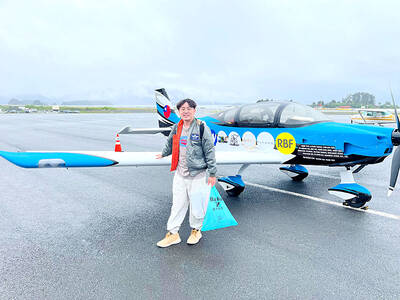
Taiwanese aviator Roger Lin (林睿哲) returned to Taiwan on Saturday after completing a nine-day round-the-world journey in a single-engine aircraft, becoming the first Taiwanese pilot to achieve the feat. Lin departed on June 5 from Los Angeles, California, and continued through Alaska, Japan, Taiwan, the Philippines, Indonesia, Malaysia, Thailand, Nepal, Jordan, Norway, Iceland and Canada before landing at the Taipei International Airport (Songshan) via Los Angeles and Japan. Lin shared numerous photos and videos of his journey on a Facebook page titled “Pilot Roger’s Around the World Flight,” including a video showing his aircraft flying over the Danjiang Bridge and
NOT JUST NUMBERS: What matters to intelligence work is crucial, reliable information, so even a few credible leads can be highly valuable to national security, a legislator said The National Security Bureau (NSB) yesterday said it has finished the establishment of an information-reporting channel for Chinese nationals, the aim of which is to broaden intelligence gathering on China’s political, military, economic and social developments. Chinese nationals can submit information on the Web page, https://report.nsb.gov.tw, the NSB said in a statement. The move aims to expand the bureau’s diverse intelligence sources and is pursuant to the National Intelligence Services Act (國家情報工作法), it said, adding that it referenced practices adopted by intelligence agencies in the US, the UK and Israel. An increasing number of people are approaching Taiwanese agencies to provide information, as


 RSS
RSS