

A leading figure in British contemporary art, Michael Craig-Martin makes his Taiwanese debut with this major solo exhibition at the Kaohsiung Museum of Fine Arts (高雄市立美術館).
For more than 60 years, Craig-Martin has subverted and reinvented the typical conventions of object, color and line.
He has challenged the spectator to reconsider our world of everyday components, provoking deep philosophical questions about human perception, consumerism, and material awareness.
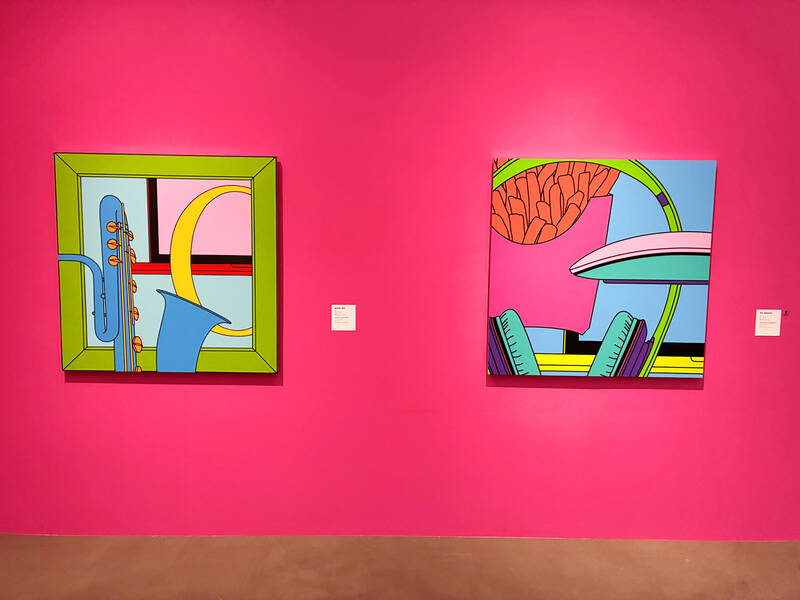
Photo: Shane O’Reilly
With over 70 artworks, closely co-curated with the museum’s in-house team, Michael Craig-Martin: The Language of the Everyday presents a comprehensive retrospective of the artist’s work with a specific emphasis on his defining later-stage career.
THE ARTIST
Born in Dublin, Ireland, in 1941, Michael Craig-Martin studied art in Paris and Yale before moving to London in 1969, where he lives to this day.
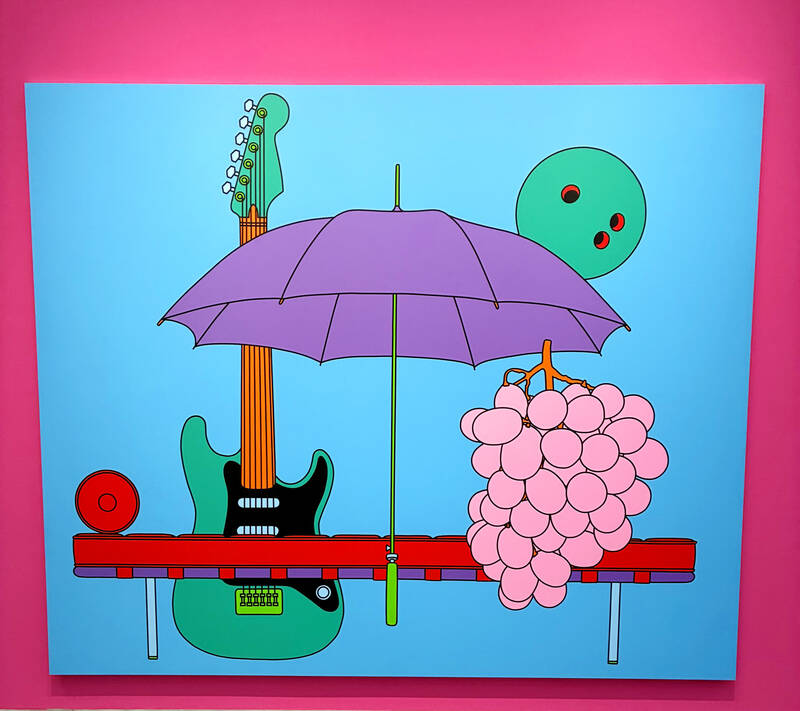
Photo: Shane O’Reilly
Initial iterations of his work focused on minimalism and box-like structures that played with dimensions of geometric design.
This culminated in his inclusion in two seminal 1972 exhibitions at the Hayward and Tate galleries, positioning him at the forefront of Britain’s emerging new wave of conceptual artists.
His seminal conceptual piece An Oak Tree followed, premiering in 1974.
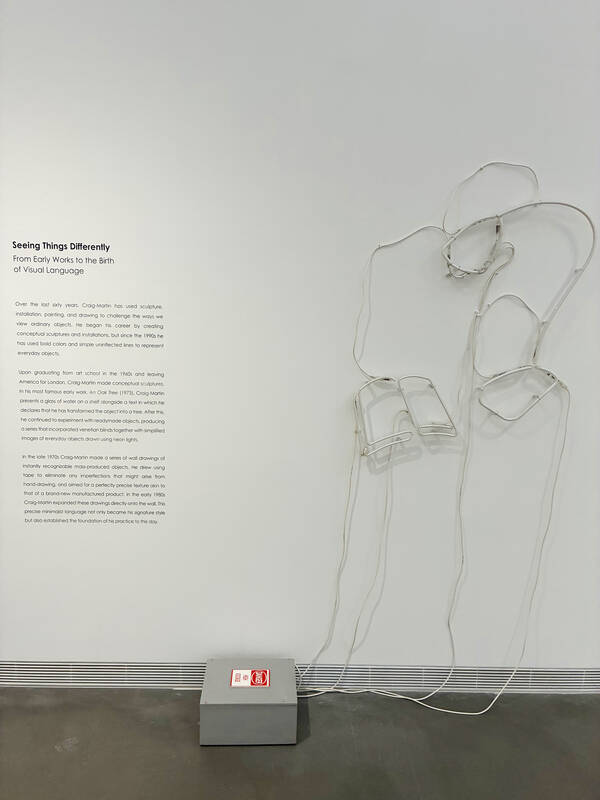
Photo: Shane O’Reilly
Perhaps influenced by Patrick Caulfield’s bold, heavily outlined symmetrical conceptualism, Craig-Martin became enamored with exposing everyday items as nakedly as possible.
He began creating large-format sketches of these rather prosaic household items and outlining them in fine black crepe tape, which retained the flat, minimalist focus he’d envisioned.
By the mid-to-late 1990s, however, his discovery of digital vector graphics would lead his work in a new direction, influencing the likes of Julian Opie, Damien Hirst and Gary Hume.
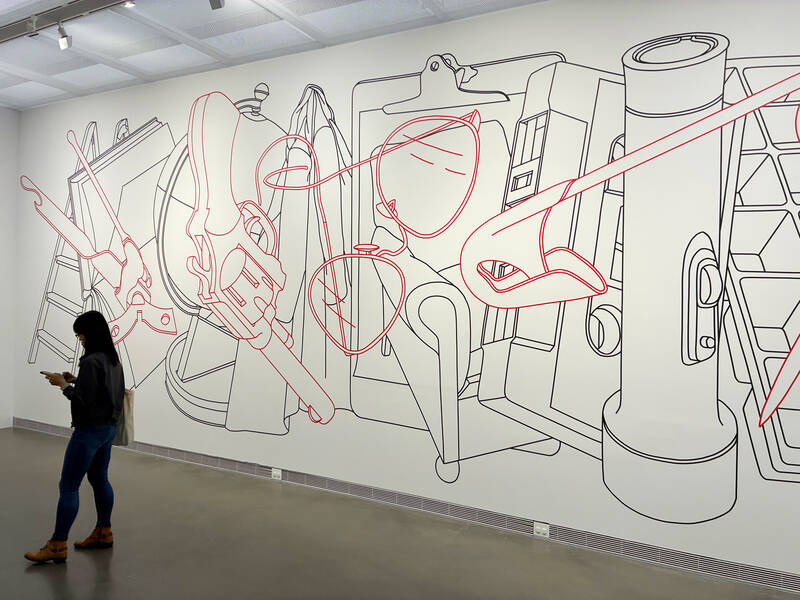
Photo: Shane O’Reilly
This new process relied on an entirely black surface, onto which he projected his vector drawing. Tape was applied exactly along the blueprint lines, then four-inch paint rollers were used to apply the color.
He used a limited range of acrylic paint with only six to ten colors per artwork, flushing his works with plenty of turquoise, aqua, pinks, purples, cadmium yellow, saturated reds, and bright greens.
Once dry, removal of the tape unveiled his brightly rendered objects.
THE EXHIBITION
Technically designated across three main gallery spaces, the interior layout is partitioned into several smaller, distinct thematic sections, creating a larger, more labyrinthine environment which was very welcome.
Vertical and horizontal works nested comfortably next to one another, beginning with the conceptually brilliant An Oak Tree, asking us to see beyond a simple glass of water.
The centrally placed Formica Box (1968) follows, and, thankfully, only two pieces of his Venetian Blinds series, which retain a place and purpose, but hardly inspire.
The evolutionary flow continued from sparsely colored blueprints to the boldest fully realized frames, with 1981’s stark trichromatic Modern Dance sitting somewhere in between; 45 years old, retaining all its mesmeric impact.
There was a noticeable lack of his 1990s works, but as most were site-specific temporary constructs, it is an unavoidable concession rather than an oversight.
Presence without physicality, the artist once demanded, and so it goes as the exhibition moved into the 21st century.
Electric neons came alive across giant crowded canvases of flat overlaid articles from 2002’s Inhale/Exhale to the monstrous splendor of 2010’s Untitled (painting) and 2016’s Space II.
A series of square-framed paintings focused on singular consumer goods from cassettes, lightbulbs and ashtrays to the present-day modernity of iPhones, laptops, and designer trainers.
It was a shame Craig-Martin’s lurid reworking of Seurat’s Bathers at Asnieres appeared as a limited-edition print Seurat (green), rather than either of its original large-scale 2004 paintings, both privately owned.
But the digital installation Cosmos (2024) was magnificent. Developed jointly with a video animator and composer, it was a dazzling kaleidoscopic dance of more than 400 of the artist’s drawings, accompanied by a stirring soundscape.
The exhibition concluded outside with four of Craig-Martin’s luminescent, powder-coated steel sculptures, including the iconic Headphone (blue), 2022, and 2021’s High Hell (red).
Taiwan often struggles to attract major solo exhibitions by international stars, but this garish, glaring show was a successful romp through a career defined by ingenuity, adaptation, and relentless creativity.

In 1986 I entered the US Peace Corps in Kenya. As a US government volunteer we had a special US government ID for use in Kenya. Because of our position, we received extensive training in how to behave. This had special urgency for my group of volunteers: we had originally been slated for Nepal, but a US Peace Corps volunteer in another country had criticized that nation’s authoritarian president in public, and all of the Peace Corps volunteers were kicked out. As a result, the next group for that nation got sent to Nepal, and we got bumped to Kenya. The
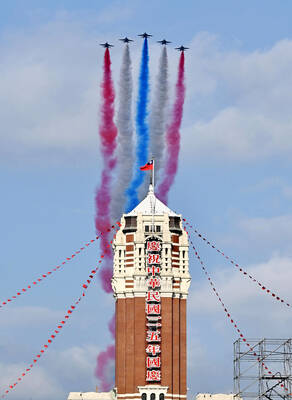
On Oct. 2, after years of delays, Taiwan’s air force took delivery of the first two F-16V Block 70 fighter jets at Chihhang Air Base in Taitung County. In a sign of how eagerly anticipated this arrival was, speculation and rumors had been flying as to why they had been sitting for weeks in Hawaii en route to Taiwan. These are part of a total of 66 F-16V Block 70s on order. There are hopes the rest will arrive by the end of next year, but no one will be surprised if that extends into 2029 or even later. Worse,

In You Can See Everything, convicted fraudster Elizabeth Holmes invites film-makers Nathan Fielder and Lance Oppenheim into her home in a supposed act of “radical transparency.” Holmes is filmed, along with her partner, Billy Evans, and their two young children, in the weeks before starting a prison sentence for defrauding Theranos investors. “The best way for people to see who she is,” Evans says, “is to give as much access as possible into our daily lives.” It may also be the best way to market “Theranos 2.0,” which the couple are working on during filming. But the documentary questions whether
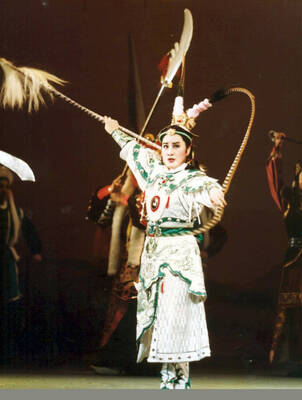
Oct. 26 to Nov. 1 Born backstage after one of her mother’s Taiwanese opera performances, Yang Li-hua (楊麗花) often says that she was already learning the craft in the womb. From a young age, she hoped to follow in her mother’s footsteps as a performer of male lead roles. But Yang came of age just a bit too late. She landed her first lead role in 1960 at the age of 16, but by then, public interest in live opera performances was declining. After a successful eight-month stint in the Philippines, she found herself without work in 1964. With fewer stage opportunities,


 RSS