

Located a 40-minute drive south of Changhua City, the Cheng Mei Cultural Park (成美文化園) lies beyond a roadside verge of tall, thick trees.
A right turn follows a long allee flanked by manicured foliage, from the thick, burly heads of large bonsai trees to the crimped bark of Japanese black pine and lush Chinese juniper.
With many stony, tree-lined scenic pathways and towering coniferous and deciduous trees, visitors will find themselves meandering happily through a sprawling, artistically sculpted masterpiece.
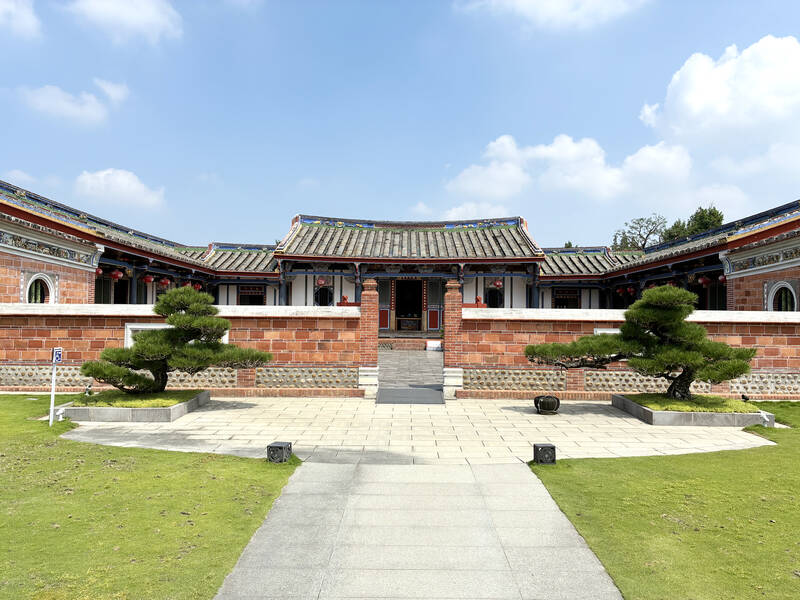
Photo: Shane O’Reilly
This undulating 10-hectare private garden estate is all thanks to the prominent Wei Family (魏家), local food and drink magnates who founded this estate as a passion project of sorts.
After a massive magnitude 7.3 earthquake in September 1999 destroyed their 1885 ancestral home, they began a seven-year restoration plan in 2005, which was expanded to include these incredibly ornate gardens in honor of their parents and ancestors.
And as such, this handsomely renovated ancestral home is the architectural gem at the heart of everything here.
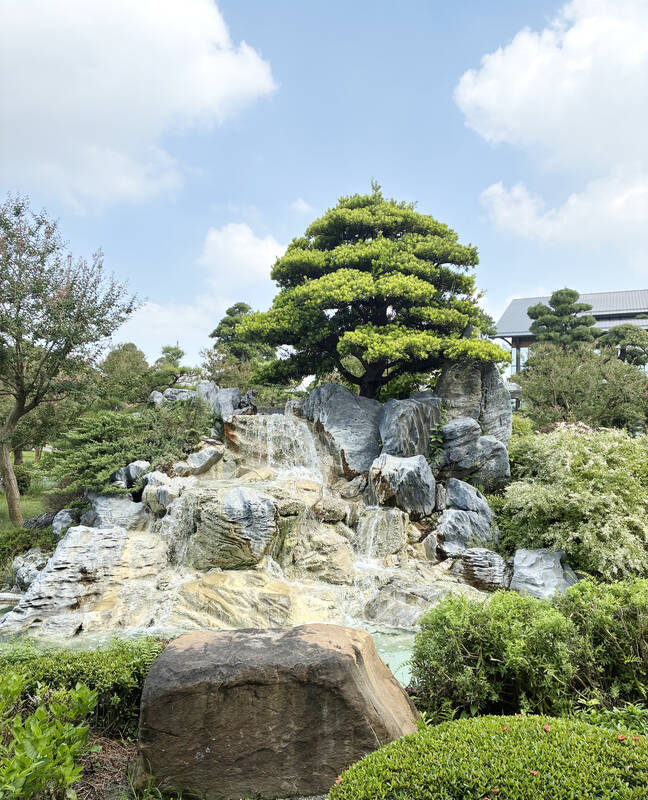
Photo: Shane O’Reilly
The Dream-Sowing Seed (播夢種子 / 播夢種籽), a tall, bulbous wood and steel installation, is located approximately 50m in from the entrance and serves as an in-and-out gateway from one garden trail to another.
A labyrinth of landmarks includes a prominent lake, ornamental pools replete with fat, mottled koi, mini waterfalls and a colossal 500-year-old Burmese Rosewood.
The meticulously pruned He-De Garden (和園) is home to a grove of impressive pine and cypress species as well as a pond and a traditional footbridge.
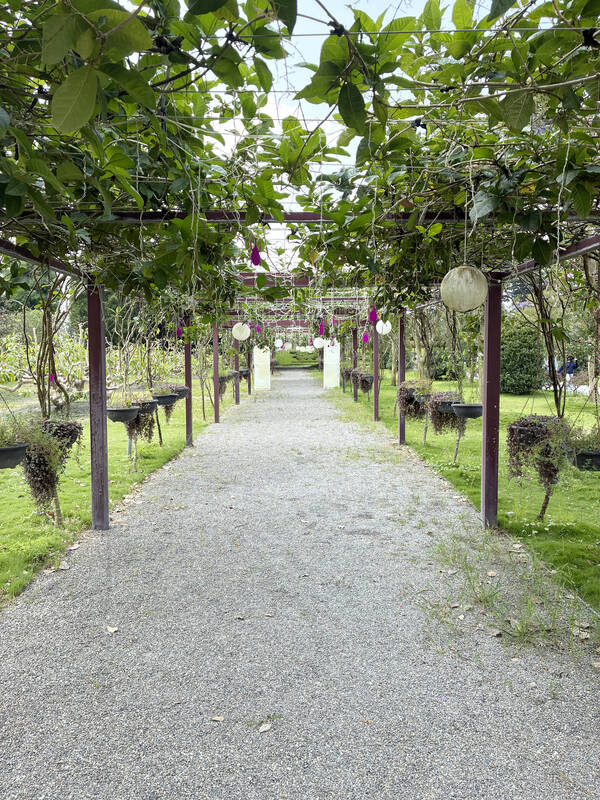
Photo: Shane O’Reilly
It’s all a sinuous, whimsical affair, wayfaring from billowing bushes to carefully crafted themed gardens and quaint cobblestone walkways.
Beautifully sheared, the topiary breathes an air of natural, flowery scents, a home to fluttering butterflies and dragonflies dancing and skimming water surfaces.
On hot summer days, visitors can recline in the underarm shade of many a knotted, gnarled tree from the comfort of a strategically placed bench or Adirondack chair.
Gravel avenues and babbling waterways run in tandem, while clearings open out to lavender patches or garden folly, their wood frames wound with the trellises of hanging plants.
Occasionally, banks of verdant shrubbery are broken by pops of color from Pink Cassia, Queen’s Wreath, and splashes of Ixora. However, much of this vibrancy will be lost between October and March.
ANCESTRAL HOME
Keeping much of its historical majesty intact, Chengmei Gongtang (成美公堂) unfolds as a layered, multi-winged, and rather angular red-brick, red-tile structure encompassing three courtyards.
Beyond the painstakingly preserved bedrooms and altar room, dozens of chambers are ideal as showrooms for what has become a traditional folk museum, with numerous interactive displays and educational spaces.
There’s even an air-conditioned, mahogany-furnished, high-wood-beam screening room with films on continuous playback, perfectly suited to relax, cool down and learn a little about the estate before venturing onward.
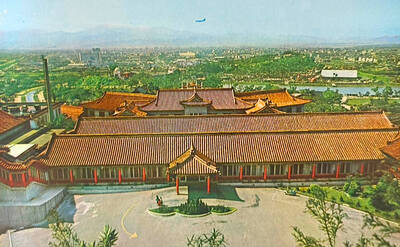
Sept. 21 to Sept. 27 When the Shah of Iran became the Grand Hotel’s (圓山大飯店) first head-of-state guest in 1958, it was hardly the landmark it is known as today. A Chinese-style, two-story structure with just 36 rooms built on the former site of the Taipei Shinto Shrine, the hotel was still referred to as its original name, the Taiwan Hotel (台灣大飯店), in an official newsreel detailing Mohammad Reza Pahlavi’s visit. The video lavished praise on the hotel, pointing out its “beautiful architecture and magnificent appearance” and noting that it had just been renovated. After being greeted personally by then-president
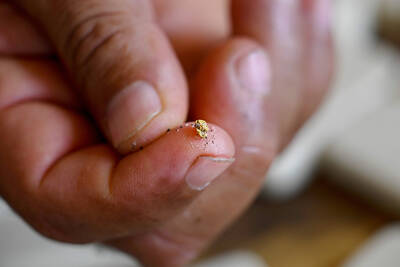
At National Cheng Kung University, researchers began with magnets from discarded electric-vehicle motors supplied by a local recycler. They dissolved a one-gram sample and tested how to separate dysprosium, a valuable rare-earth metal, from neodymium and praseodymium. A 2022 paper in Materials, by Chen Wei-sheng (陳偉聖), Jian Guo-cai (簡國財) and Lee Cheng-han (李政翰), demonstrated selective extraction. It also identified unfinished work, including multistage processing and regenerating the extraction liquid. The experiment established a technical foundation, without claiming an industrial business. The government wants to turn such expertise into a more secure source of industrial materials. Minister of Economic Affairs Kung Ming-hsin (龔明鑫)
Apetition on the Web site of the National Development Council (NDC) arguing that non-citizens receiving National Health Insurance (NHI) should make up payments from their birth to their current age has reached 5,000 signatures last week, the threshold requiring a response. The comments under the petition are predictably odious, proving once again that the Venn diagram of racism and idiocy is a perfect circle. Also last week, the Ministry of the Interior proudly announced that the 400th “high-level professional” was approved for citizenship on Aug. 26. Four hundred carefully selected dual citizens! At that rate, sometime around the year 2600, Taiwan
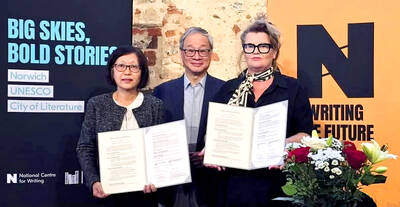
Serving as interpreter during Culture Minister Li Yuan’s (李遠) visit to Britain offered an unusual view of cultural diplomacy — not as ceremony, but as a series of conversations capable of becoming lasting relationships. During four intensive days, from Sept. 6 to Sept. 9, the delegation moved between museums, arts centers, universities and literary organizations. The program ranged from urban planning and museum access to translation, illustration and contemporary dance. Yet one question connected these encounters: How can an initial meeting become a relationship that lasts? Li described himself as “greedy” about the possibilities. The word was characteristically humorous, but the ambition


 RSS
RSS