

Taiwan wants AI to know more about Taiwan. On Sept. 15, the Ministry of Digital Affairs (MODA) invited publishers, writers and electronic-book platforms to contribute to Taiwan’s Sovereign AI Training Corpus. The database now contains about 5,000 datasets and well over a 2.2 billion tokens of text.
Digital Minister Lin Yi-jing (林宜敬) explained that an AI model’s understanding of ideas such as democracy and checks and balances is shaped by its training data.
To let AI better understand Taiwan, he said, Taiwan’s language, culture and values need to become part of what AI learns.
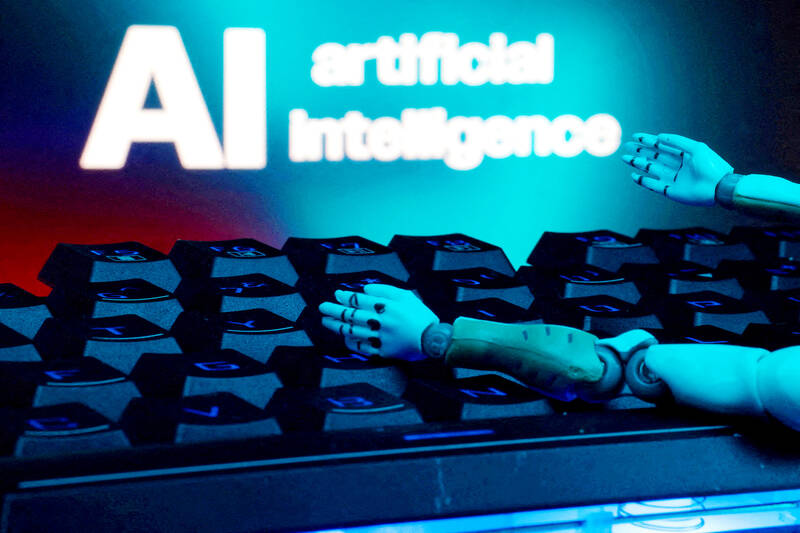
Photo: Reuters
Taiwan is not alone in its move toward “sovereign AI.” Many countries are reconsidering dependence on US and Chinese technology companies. Chinese models can carry political assumptions shaped by the Chinese Communist Party, while American companies control access, prices and development of the most capable frontier systems.
Here, sovereign AI has three dimensions: Knowledge sovereignty means AI understands Taiwan accurately; Data sovereignty means sensitive information remains under local control; and Technological sovereignty means Taiwan is not overly dependent on a foreign model provider. Switzerland’s open Apertus model similarly prioritizes transparency and local control rather than competing with frontier models.
WHEN CHINESE DID NOT MEAN TAIWANESE
Taiwan launched the government-backed Trustworthy AI Dialogue Engine, or TAIDE, in 2023 to better handle Traditional Chinese and Taiwanese knowledge.
The need was clear. At the time, TAIDE project leader Lee Yu-chieh (李育杰) noted that BLOOM, a 2022 multilingual model from the international BigScience project, had trained on 16 percent Simplified Chinese data but only 0.05 percent Traditional Chinese.
Shortly before National Day in 2023, an Academia Sinica Traditional Chinese model based partly on Simplified Chinese datasets also gave incorrect answers about Taiwan’s National Day and president.
With Oct. 10 approaching, the lesson remains relevant.
TAIDE addressed this by adapting existing open-weight models, whose trained parameters can be downloaded and modified. Early versions used Meta’s Llama, while the current Gemma-3-TAIDE-12B is based on Google’s Gemma 3 12B, released in March last year.
Even in 2023, iKala founder Sega Cheng (程世嘉) questioned the economics of building a national foundation model from scratch.
“Anyone with some sense of the costs would not rush headlong into training their own foundation model,” he said. TAIDE’s later development largely followed that logic: Sovereign AI 1.0 meant taking a capable foreign base model and teaching it more about Taiwan.
DOES LOCALIZATION HELP?
Quite a bit, but only up to a point. MODA’s sovereign corpus contains 2.2 billion tokens, the units of text processed by an AI. Google trained Gemma 3 12B on about 12 trillion tokens. The scales are different because the datasets serve different purposes: foundation models need vast, diverse data, while Taiwan’s corpus adds concentrated local knowledge through further training, fine-tuning or retrieval.
Tests show that this localization works. TMMLU+, a Taiwanese benchmark developed by researchers including Cheng, contains more than 20,000 multiple-choice questions across 66 subjects reflecting Taiwanese contexts. The February TAIDE model scored 58 percent overall, compared with 54 percent for the original Gemma model. On Taiwan’s geography, it scored 70 percent versus 61 percent.
That is a clear improvement, but 58 percent still means getting roughly four questions in 10 wrong. Meanwhile, on the current TMMLU+ v1.1 leaderboard, Claude Opus 5 scores 96 percent, Grok 4.3 scores 76 percent and Google’s open-weight Gemma 4 31B scores 70 percent. The benchmark has since been revised, so these scores are not directly comparable, but they still illustrate a wide capability gap.
Taiwan-focused training improves local knowledge but does not erase that gap. If Taiwan closes it by relying on proprietary foreign frontier models, it gains capability at the cost of technological sovereignty.
FROM SOVEREIGN MODEL TO SOVEREIGN SYSTEM
That compromise helps explain why Taiwan’s strategy has expanded beyond TAIDE. MODA’s corpus can also support retrieval-augmented generation (RAG). Instead of trying to put every fact inside a model during training, RAG searches a trusted database and passes relevant documents to the AI before it answers.
Still, while RAG can improve accuracy, it can’t guarantee it. An April benchmark study found that while standard RAG provided increasing gains on complex queries, combining retrieval with dedicated large reasoning models improved accuracy by an additional 10 percent in that benchmark.
“A stronger reasoning model grounded in the same trusted Taiwanese data,” says Yung-Chun (Peter) Chang (張詠淳), Deputy Director of Taipei Medical University’s Research Center for AI in Medicine, “could outperform a weaker locally adapted model,” especially for tasks requiring “complex interpretation or synthesis across documents.”
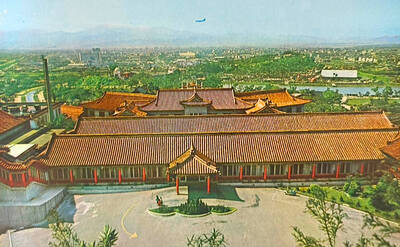
Sept. 21 to Sept. 27 When the Shah of Iran became the Grand Hotel’s (圓山大飯店) first head-of-state guest in 1958, it was hardly the landmark it is known as today. A Chinese-style, two-story structure with just 36 rooms built on the former site of the Taipei Shinto Shrine, the hotel was still referred to as its original name, the Taiwan Hotel (台灣大飯店), in an official newsreel detailing Mohammad Reza Pahlavi’s visit. The video lavished praise on the hotel, pointing out its “beautiful architecture and magnificent appearance” and noting that it had just been renovated. After being greeted personally by then-president
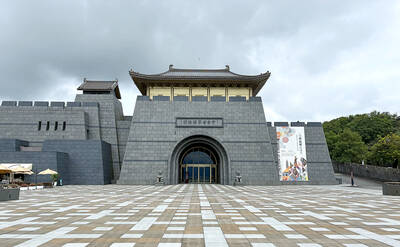
The one-day trip begins at the geographical center of Taiwan: Puli Township’s (埔里) Hutou Mountain Geographic Center of Taiwan Monument (臺灣地理中心碑), embedded at the foot of Nantou County’s dense forested slopes. It sits entrenched in forest vegetation amid the tall, spindly bodies and spiky heads of the betel nut trees; the air is cool, and its surroundings are mostly silent save the sounds of late-season cicadas. Roughly two minutes from the first destination, and after a bend in Yongfeng Road (永豐路), there’s a glimpse of a resplendent golden dome on the horizon. It’s the cap of the 135m-tall main building of the
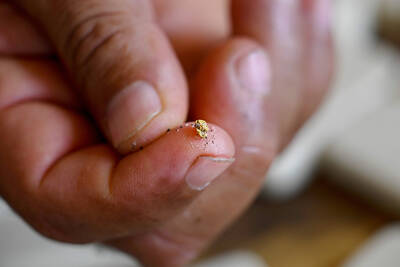
At National Cheng Kung University, researchers began with magnets from discarded electric-vehicle motors supplied by a local recycler. They dissolved a one-gram sample and tested how to separate dysprosium, a valuable rare-earth metal, from neodymium and praseodymium. A 2022 paper in Materials, by Chen Wei-sheng (陳偉聖), Jian Guo-cai (簡國財) and Lee Cheng-han (李政翰), demonstrated selective extraction. It also identified unfinished work, including multistage processing and regenerating the extraction liquid. The experiment established a technical foundation, without claiming an industrial business. The government wants to turn such expertise into a more secure source of industrial materials. Minister of Economic Affairs Kung Ming-hsin (龔明鑫)
Apetition on the Web site of the National Development Council (NDC) arguing that non-citizens receiving National Health Insurance (NHI) should make up payments from their birth to their current age has reached 5,000 signatures last week, the threshold requiring a response. The comments under the petition are predictably odious, proving once again that the Venn diagram of racism and idiocy is a perfect circle. Also last week, the Ministry of the Interior proudly announced that the 400th “high-level professional” was approved for citizenship on Aug. 26. Four hundred carefully selected dual citizens! At that rate, sometime around the year 2600, Taiwan


 RSS
RSS