

Taipei Mayor Chiang Wan-an (蔣萬安) in recent weeks has taken the lead in the Chinese Nationalist Party (KMT) in more ways than one. He spearheaded efforts to organize last Saturday’s “I am human, I oppose a toxic Taiwan” rally, has stolen the march on the party’s agenda by proposing the legislature vote to topple the cabinet and a recent poll shows him as the “most suitable” candidate to represent the KMT in the 2028 presidential race.
He is clearly taking up the mantle of a party leader, including actions more typical of the party chair. Speculation is running rampant he is gearing up for a presidential run.
It is still not clear that that’s his intention. Making a decision now would be rash, but following this year’s local elections, there will be only 13 months before the election in January 2028. Typically, potential candidates hint that they are in the race in the December to March period, even if they only formally declare in April or May.
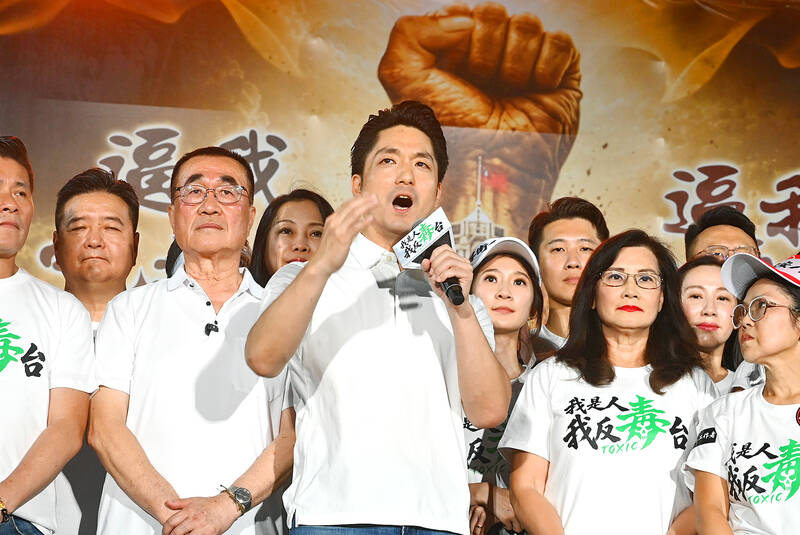
Photo: Wang Yi-sung, Taipei Times
There are already events in motion that will encourage supporters to pressure him to run, with plenty of signs that he is in a strong position to win the nomination. Those are normal for any high-flying politician, and especially so for a mayor of Taipei.
Unlike typical politicians, he has a set of unusual and potentially psychologically important pressures and expectations. These are worth examining because they provide interesting context.
IS HE REALLY?
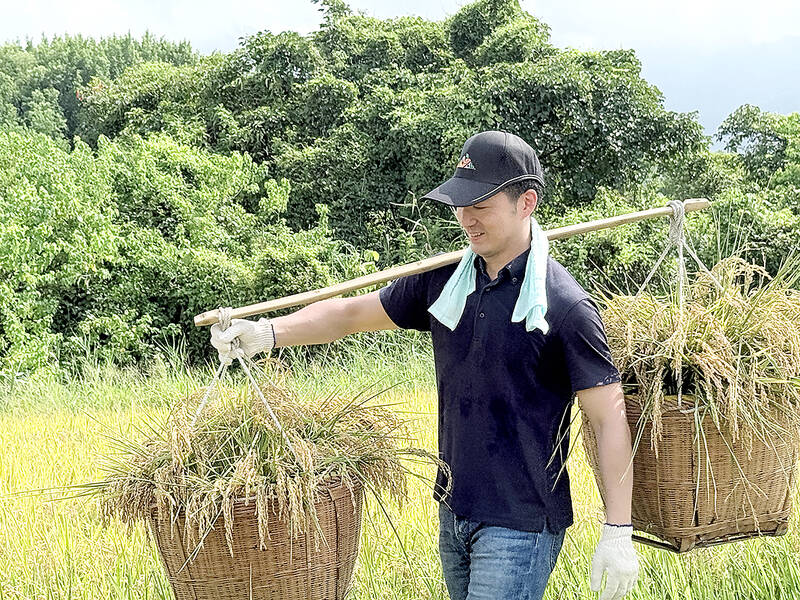
Photo: Tsai Kai-hung, Taipei Times
When Chiang was 16, his father sat him and his siblings down for an important talk. His father, John Chang (章孝嚴), was a high-ranking KMT official and would go on to become foreign minister and vice premier. A refugee of the Chinese Civil War, he was a member of the party elite.
Chang told his children that he was the illegitimate son of former president Chiang Ching-kuo (蔣經國), and therefore also the great-grandchild of former president Chiang Kai-shek (蔣介石).
The Penn Law Journal quotes Chiang Wan-an as saying, “I was certainly surprised, but I don’t think it changed my life a lot. I tried not to take advantage of my family background,” he says. “My dad told me, ‘You still have to be yourself.’ He insisted that I keep a very low profile, go to public school and live like an ordinary person.”
Perhaps, but having your great-grandfather’s face on the money and a giant mausoleum in the center of the capital must have had some impact. Together with his father, in 2005 they formally changed their surname from Chang to Chiang.
There is some dispute over whether he is actually descended from the Chiang family, and the topic has flared up once again in recent days.
Years ago I researched the topic, examining the various cases made that he was or was not a true Chiang. The historical record has too many gaps to be conclusive one way or the other. However, during that era it was typical for powerful men to have mistresses, so it is very possible.
Ultimately, I concluded that it is best to work from the assumption that it is true. Nobody in the top echelons of the KMT from the era came forth to dispute it, and acted on the assumption that it is true. John Chang was absolutely convinced it was true, and he would likely know.
Chiang Wan-an has repeatedly faced calls to prove it through a DNA test. Quite reasonably, he has rejected such a ghoulish invasion of privacy.
STEALING THE MARCH
Keep that context in mind in considering recent events.
He reversed the standard order of things in the KMT by first visiting the party’s legislative caucus and getting their support — plus those of some key local leaders — before presenting the plan to hold the “I am human, I oppose a toxic Taiwan” rally to party Chair Cheng Li-wun (鄭麗文). What she thought of the plan personally we do not know, but Chiang left her little choice in having to support the plan.
The rally was a success. Though estimates put forth by the KMT of 150,000 to 200,000 attendees is — as usual in Taiwan — wildly exaggerated, the turnout was more than respectable, especially considering it was organized on relatively short notice. He deservedly got much of the credit, but leading the party like this is typically the party chair’s job.
He also stole the limelight and dominated the headlines with his proposal for the legislature to vote to topple the cabinet. This is not the first time he has proposed this, but in the current atmosphere it has gained far more attention.
The legislature has the legal right to vote out the cabinet (Executive Yuan), including the premier. The president then has the right to disband the legislature in response, forcing a re-election within 60 days.
Chiang’s case is that ousting the cabinet is reasonable to make them pay for the recent food safety scandal.
He also makes another interesting case, which is that by forcing a legislative election this year, it would decouple the legislative elections from the presidential one. This would reschedule the legislative election timetable to roughly the mid-point of a president’s term, allowing the public to use their legislative vote to render a verdict on the president much like US mid-terms do.
As Chiang noted, this would only be possible if the KMT legislative caucus can reach a consensus to do so, the Taiwan People’s Party (TPP) caucus in on board. Having lost around a third of their support in polling, naturally the TPP is cagey.
To assuage the TPP’s fears, a proposal has been floated that the KMT would offer five safe party list seats to the TPP to ensure their continued representation. Theoretically, that could even increase the TPP’s number of seats if they can hold onto seven or eight percent of the popular vote.
Chiang says many members of the KMT caucus have told him they support the plan. However, KMT caucus whip Fu Kun-chi (傅?萁) claims that there is not much discussion about it among their members.
At this point, it is in the possible-but-unlikely category. The important point here is that Chiang is driving the agenda and debate, not Fu and especially not Cheng, the party chair.
IN HIS SHOES
The Taiwan Inspiration Association on July 27 released a poll showing that 30 percent viewed Chiang as the “most suitable” candidate to represent the KMT in the next presidential election, topping the list. Taichung Mayor Lu Shiow-yen (盧秀燕) got 22.7 percent, and Cheng only 4.9 percent.
For the last few weeks, Chiang has also topped the Daily View social media tracker’s politicians list by a wide margin, which is usually dominated by the president. His most used keyword is “Prince Chiang.”
Imagine you are the mayor of Taipei, which has served as the launch pad for three of the five democratically elected presidents. Of all the mayors serving since 1994, only Hau Lung-bin (郝龍斌) did not run for president.
You have stolen the march on the party chair, are driving the party’s agenda and political debate, you have pulled together a massive rally, and are leading in the polls and dominating on social media.
Oh, and do not forget that your grandfather and great-grandfather were both presidents.
Add up the cumulative psychological impact of all of this.
We cannot know how much these factors play in Chiang’s decision-making process, but they must have some emotional impact.
Ostensibly, he is running for re-election as mayor. Everything he has been doing recently would also lay a solid groundwork to run for president.
Perhaps he has already made up his mind.
Donovan’s Deep Dives is a regular column by Courtney Donovan Smith (石東文) who writes in-depth analysis on everything about Taiwan’s political scene and geopolitics. Donovan is also the central Taiwan correspondent at ICRT FM100 Radio News, co-publisher of Compass Magazine, co-founder Taiwan Report (report.tw) and former chair of the Taichung American Chamber of Commerce. Follow him on X: @donovan_smith.
Unable to solve the enduring mystery of why Taiwan does not attract tourists in the desired numbers (despite the collective screams of all of us knowledgeable long-term foreigners watching the government flail uselessly at the problem), policymakers have decided to establish a Taiwan Tourism Institute (台灣觀光研訓院), which was inaugurated last week to great fanfare and almost certain futility. Premier Cho Jung-tai (卓榮泰), speaking at the opening ceremony for the institute, said that “we hope that the Taiwan Tourism Institute could function like ITRI [Industrial Technology Research Institute] and develop Taiwan’s tourism industry.” The chip industry dates back to the 1960s, but
This paper ran a piece this week on the rampant smuggling of Kaoliang liquor from Kinmen through customs to Xiamen in the People’s Republic of China (PRC). Our paper reported that “Chinese frequently approach passengers heading to Xiamen and offer them 80 yuan (US$11.82) to carry kaoliang liquor through customs.” The couriers are then photographed and the images sent to smugglers on the other side of customs at the Wutong Ferry Terminal. The liquor couriers can pay half the cost of their ferry ticket from the transaction, the report said. In the PRC this tactic of splitting smuggling of goods
July 27 to Aug. 2 Chiang A-hsin’s (姜阿新) father did not want him to work. As one of the wealthiest families in the Hsinchu area, the Chiangs owned enough property and other assets to live comfortably, and his father reportedly spent much of his time smoking opium. Whenever Chiang came up with a business idea, his father rejected it. “He wanted me to be like him, just sit back and enjoy life. This pained me very much,” he later told his son-in-law, Liao Pan-yun (廖潘運), who wrote about his family in The Days of Golden
Prior to March 6, 2011, Taichung was the place to be. Known as the “city of culture” in the 1920s, Martial Law crackdowns had made Taichung a sleepy backwater by the 1990s. Taipei, and even the port city of Kaohsiung, were more exciting and cosmopolitan. In the 2000s, Taichung began to punch well above its weight. Taiwan joined the WTO, the High Speed Rail arrived and the Central Taiwan Science Park opened. In 2001, former foreign minister Jason Hu (胡志強) was elected mayor, and he set about reimagining the city as a cosmopolitan center for business, sports, arts and culture. His


 RSS
RSS