


As in previous years, last year’s typhoon season left many of Taiwan’s beaches littered with driftwood. Media coverage focused on the legal status of this debris, as the rules which govern who can remove fragments of trees washed out of state-owned forests, what they can take and whether they can use it for commercial purposes are complex.
At the same time, a few people were wondering if there’s another way to exploit this windfall. Couldn’t we burn it in our power plants, they asked, instead of importing coal?
Uprooted trees are a vast and mostly untapped resource. A study by Taiwanese researchers that appeared in the July 2011 issue of Marine Pollution Bulletin noted that “more than three million trees fell and were washed away” during 2009’s Typhoon Morakot. Just one-seventh of the estimated 980,000 tonnes of wooden debris was cleared up by the authorities, the remainder being carried away by citizens or left to rot.
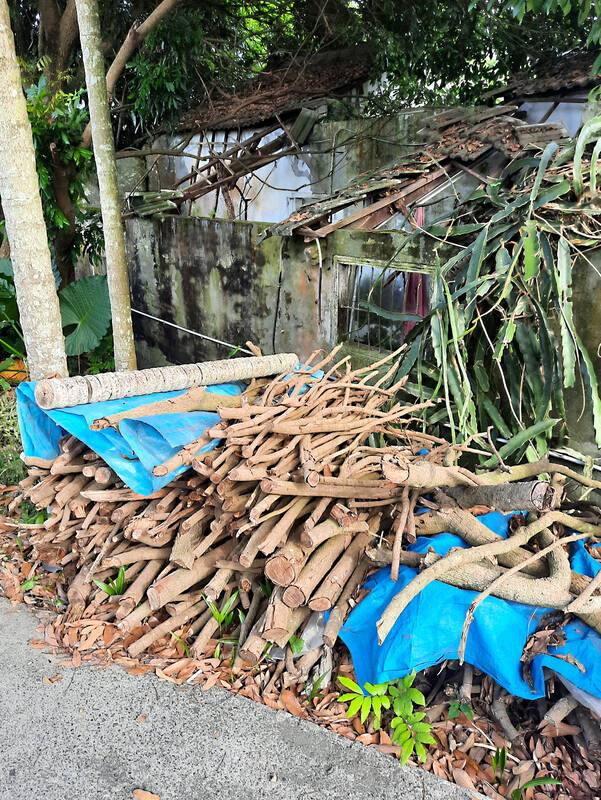
Photo: Steven Crook
The 980,000-tonne figure is impressive, yet it’s less than a quarter of Taiwan’s monthly coal imports.
What’s more, the energy content of wood is much lower than that of coal. Burning a single tonne of the fossil fuel generates the same amount of heat energy as 2.6 tonnes of hardwood. The Intergovernmental Panel on Climate Change (IPCC) recognized the disadvantages of wood as long ago as 2006, noting that combusting solid biomass produces 110 kilograms of carbon dioxide per gigajoule of energy, while for coal the emissions are around 96 kilograms.
Several countries operate wood-fired power stations nonetheless. These plants burn wood pellets (compressed wood fibers), wood chips (typically two centimeters in length) and/or forestry residues, including branches, bark, sawdust and other logging-industry leftovers.
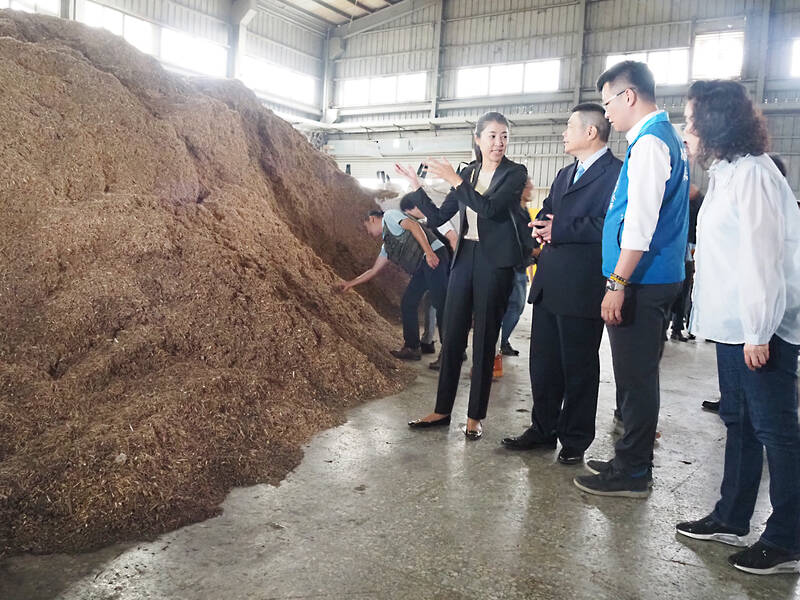
Photo: Chen Feng-li, Taipei Times
In 2017, local journal Forest Economy published a mostly positive assessment of Taiwan’s potential for using wood as an energy source. The authors estimated the country could produce 204,000 metric tons of wood and bamboo per year by sustainably extracting biomass from artificial forests, recycling imported timber and gathering what’s pruned from roadside trees. This total doesn’t include driftwood, they added.
Unfortunately, driftwood isn’t suitable for power generation, explains Chang Chia-chi (張家驥), a senior researcher at the Taiwan Bio-energy Technology Development Association (TBETA).
SAND AND MOISTURE ISSUES
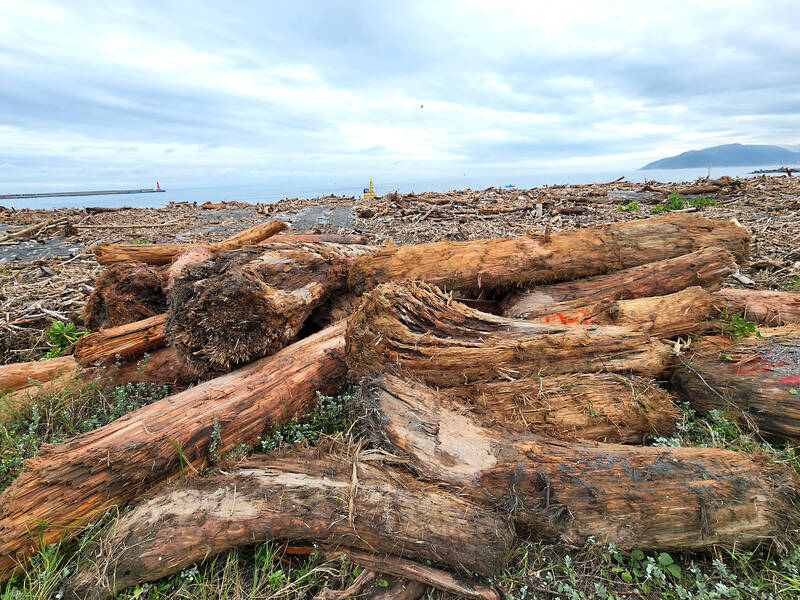
Photo: Hua Meng-jing, Taipei Times
Taiwan has several cogeneration plants and small boilers that burn recycled wood, and these facilities have lower fuel-quality requirements compared to large power stations, says Chang. They can burn woody biofuels, but “driftwood has high moisture, sand and chlorine content. It’s easy to damage a boiler when using it as fuel. In addition, driftwood is expensive to transport and handle,” he says.
As an energy source, the masses of wood that appear in Taiwan’s waterways and along its shores after each typhoon therefore holds no real potential, Chang says. Yet he’s convinced that fuels derived from biomass — recently living organisms such as trees and crops — can and should play a part in Taiwan’s energy transition.
Biomass contains carbon absorbed by plants via photosynthesis. The International Energy Agency (IEA)’s Web site acknowledges that combusting biomass inevitably releases carbon into the atmosphere, yet reasons that the production of new biomass absorbs an equivalent amount of carbon dioxide, thereby “making modern bioenergy a near-zero emissions fuel.” But not everyone agrees with the IEA’s position.
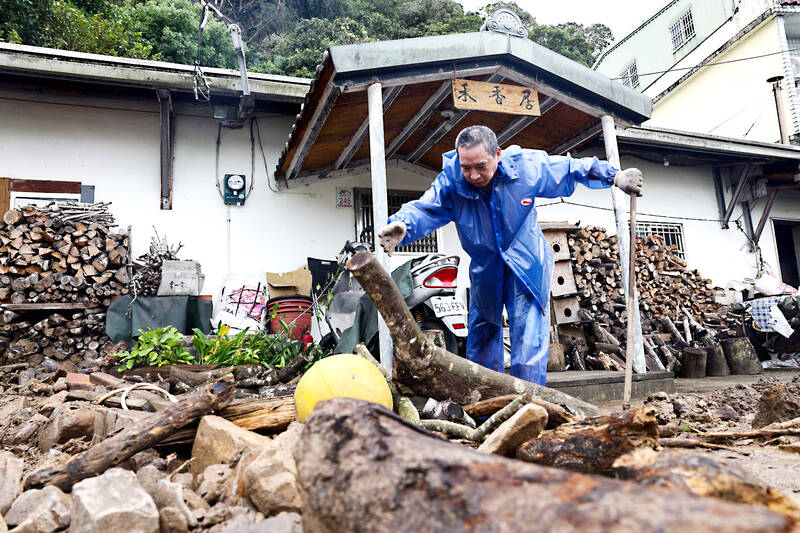
Photo: AFP
Among the reasons why Chang backs bioenergy is the inconsistency of wind and solar energy. Bioenergy can help stabilize energy supplies by contributing to base load, he argues. Waste-to-energy (WtE) systems have a similar advantage in that they also enjoy a stable and reliable fuel supply, he adds.
Chang points out that while the quantity of agricultural and forestry residues in Taiwan isn’t huge, and their quality isn’t ideal, “they can still be mixed in low ratios with other solid biofuels or coal in thermal power plants and cogeneration plants,” as long as the boilers have been designed to cope with these fuels, he adds.
Since the first half of the 1895-1945 period of Japanese colonial rule, Taiwan’s sugar mills have been burning bagasse, the dry pulpy material left after sugarcane has been crushed to extract the juice.
Taiwan Sugar Corp. (TSC) currently burns 70 percent of the bagasse it handles, according to the state-owned company’s Web site. The combined heat and power (CHP), or cogeneration, facility at Huwei (虎尾) in Yunlin County was certified as a biomass power generation system in June last year; its approved capacity is 8.8 megawatts, not much more than that of a single offshore wind turbine. TSC plans to use this output to create Renewable Energy Certificates (REC) which it can sell to other enterprises. At the same time, TSC is continuing to “actively cooperate with government initiatives in developing bioenergy technologies,” the site says.
In east Taiwan, another type of bioenergy has been utilized for decades. Since 1968, the Chung Hwa Pulp Corp. plant in Hualien County has been burning lignin, a byproduct of the wood-pulping process. This black liquid is concentrated through evaporation, then combusted in a boiler to produce steam that propels a generator. Heat from the boiler is diverted for drying and heating within the factory, CommonWealth magazine reports.
Emphasizing that electricity isn’t the only useful type of energy, Chang points out that biomass-fired cogeneration systems like those used by Chung Hwa Pulp and TSC tend to be highly efficient. In his opinion, recent increases in feed-in-tariff rates — subsidies offered to enterprises which supply renewable energy to the grid — for bioenergy, including biogas derived from animal manure, “are sufficient economic incentives to build new biomass power plants.”
In contrast to the massive expansion of wind and solar energy in recent years, Taiwan’s biomass and WtE capacity has barely grown since 2015. Between 2030 and 2050, the country’s Net-Zero Emissions Plan expects this to double to between 1.4 and 1.8 gigawatts. But compared to Japan’s national biomass energy target for 2030 of 6.02 to 7.28 gigawatts, Taiwan’s isn’t ambitious.
LOCAL PROGRESS, GLOBAL CRITICISM
State-run utility Taiwan Power Co (Taipower) canceled two bioenergy projects last year. One was the planned conversion of a coal-fired unit at Kaohsiung’s Hsinta Power Plant into a wood-burning facility. The other would have resulted in the construction from scratch of a bioenergy plant in Taichung.
Despite these setbacks, a small-scale biomass power station opened in Nantou County. The privately-owned facility turns agricultural waste into electricity via gasification, with an output of 1 to 1.2 megawatts per hour, 24 hours a day.
Among the world’s biggest biomass power stations are the UK’s Ironbridge and Drax plants. The latter is especially controversial, with The Guardian reporting that it’s the country’s “largest single source of carbon emissions,” that its owners have pocketed billions of pounds in subsidies and that most of the wood pellets burned there are shipped from North America.
Back in 2019, a commentary published in GCB Bioenergy looked at surging international demand for pellets derived from forestry biomass, and warned:
“Critical to this trade is the classification of woody biomass as ‘renewable energy’ and thus eligible for public subsidies. However, much scientific study on the net effect of this trend suggests that it is having the opposite effect to that expected of renewable energy, by increasing atmospheric levels of carbon dioxide for substantial periods of time.”
It’s assumed that carbon dioxide emitted by wood-fired power plants will be reabsorbed, the commentary explains. But, while burning forest biomass sends this carbon into the atmosphere in a matter of minutes, “there is a ‘payback period’ between this initial release and a return to forest carbon stocks through regrowth.”
This could be years in the case of forestry residues, but when trees are harvested, “the payback periods depend on the species and conditions of regrowth which range from decades to centuries.”
There are other concerns. If artificial woodlands optimized for pellet production expand, biodiversity is likely to suffer.
The authors of the Forest Economy article described deadwood that stays where it falls as “a waste of national resources.” Given their affiliation with the Taiwan Forestry Research Institute, now part of the Ministry of Agriculture’s Forestry and Nature Conservation Agency, this is surprising. Dead trees left in situ have considerable ecological value: as they decompose, they provide wildlife habitat and slow soil erosion, while aiding plant regeneration and nutrient cycling.
The authors argue that fully utilizing abandoned forestry resources and establishing “multiple regional wood-energy centers” could “open up win-win opportunities for energy supply and environmental protection.”
If Taiwan embraced wood energy, they’d surely be winners. But whether it’d be a net gain for the global climate is less certain.
Steven Crook, the author or co-author of four books about Taiwan, has been following environmental issues since he arrived in the country in 1991. He drives a hybrid and carries his own chopsticks. The views expressed here are his own.

Ajay Verma, a consultant gastroenterologist at Kettering general hospital in Northamptonshire, says our gut is a “complex machine.” “It is constantly providing us with the nutrition we need, initially to grow and develop, and then for us to survive, thrive and repair from injury and illness.” How can we keep it functioning well? Put simply: “Make sure what you put into it is balanced, and that you clear out its waste products adequately,” Verma says. “In a general gastroenterology clinic, the most common conditions we see are irritable bowel syndrome (IBS), gastroesophageal reflux disease, inflammatory bowel disease and constipation,” says Nisha
The arithmetic is straightforward and uncomfortable. By the end of 2025, Taiwan had committed itself to a 50-30-20 electricity mix — half natural gas, 30 per cent coal, 20 per cent renewables. The Ministry of Economic Affairs’s (MOEA) own monthly energy reports tell a different story. Natural gas reached 47.8 per cent of generation last year. Coal stood at 35.4 per cent, comfortably above its target ceiling. Renewables came in at 13.1 per cent, well short of the 20 per cent Taipei had pledged a decade earlier. Installed renewable capacity reached roughly half of the 12 gigawatts (GW) the government

Taiwan’s drone exports are taking off, fuelled by the war in Ukraine, as Taiwanese companies seek a stake in the fast-growing global market for unmanned aerial vehicles (UAV). Low-cost drones used for reconnaissance and strikes are in high demand as governments around the world boost defense spending in the face of intensifying conflicts. A relative new player in the increasingly competitive industry, Taiwan’s pitch is to be an “Asian hub” for the production of UAVs and components free of Chinese materials, or “non-red.” That means its UAVs can be up to three times more expensive than their Chinese competitors, like the world’s biggest

There are shadowy cabals plotting to sell out Taiwan to be annexed by China, by invasion if necessary. Fortunately, they are buffoons. In 2019, former Bamboo Union gangster and founder of the China Unification Promotion Party (CUPP), Chang An-le (張安樂, colorfully known as “White Wolf”), led a protest at the Legislative Yuan against comments made by then-premier Su Tseng-chang (蘇貞昌) that in the event of an attack by China, he would never surrender, but would protect the nation by fighting to the end, even if he only had a broom. Chang had party members bring a wooden casket that they


 RSS
RSS