


One of the best ways to get to know a country is to spend time at its markets. From a visit to Yongkang Farmers’ Market (永康小農市集), it’s clear that Taiwan is blessed with growers and makers for whom farming is much more than crops and livestock. It’s a distinct way of life, founded on a reverence for what their native environment, traditional wisdom and the natural passage of time can achieve.
What started as a collaboration between 248 Farmers’ Market (248農學市集) and the community service corps of the Rotary Club in July 2016 has since become Taipei’s largest farmers’ market, with more than 30 stalls each month.
“Taiwan has excellent agricultural produce and artisans, so we wanted a platform for small-batch producers to promote and sell their products themselves,” organizer Lee Chien-cheng (李建誠) says. Lee personally cultivates relationships with farmers and artisans, visiting their farms to see whether their work matches the market’s fun, friendly and relaxing spirit.
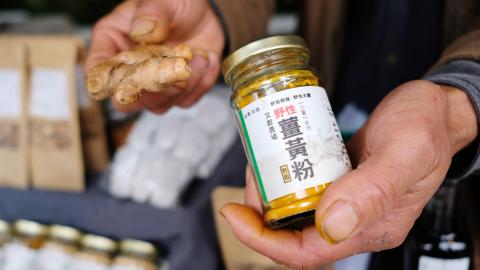
Photo: Davina Tham, Taipei Times
“It takes some time to understand the producers’ values, practices and beliefs,” Lee says. The selectivity means that the market is a carefully curated gathering of producers from all over Taiwan, and there is a waiting list of interested vendors. But the organizers are in no hurry to expand, choosing instead to focus on ensuring the market’s longevity and fostering meaningful exchanges among the producers, their customers and the surrounding neighborhood. They hope for more diverse activities, such as performances, art exhibitions and cooking lessons, to become part of the market’s ecosystem.
“If the market is just a place where things are sold, then only people who want to shop would come here, and that would be a real pity,” Lee says.
HERB LIFE (花滿蹊農場)
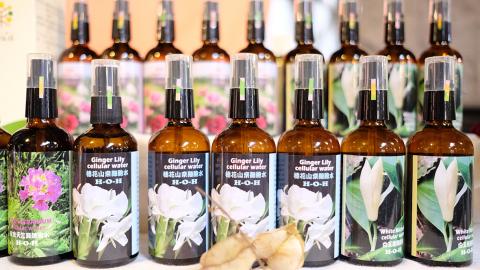
Photo: Davina Tham, Taipei Times
Owner Huang Su-hsin (黃素馨) runs an organic farm in Pingtung, where she grows flowers such as rose geranium, honeysuckle, ginger lily, white michelia and jasmine. The flowers are used in tisanes, body oils and creams, but Herb Life’s signature product is a floral essence spray, which can be consumed orally or spritzed on the body. Huang believes in the medicinal properties of flowers, immediately dispensing an anti-inflammatory chrysanthemum spray to a customer who came by with a cold and sore throat.
James & Erika’s Garden Handmade Sauces
All of the herbs and vegetables used are grown at the owners’ permaculture farm in Wulai (烏來). The mostly Western-style spreads and sauces include a herby chimichurri, piquant chilli sauce, cashew “cheese” and pesto that adapts to the seasonality of ingredients — in the summer, basil is used for a traditional pesto, but in the colder months, it is replaced with arugula, imparting a peppery, bitter kick.
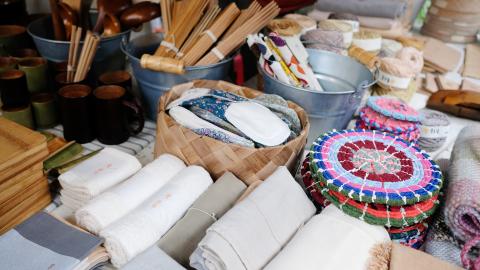
Photo: Davina Tham, Taipei Times
NATURE MIFFY (綠兔子工作室)
Owners Chen Jen-chuan (陳仁全) and Hung Min-hui (洪閔慧) have traveled around Taiwan to find the best handmade household products, in the hopes that people will make more space in their busy lives for items made with thought and care. These include grass slippers woven by a nonagenarian grandmother, bamboo containers from Miaoli, organic cotton towels and wooden brushes made with animal hair. Creators in their own right, Chen and Hung also sew reusable, eco-friendly cotton sanitary pads, dye yarn and shawls and carve wooden spoons.
WU SSU FARM (無思農莊)
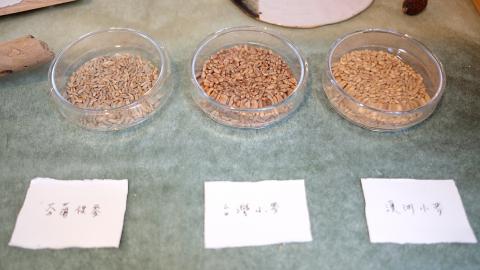
Photo: Davina Tham, Taipei Times
Blending Japanese techniques and Taiwanese ingredients, Wu Ssu Farm specializes in fermented goods such as miso and shio koji, a Japanese seasoning of inoculated rice, salt and water, which they recommend using to marinate ingredients and deepen the umami flavor in dishes. They also make amazake, a sweet, mildly alcoholic fermented rice drink from Japan. The fermentation process accentuates the distinctive characteristics of different Taiwanese rice varietals, resulting in amazake with startling differences in flavor and aroma.
WEN HSIEN FARM (文獻農場)
One regular customer describes Samuel Yang’s (楊文獻) fruit vinegar as “life-altering.” Yang ferments his vinegar, made from fruits such as lemon, pineapple and plum, for at least one year. His vinegar can be drunk neat — take a sip and keep it in the mouth for a while to activate the saliva glands — or diluted. Yang also grows turmeric and ginger, which he grinds to a powder or sundries in slices. He takes a homeopathic approach to his produce, recommending a shot of vinegar every day for good health and a slice of sundried ginger to keep the body warm.
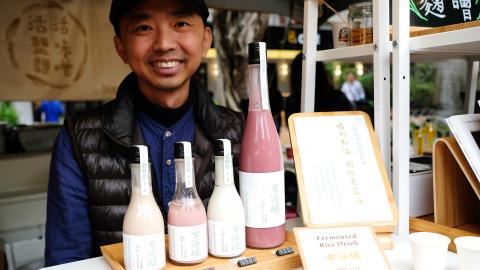
Photo: Davina Tham, Taipei Times
Piccola Isola (小島) and Sousan (曾)
Piccola Isola and Sousan take turns selling their bread at the market in alternative months. Both grind their own flours. Piccola Isola uses high-gluten hard red winter wheat grown in Taiwan alongside Finnish rye and European wheat varieties. The high-quality wheat results in bread that plays off beautifully when topped with brown sugar, bananas, caramelized onions or Nepalese peppercorns. Seasonal breads include a winter special of cranberry bread with roasted peanuts from Kinmen.
■ Yongkang Farmers’ Market takes place over the first weekend of each month at Yongkang Park (永康公園) in the heart of buzzy Yongkang Street (永康街). This month, the market takes place on Feb. 16 due to the Lunar New Year holidays.

Taiwan’s English education system is being pulled apart by three opposing forces. Bilingual Nation 2030 pulls students toward English and global communication. Artificial Intelligence (AI) readiness pulls them toward digital judgment, verification and AI-mediated work. But Taiwan’s old exam culture pulls them back toward memorization, grammar drills, timed reading and correct answers. If the education system keeps using old exams to define success, it risks producing graduates who are neither genuinely bilingual nor genuinely AI-ready, but trained for tasks machines can already perform. The first force is Bilingual Nation 2030. Launched in 2018, the policy aimed to “help Taiwan’s workforce connect
It seems every few days one bumps into one of those “real man” comments in which Taiwan is urged to “face reality” or similar, and “make a deal,” with the speaker implying that soon it will be too late. “Deal” advocates always present themselves as having a superior grip on reality, and the manly ability to make the “hard choice.” Their testosterone-laden language often echoes that of Taiwan sellout advocates. Note that such commentary always specifies a process (“make a deal, work with, make progress”), never the end state of what occupation by a violent authoritarian colonialist state will entail. In
June 1 to June 7 "If all Taiwanese were as afraid of dying as you, then what would happen?” Physician Shih Chiang-nan (施江南) reportedly said this to his wife Chen Chiao-tung (陳焦桐) after she urged him to stop intervening on behalf of Taiwanese soldiers stranded overseas after serving in the Japanese Army during World War II. Shih had clashed with high-ranking officials over the issue, engaged in several heated arguments with Taiwan governor-general Chen Yi (陳儀) and allegedly shouted at general Ko Yuan-fen (柯遠芬), chief of staff of the Taiwan Garrison Command, over

“Taiwan’s Opposition Leader Comes to US With a Message Straight Out of Beijing” read a May 31 headline in the Wall Street Journal. Top US administration officials and members of Congress almost certainly read the WSJ, and if there was a bullet point takeaway that people in Washington should absorb ahead of Chinese Nationalist Party (KMT) Chair Cheng Li-wun’s (鄭麗文) arrival in DC on June 9, that headline is it. The last few columns have discussed this very topic, and the timing is not coincidental. While those top officials likely do not read the Taipei Times, judging by the number


 RSS
RSS