


Taiwan-born celebrity chef Ching-he Huang (黃靜億) has spent most of her life in the UK but has never forgotten her roots, with the nation’s capital city featuring prominently in her new TV series Ching’s Amazing Asia (黃靜億的亞洲佳餚).
In addition to Taipei, the program showcases the food scene in Hong Kong, Macau, Okinawa and Tokyo. It currently airs every Monday on the Asia Food Channel.
Huang, who has been nominated for a daytime Emmy and recently received an award from the Taiwan Tourism Bureau for the series, says the program was a dream come true.
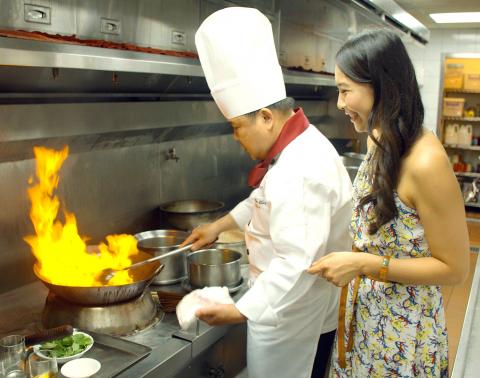
Photo courtesy of Ching’s Amazing Asia, Food Network UK
“I really wanted to celebrate the chefs in Asia and Asian cuisine and take people on a tour so they can see with their own eyes the beauty of the signature dishes of the chefs and really kick open the kitchen doors,” Huang says.
Huang, who has also called South Africa her home, says there is a commonly held assumption in the West that Asian kitchens are “secretive” because the chefs don’t share their recipes.
“I wanted to dissolve those myths.”
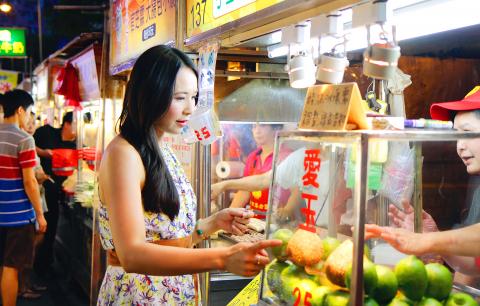
Photo courtesy of Ching’s Amazing Asia, Food Network UK
CULINARY ROOTS
Huang says the highlights of her adventure, which incorporated everything from street stalls to Michelin-starred restaurants, were both culinary and nostalgic.
“This is not because I’m biased, but I really, really enjoyed Taipei,” she says.
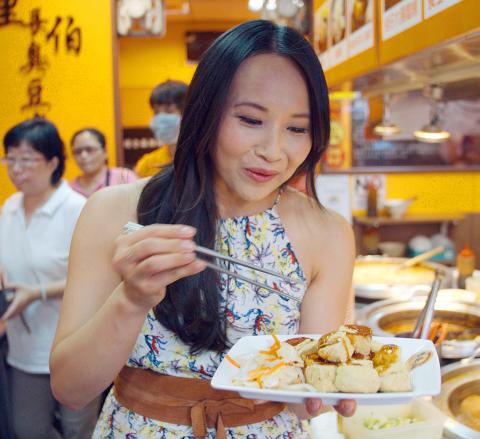
Photo courtesy of Ching’s Amazing Asia, Food Network UK
Street food classics were the dishes Huang most enjoyed filming and eating. She includes Ningxia Night Market’s (寧夏夜市) stinky tofu, her favorite, as well as oyster omelet (蚵仔煎) and Aiyu (愛玉) jelly, as well as a small sausage encased in a big sausage with rice.
Huang says that when deciding what to include in the series, dishes were chosen first and then the eateries.
Things did not always go according to plan, like the time she went to James Kitchen (大隱酒食), a restaurant in Taipei’s Da-an District (大安), to sample their famous braised pork rice and was given youtiao (油條, fried dough sticks) with oysters instead.
“I said ‘sure, why not, that sounds delicious,’” Huang says.
Filming was a family affair, with husband and co-executive producer Jamie Cho behind the camera. Huang says it is an ideal partnership because they communicate well and any conflict is worked out quickly.
“I couldn’t have done this project without him,” Huang says.
Putting the series together involved hard work and a tight schedule, the five-and-a-half weeks of shooting incorporating five locations and approximately 70 different eateries.
TAIWAN IN THE UK
Shows such as Ching’s Amazing Asia have helped raise the profile of Taiwanese cuisine and Huang highlights the burgeoning Taiwanese food scene in London.
As well as a proliferation of bubble tea joints, it is becoming easier to sample the delights of three-cup chicken, oyster omelet and gua bao (割包), a steamed flat bun stuffed with stewed pork.
She’s also acquired a taste for the food of her adopted homeland to go with her love for Taiwanese dishes, a sort of culinary yin and yang.
“I love British food,” Huang says. “For my Western fix my husband and I will go out for fish and chips. I love Cornish pasties. If I’m traveling on the train I’ll grab one.”
At home, Huang likes to cook simple, healthy dishes that are nourishing.
“I always make something comforting like a Taiwanese-style danhuatang (蛋花湯) — egg flower drop soup, lots of vegetables, noodles,” she says.
Huang says the popularity of Taiwanese food in the UK is growing.
“Taiwanese restaurants, Taiwanese-style dumplings, Taiwanese baozi. A lot of students who have stayed here [in the UK] are cooking up some wonderful things,” she says.
■ Ching’s Amazing Asia airs every Monday from 10pm to 10:30pm on the Asia Food Channel, which can be seen on channel 135 on MOD.


Taiwan’s English education system is being pulled apart by three opposing forces. Bilingual Nation 2030 pulls students toward English and global communication. Artificial Intelligence (AI) readiness pulls them toward digital judgment, verification and AI-mediated work. But Taiwan’s old exam culture pulls them back toward memorization, grammar drills, timed reading and correct answers. If the education system keeps using old exams to define success, it risks producing graduates who are neither genuinely bilingual nor genuinely AI-ready, but trained for tasks machines can already perform. The first force is Bilingual Nation 2030. Launched in 2018, the policy aimed to “help Taiwan’s workforce connect

“Taiwan’s Opposition Leader Comes to US With a Message Straight Out of Beijing” read a May 31 headline in the Wall Street Journal. Top US administration officials and members of Congress almost certainly read the WSJ, and if there was a bullet point takeaway that people in Washington should absorb ahead of Chinese Nationalist Party (KMT) Chair Cheng Li-wun’s (鄭麗文) arrival in DC on June 9, that headline is it. The last few columns have discussed this very topic, and the timing is not coincidental. While those top officials likely do not read the Taipei Times, judging by the number
With weighty, anxiety-inducing geopolitical topics dominating the headlines, checking in on the wild and weird state of local politics can take some of the edge off. This November’s elections will determine who will be in charge of fixing potholes in your neighborhood, not the potholes in Taiwan’s complicated geopolitical space. Recently, after an online interview with a Taipei-based journalist, I commented that Taipei journalists never go further than the MRT can take them. He laughed and agreed. Naturally, the Taipei mayoral race is eating up much of the press attention. TAIPEI CITY Democratic Progressive Party (DPP) candidate Puma Shen (沈伯洋) has
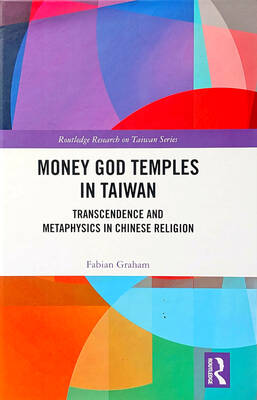
As someone who normally steers clear of books with “transcendence” or “metaphysics” in their subtitles, this reviewer — a casual observer of local belief systems since the 1990s — found Fabian Graham’s Money God Temples in Taiwan a challenging read. Those who’ve only dipped their toes into temple culture will likely need to parse several sections with special care if they’re to keep up with the author, a British ethnographic researcher whose previous books have investigated religious practices among ethnic Chinese in Southeast Asia. This scholarly volume examines a facet of Taiwan’s religious landscape that didn’t exist a century ago, and


 RSS
RSS