


A lack of online resources can make learning Taiwan’s Aboriginal languages incredibly difficult. But a new app called Moedict Amis dictionary (阿美語萌典—方敏英字典) has made learning the Amis language as easy as cecay, tosa, tolo (one, two, three).
A group of volunteers have come together to create the first ever Amis language dictionary app for mobile phones. The group includes both Amis and non-Amis, engineers and tech luddites — and even a former legislator and a Catholic priest.
The app’s development is not targeted at language enthusiasts but for the Amis to save their language from years of regressive government policies, and urban migration that has crippled the development of Aboriginal languages.

Photo: Aaron Wytze Wilson
“We’re not just looking to preserve the language for future generations, but also hoping to set off a cultural revival for other Aboriginal languages,” says group member Tsai Wei-ting (蔡維庭).
FACING EXTINCTION
According to a UNESCO report in 2009, Taiwan’s Aboriginal languages are in serious danger of extinction unless drastic action is taken to preserve them.
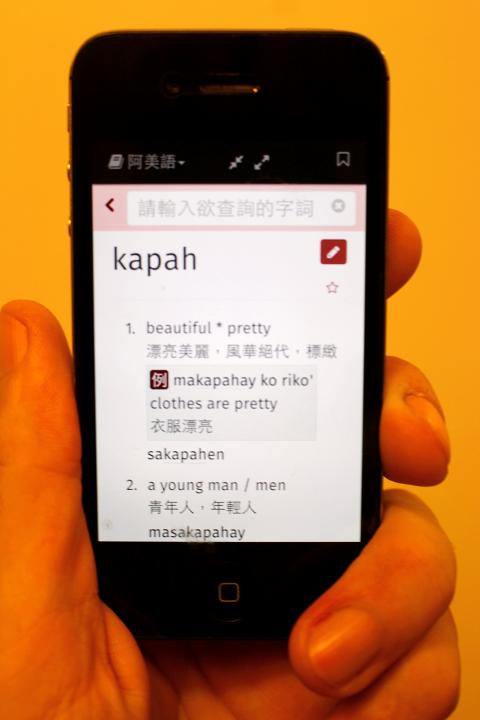
Photo: Aaron Wytze Wilson
Due to decades of regressive language policies under the Japanese and Chinese Nationalist Party (KMT) governments, people of Aboriginal background grew up and were educated in a language that is not originally their own.
Taiwan’s Amis are no exception. Although the government estimates the Amis population at a little over 200,000, the number of people who speak Amis as their first language is estimated to be lower than 10,000.
However, the exact number is not known because no government survey has been carried out to find it.

Photo: Aaron Wytze Wilson
With such a rapid decline in native-speaking Amis, immediate action is needed to prevent further decline. However, the government’s response has been slow because it doesn’t seem willing to acknowledge how dire the situation is.
ALINGATO, AMIS FOR THANK YOU
Just as the Amis language is facing a critical juncture in its preservation, a group of software engineers and concerned citizens have come together to create an Amis dictionary phone app.

Photo: Aaron Wytze Wilson
“We didn’t have too much interest from the Amis community at first, until Lafin Miku, who is Amis, stepped forward to help out with the project” says Miaoski Lin (林哲民), one of the app’s software programmers.
Lafin and Lin are part of the netizen collective g0v, a civic activist group that uses tech, new media and data to solve some of Taiwan’s biggest social and political problems.
Lafin has acted as a critical go-between for the group and the larger Amis community. “It’s a very meaningful project, but I was skeptical at first. Digitizing an entire dictionary is so tiring,” Lafin says.
Much of the Amis language is preserved in leather-bound dictionaries that are decades old, with very few of them making it online.
Converting them into digital content is an exhausting task, requiring weeks of monotonous scanning and data input.
To simplify the procedure, the group uses crowd-sourcing, a tactic that allows multiple group-members to work on the task of scanning and inputting at once.
The group has also been fortunate to have the help of two patron saints of the Amis language.
The first is former People First Party legislator Tsai Chung-han (蔡中涵), a respected member of the Amis community who has spent decades of his own time and money to compile an Amis-Chinese dictionary.
The second is 82-year-old father Maurice Poinsot, a French Catholic priest who moved to Taiwan when he was 21 years old to do missionary work in Hualien.
Poinsot compiled his French-Amis Dictionary along with now-deceased father Louis Pourrias.
Both Tsai and Poinsot have generously allowed the group to use the copyrights of their respective dictionaries free of charge.
“They are extremely supportive of our project,” said Tsai Wei-ting, “all they ask is that we show them the app when it’s finished.”
FUTURE DEVELOPMENTS
The group has made remarkable progress in the span of a year, with the first version of the app already online. They plan to add new features soon, including real voice pronunciation, dialect variations, and recordings of traditional Amis stories and legends.
The group hopes other Taiwanese Aborigines will feel empowered to start their own language dictionaries, and have made the programming code used to create the app available for anyone to use. “It’s important that Aborigines are not left out of the digital movement,” said Lafin.
The app is available now on both iOS and Android operating systems, and is free to download.

In Taiwan there are two economies: the shiny high tech export economy epitomized by Taiwan Semiconductor Manufacturing Co (TSMC, 台積電) and its outsized effect on global supply chains, and the domestic economy, driven by construction and powered by flows of gravel, sand and government contracts. The latter supports the former: we can have an economy without TSMC, but we can’t have one without construction. The labor shortage has heavily impacted public construction in Taiwan. For example, the first phase of the MRT Wanda Line in Taipei, originally slated for next year, has been pushed back to 2027. The government

July 22 to July 28 The Love River’s (愛河) four-decade run as the host of Kaohsiung’s annual dragon boat races came to an abrupt end in 1971 — the once pristine waterway had become too polluted. The 1970 event was infamous for the putrid stench permeating the air, exacerbated by contestants splashing water and sludge onto the shore and even the onlookers. The relocation of the festivities officially marked the “death” of the river, whose condition had rapidly deteriorated during the previous decade. The myriad factories upstream were only partly to blame; as Kaohsiung’s population boomed in the 1960s, all household

Allegations of corruption against three heavyweight politicians from the three major parties are big in the news now. On Wednesday, prosecutors indicted Hsinchu County Commissioner Yang Wen-ke (楊文科) of the Chinese Nationalist Party (KMT), a judgment is expected this week in the case involving Hsinchu Mayor Ann Kao (高虹安) of the Taiwan People’s Party (TPP) and former deputy premier and Taoyuan Mayor Cheng Wen-tsan (鄭文燦) of the Democratic Progressive Party (DPP) is being held incommunicado in prison. Unlike the other two cases, Cheng’s case has generated considerable speculation, rumors, suspicions and conspiracy theories from both the pan-blue and pan-green camps.

Stepping inside Waley Art (水谷藝術) in Taipei’s historic Wanhua District (萬華區) one leaves the motorcycle growl and air-conditioner purr of the street and enters a very different sonic realm. Speakers hiss, machines whir and objects chime from all five floors of the shophouse-turned- contemporary art gallery (including the basement). “It’s a bit of a metaphor, the stacking of gallery floors is like the layering of sounds,” observes Australian conceptual artist Samuel Beilby, whose audio installation HZ & Machinic Paragenesis occupies the ground floor of the gallery space. He’s not wrong. Put ‘em in a Box (我們把它都裝在一個盒子裡), which runs until Aug. 18, invites


 RSS
RSS