


It was early June, 1945, and World War II was nearing its end. In what was then known as the Taihoku Prison, 14 condemned American airmen wondered when their execution would take place. Just a week earlier, they had been brought before a Japanese War Disciplinary Tribunal, and after a brief, mock trial, they were convicted of “indiscriminate bombing” and sentenced to death.
The moment came in the early hours of June 19, as the 14 men were brought into the prison courtyard to face a Japanese army firing squad. Most were between the ages of 19 and 24.
NEVER FORGET
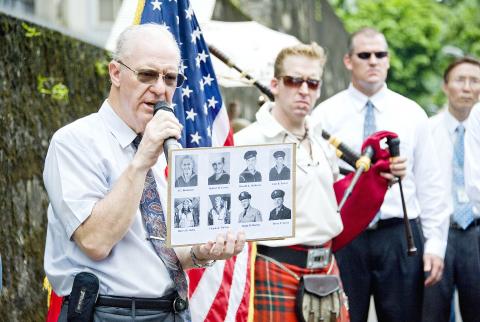
Photo: Han Cheung, Taipei Times
On Saturday morning, 70 years and one day later, about 50 people stood silently under the sweltering sun in the parking lot of Chunghwa Telecom (中華電信) on the corner of Aiguo East Road (愛國東路) and Jingshan South Road (金山南路).
Michael Hurst, director of the Taiwan POW Camps Memorial Society (TPCMS), was wrapping up his speech to the crowd.
“It was a needless sacrifice of these young men,” he said. “This morning, we want to remember that as we stand in this place.”

Photo: Han Cheung, Taipei Times
As the somber yet majestic melody of Amazing Grace, played by bagpiper Mal Turner, fills the parking lot, it’s still hard to imagine that this very spot was the execution grounds of the Taihoku Prison.
Two 100-meter-long stone walls are all that remain of the prison, which once held a number of Allied airmen who were shot down or crashed over Taiwan during World War II. Only 11 made it out alive.
This was society’s third memorial for the 14 executed — the first taking place on the event’s 60th anniversary in 2005 and the next one in 2009 when a memorial plaque was dedicated on the prison’s north wall.
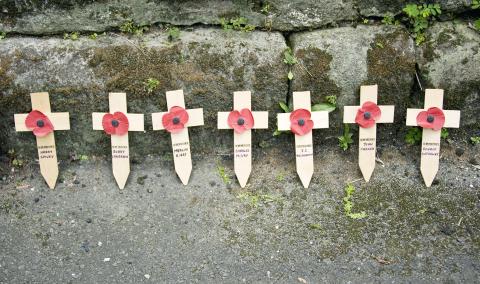
Photo: Han Cheung, Taipei Times
Old newspaper articles, such as one in the Pittsburgh Press, show that the executions remained unknown to the US until that October, when 14 urns containing the ashes of the airmen were flown from Taiwan to Shanghai, where their identities were confirmed.
Their lives may have been cut short, but they are certainly not forgotten. After paying tribute at the execution grounds, the crowd headed toward the prison’s north wall, against which rested a row of 14 tiny wooden crosses each adorned with a single red flower — a “remembrance poppy,” inspired by the World War I poem In Flanders by John McCrae.
On each cross, written in black ink, is the name of one of the fallen: JC Buchanan. Delbert Carter. Donald Hathaway. John Parker. Wayne Wilson. Harry Aldro. James Langiotti. Freddy McCreary. Charles McVay. Harwood Sharp. Ralph Hartley. Bobby Lawrance. Merlin Riggs. Harry Spivey.
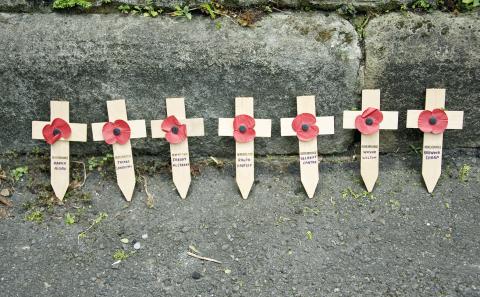
Photo: Han Cheung, Taipei Times
The 40-minute ceremony included speeches, poems, prayers, music and the laying of poppy wreaths by representatives from organizations including the American Institute in Taiwan, Ministry of Foreign Affairs and Chunghwa Telecom.
Hurst also emphasized the incident’s proximity to Father’s Day, as most of these men never had the chance to be fathers. While no relatives of the deceased were present, master of ceremonies Jerome Keating read three of their letters, sent from the US.
“The shabbiness of how his life was taken magnified the tragedy of losing him so near to the end of the war,” wrote BJ LeJeune, a niece of Ralph Hartley.
LESSONS FROM HISTORY
While many attendees represented various organizations, which also included the British and Australian offices in Taipei, the Salvation Army and the Republic of China Air Force, others came to pay their tributes or just happened to be passing by.
“I’m here as an American,” Ted Pigott said. “I also like history. I live nearby, I’ve seen the plaque and I wanted to learn more about Taipei’s history.”
Edward McGuire said he was “very touched” by the ceremony and that he visits the wall often.
“My father was in World War II,” he said. “I feel that this wall is very special. It represents Taiwan’s endurance and perseverance.”
According to Hurst, while it has been long-known that the Chunghwa Telecom complex sits on the former Taihoku Prison site, he wasn’t able to identify the exact location of the execution grounds.
Although the 14 airmen were the only Allied soldiers put to death at the prison, it saw its fair share of executions during its 61-year history. Another notable event was the 1914 hanging of Lo Fu-hsing (羅福星) and 20 other anti-Japanese revolutionaries over the Miaoli Incident (苗栗事件).
In January last year, Hurst was able to enter the complex after meeting a former chairman of the company.
“I pieced together the old photos and new overlays and came up with the site,” Hurst said. “So, this year I thought it would be nice for people to visit the actual site for a better feeling of what happened that day.”
Hurst approached Chunghwa Telecom officials, who gladly cooperated in setting up the event.
Ho Hsu-hui (何旭輝), vice president of Chunghwa Telecom’s public affairs department, said this is the first ceremony held on company grounds, which are usually not open to the public.
“Of course it wouldn’t be our role to initiate something like this,” he said. “However, after all, the incident happened on our grounds. Part of the ceremony’s purpose is to remind people of the cruelty of war, to reawaken these memories so the same mistakes wouldn’t happen again. We feel that we should support this type of activity and we’re willing to help out any way we can.”
EDUCATING THE PUBLIC
Hurst was very happy about the turnout, though he says that there is more work to be done in conducting research and spreading awareness on the 16 camps in Taiwan that housed more than 4,350 Allied POWs.
“The whole thrust of all of this is to make sure these men who were here in Taiwan, which was little known and even today still largely unknown in many cases, we just want to make sure these men who were here are not forgotten,” he says.
Hurst adds that these camps are largely unknown to the Taiwanese people as well. Many older people who lived through the war know of the existence of the camps, but had no idea about the conditions and torture that took place inside.
Hurst is working on a book on the subject, which he hopes to publish sometime this year and have translated into Chinese. One day, he hopes to establish a POW museum in Taiwan.
For more information on Taiwan POWs, visit the TPCMS Web site at www.powtaiwan.org

Oct. 21 to Oct. 27 Sanbanqiao Cemetery (三板橋) was once reserved for prominent Japanese residents of Taipei, including former governor-general Motojiro Akashi, who died in Japan in 1919 but requested to be buried in Taiwan. Akashi may have reconsidered his decision if he had known that by the 1980s, his grave had been overrun by the city’s largest illegal settlement, which contained more than 1,000 households and a bustling market with around 170 stalls. Fans of Taiwan New Cinema would recognize the slum, as it was featured in several of director Wan Jen’s (萬仁) films about Taipei’s disadvantaged, including The Sandwich

“Wish You Luck is not just a culinary experience, it’s a continuation of our cultural tradition,” says James Vuong (王豪豐), owner of the Daan District (大安) Hong Kong diner. On every corner of Kowloon, diners pack shoulder-to-shoulder over strong brews of Hong-Kong-style milk tea, chowing down on French Toast and Cantonese noodles. Hong Kong’s ubiquitous diner-style teahouses, known as chachaanteng (茶餐廳), have been a cultural staple of the city since the 1950s. “They play an essential role in the daily lives of Hongkongers,” says Vuong. Wish You Luck (祝您行運) offers that same vibrant melting pot of culture and cuisine. In

Much noise has been made lately on X (Twitter), where posters both famed and not have contended that Taiwan is stupid for eliminating nuclear power, which, the comments imply, is necessary to provide the nation with power in the event of a blockade. This widely circulated claim, typically made by nuclear power proponents, is rank nonsense. In 2021, Ian Easton, an expert on Taiwan’s defenses and the plans of the People’s Liberation Army (PLA) to break them, discussed the targeting of nuclear power plants in wartime (“Ian Easton On Taiwan: Are Taiwan’s nuclear plants safe from Beijing?”, April 12, 2021). The

Artificial intelligence could help reduce some of the most contentious culture war divisions through a mediation process, researchers say. Experts say a system that can create group statements that reflect majority and minority views is able to help people find common ground. Chris Summerfield, a co-author of the research from the University of Oxford, who worked at Google DeepMind at the time the study was conducted, said the AI tool could have multiple purposes. “What I would like to see it used for is to give political leaders ... a better sense of what people ... really think,” he said, noting surveys gave


 RSS
RSS