


Rhythm, lines and Turkish tradition are among the words used to describe the art of Devrim Erbil, a key figure in the development of modern Turkish painting whose artistic career has spanned more than half a century. The National Museum of History (國立歷史博物館) is currently holding an exhibition, Poetical Abstraction From Istanbul (詩意的抽象—來自伊斯坦堡), of work by the internationally-renowned artist, including recent abstract paintings and textile-art, that eloquently illustrate his preoccupations with motifs such as birds, trees, rhythmic composition and the cityscapes of Istanbul.
Born in 1937 in the carpet-weaving province of Usak, Central Anatolia, Erbil studied painting at the respected State Academy of Fine Arts in Istanbul during the 1950s, and soon garnered recognition as an abstract painter at home and abroad. A prolific artist who, at the age of 76, still reportedly works seven to 12 hours a day, Erbil has also served as an academic at several art institutions in Turkey and helped to influence a younger generation of Turkish artists.
Although trained in the abstract tradition of European masters such as Paul Klee and Piet Mondrian, Erbil nevertheless seeks inspiration in the culture, tradition and landscapes of Turkey, particularly Anatolia, the Asian part of the nation. He renders Istanbul in intricate lines and shapes and always from an aerial perspective. From a distance, the city’s maze of streets, mosques and the Bosphorus, a strait that is part of the border separating Europe and Asia, appear sketched or engraved on the canvas and often painted in vibrant colors of red, green and Turkish blue. A closer look, however, reveals an immense complexity composed of straight and broken lines, curves and their variations in various hues.
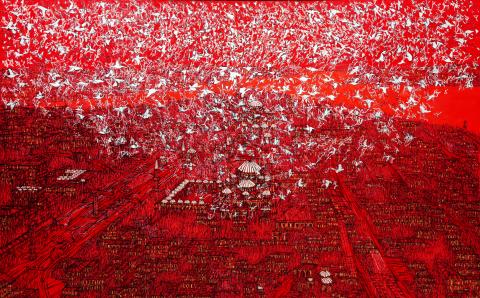
Photo courtesy of the Turkish Trade Office in Taipei
Erbil’s abstract paintings are also suffused with images of nature. Subjects like the flapping of a bird’s wings or the branches and leaves of a tree, which seem to expand and grow to infinity, are often unrecognizable, while a sense of rhythmic motion and dynamism is deeply felt in the artist’s intricately detailed rendering.
Believing that art is made for sharing, Erbil has worked with a variety of media that ranges from mosaics, ceramics and stained glass to tapestry. Among them, Anatolian carpet occupies a special position in the creative world of Erbil, who once said that carpets are the Turks gift to humanity. Several of Erbil’s textile-art works that adopt ancient weaving techniques are on display at the museum, aiming to change the viewer’s ideas of carpets not only as a piece of decoration on the floor but as an artwork that can be hung on the wall.
■ National Museum of History (國立歷史博物館), 49 Nanhai Rd, Taipei City (台北市南海路49號), tel: (02) 2361-0270. Open Tuesdays to Sundays from 10am to 6pm. General admission: NT$30. On the Net: www.nmh.gov.tw

Photo courtesy of the Turkish Trade Office in Taipei
■ Until Oct. 2

Photo courtesy of the Turkish Trade Office in Taipei

Photo courtesy of the Turkish Trade Office in Taipei

Oct. 21 to Oct. 27 Sanbanqiao Cemetery (三板橋) was once reserved for prominent Japanese residents of Taipei, including former governor-general Motojiro Akashi, who died in Japan in 1919 but requested to be buried in Taiwan. Akashi may have reconsidered his decision if he had known that by the 1980s, his grave had been overrun by the city’s largest illegal settlement, which contained more than 1,000 households and a bustling market with around 170 stalls. Fans of Taiwan New Cinema would recognize the slum, as it was featured in several of director Wan Jen’s (萬仁) films about Taipei’s disadvantaged, including The Sandwich

“Wish You Luck is not just a culinary experience, it’s a continuation of our cultural tradition,” says James Vuong (王豪豐), owner of the Daan District (大安) Hong Kong diner. On every corner of Kowloon, diners pack shoulder-to-shoulder over strong brews of Hong-Kong-style milk tea, chowing down on French Toast and Cantonese noodles. Hong Kong’s ubiquitous diner-style teahouses, known as chachaanteng (茶餐廳), have been a cultural staple of the city since the 1950s. “They play an essential role in the daily lives of Hongkongers,” says Vuong. Wish You Luck (祝您行運) offers that same vibrant melting pot of culture and cuisine. In

Much noise has been made lately on X (Twitter), where posters both famed and not have contended that Taiwan is stupid for eliminating nuclear power, which, the comments imply, is necessary to provide the nation with power in the event of a blockade. This widely circulated claim, typically made by nuclear power proponents, is rank nonsense. In 2021, Ian Easton, an expert on Taiwan’s defenses and the plans of the People’s Liberation Army (PLA) to break them, discussed the targeting of nuclear power plants in wartime (“Ian Easton On Taiwan: Are Taiwan’s nuclear plants safe from Beijing?”, April 12, 2021). The

Artificial intelligence could help reduce some of the most contentious culture war divisions through a mediation process, researchers say. Experts say a system that can create group statements that reflect majority and minority views is able to help people find common ground. Chris Summerfield, a co-author of the research from the University of Oxford, who worked at Google DeepMind at the time the study was conducted, said the AI tool could have multiple purposes. “What I would like to see it used for is to give political leaders ... a better sense of what people ... really think,” he said, noting surveys gave


 RSS
RSS