


“Where do you want to go?” the old taxi driver inquired as we approached his car outside the Yuanli (苑裡) train station in Miaoli County, a small stop reminiscent of train stations in an old Western movie.
“Please take us seaside, where they are building the wind turbines,” we said.
The driver, assuming we were ordinary tourists, had evidently not expected such a request.

Photo: J. Michael Cole, Taipei Times
“Why would you want to see those?” he asked. “There are much better things to see here — there’s a puppet show.”
PROTEST
But we insisted. While driving, he pointed toward a small community behind the vibrantly green rice paddies, right by the seashore. “Those wind turbines are trouble. People are protesting,” he said.
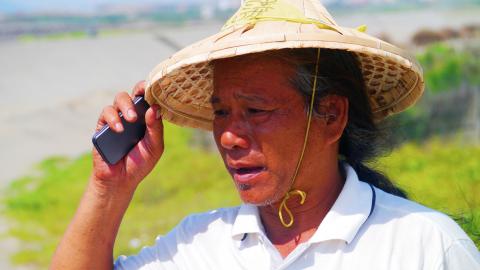
Photo: J. Michael Cole, Taipei Times
The residents of Yuanli Township launched their resistance movement against InfraVest GmbH, a German wind power company, in September, after a concerned Chen Ching-hai (陳清海), a local artist and owner of the Xin Diao Ju (心雕居) wood sculpture gallery, attended a pre-construction information session for residents living within 250m of the planned wind turbines. He learned that the firm intended to build 14 wind turbines, each capable of generating 2,300 kilowatt hours (kWh) of energy, along the township’s 2km pristine coastline.
But something wasn’t altogether right: records of the meeting showed that only 18 people in the four affected communities were present at the briefing.
Worried about the density and close proximity of turbines to their homes, Chen and the residents formed the Yuanli Self-Help Group (苑裡反瘋車自救會). In all, of the 7,682 residents of Yuanli, 4,281 signed the petition opposing the construction of so many turbines in their neighborhood, and so close to their homes.
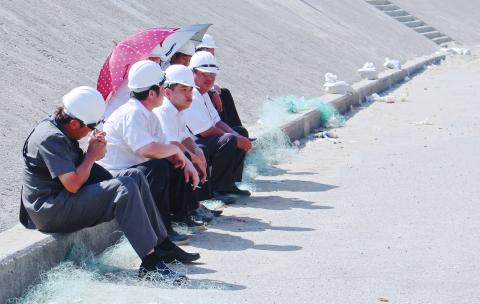
Photo: Ketty Chen
MONTHS OF STRUGGLE
Since September, members of the self-help organization have protested at the Bureau of Energy, the Environmental Protection Agency (EPA), the Executive Yuan, the Control Yuan and in front of the InfraVest office in Taipei. Chen, the leathery-skinned group leader, went on hunger strike for 10 days and had to stop after he began throwing up blood.
The organization claims that InfraVest manipulated data and paperwork to obtain approval from the EPA. They also allege that the firm submitted a single application for Yuanli, Tongsiao (通宵) and Jhunan (竹南) townships for the Environmental Impact Assessment (EIA) to create the illusion of a much larger area for the wind farms and to avoid the 10 percent land usage quota. By doing so, it also avoided having to address the three townships’ idiosyncratic environmental specifications. After receiving conditional EIA approval, InfraVest submitted a Difference of Environmental Impact (DEI) evaluation and requested that five wind turbine sites be shifted to Yuanli, bringing the total there to 14 and above the 10 percent limit.
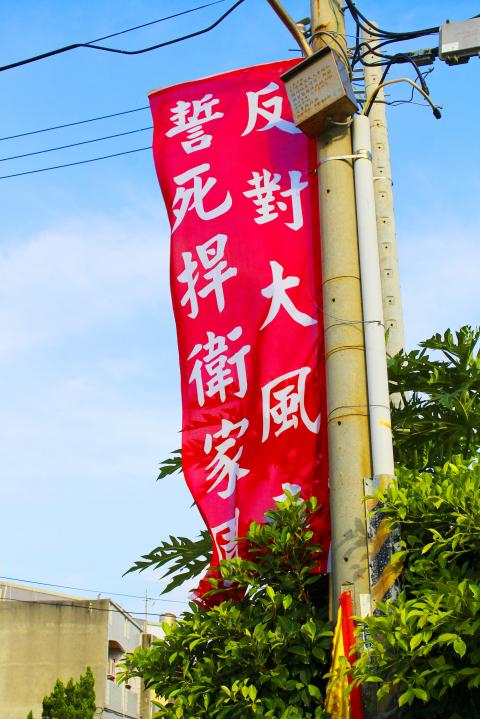
Photo: Ketty Chen
More importantly, the residents accuse InfraVest of not following the distance requirement in the company’s own DEI report, which clearly states that “the wind turbines should ideally be erected away from other structures, and for the wind turbines facing north or south, the turbines should be at least 350m away from each other. For the wind turbines facing east or west, the distance between the turbines should be at least 210m.”
The residents’ worries also go beyond what environmental specialist Vaclav Smil has called “esthetic objections” (for the sake of comparison, the Statue of Liberty is 93m tall ground to torch). They apprehend the low-frequency noise generated by the turbines and fear they might develop a condition known as wind turbine syndrome from living so close to them. Although the condition has yet to be medically recognized, a number of scientists believe there could be a correlation between a higher incidence of health problems and depression due to long-term exposure to the low-frequency noise generated by wind turbines.
During our visit at the No. 26 site, we briefly spoke with Galynn Brackett, the team leader for equipment installation with Solvent GmbH Taiwan Branch, based in Greater Taichung. We asked the American what he thought of the protests.
“You know, I do my job and they do what they think is right,” he said. “Yes, there’s a bit of noise, but given the choice between air pollution and that, I’d take the noise.” Compared with fossil-fueled generation, wind power is indeed clean, as it produces no CO2 and does not emit particulate matter, something that cannot be said of coal generation or the oil industry.
He also maintained that the InfraVest turbines use very little oil, which reduces the risks of leaks and fire — and catastrophes that have made for gripping news clips worldwide — and was adamant that the structures could withstand even the most severe of Taiwan’s typhoons.
After Yuanli residents began to physically block InfraVest trucks from accessing the construction site, many students joined the fight. Meanwhile, Yuanli Township Mayor Tu Wen-ching (杜文卿), a former legislator, and Miaoli County Commissioner Liu Cheng-hung (劉政鴻) offered negotiation and arbitration meetings, but those went nowhere, as the residents felt that government officials were siding with the company. InfraVest proceeded with construction as negotiations continued, a move that residents saw as a sign of insincerity.
CORPORATE INTERESTS
The strong resistance from Yuanli residents and university students has become a source of frustration for InfraVest. The company has already invested considerable resources in wind turbine projects on Taiwan’s west coast. Every day the Yuanli project falls behind schedule, the company loses money and time for projects elsewhere.
“I am very sincere in negotiating with the residents,” said Wang Yun-yi (王雲怡), the vice president of InfraVest Taiwan, who was overseeing construction at the No. 26 site the day we visited. “I already made several concessions, but now the residents are saying they won’t allow me to build any turbine. All our hard work in the past six or seven years, down the drain.”
The firm’s first wind turbines, also built in Miaoli, began operation in March 2006. According to the company Web site, a total of 165 wind turbines have been built, or are being built, since the firm entered Taiwan in 2000. While other firms have entered the Taiwan market, InfraVest has made no secret of its intention to monopolize the country’s wind energy sector.
The firm threatened to leave Taiwan in 2006 after it accused the government of not being serious about green energy and cutting into its profit margins.
“Even though we received approval to build 14 wind turbines, we are willing to build just four. Just let us do our work and we’ll go after we’re done,” Wang said, as private security hired by the firm filmed the conversation. “They accuse us of falsifying surveys. The fact is, we have permission to build here. By the way, these protesters don’t even live near the No. 26 site.”
In another press conference in Taipei on May 2, Wang sought to ease concerns about turbine noise and blowing sand. She said that noise would not exceed 2dB at a location 70m away from the turbines, and the low-frequency noise measured from 150m away from a turbine would be 20Hz, “the same level of noise that an air conditioner or a refrigerator produces.”
GETTING NASTY
Last month and earlier this month, the Forestry Bureau and the Water Resource Agency ordered InfraVest to remove fences and road blocks on public roads leading to the beach and to give the residents a seven-day notice before erecting any more fences and resuming construction. After the EIA conference on June 3, the EPA rejected InfraVest’s DEI evaluation to move five wind turbines to Yuanli and pointed to the possibility that the firm manipulated data.
Outraged, Wang said wind power has been demonized in Taiwan. She also blamed DPP Legislator Lin Shu-fen (林淑芬) for “pressuring” and “influencing” the EPA and the BOE.
Meanwhile, InfraVest filed a NT$10 million (US$335,000) lawsuit against seven members of the Yuanli Self-Help Organization. The company also distributed a pamphlet with information supporting its claim that Chen’s residence and gallery — located 176m from one of the planned wind turbines — are illegal.
The lawsuit prompted 12 civic organizations, including the Taiwan Association for Human Rights, Covenants Watch, the Green Party, Green Citizens’ Action Alliance and the Environmental Jurists Association to issue a joint public statement condemning the company for using the law as intimidation.
InfraVest also stepped up security by having dozens of security guards on site at all time, where they trail, film, question and prevent visitors, residents and students from going to the beach and embankment and approaching the construction site. Their behavior is illegal, as they have no law enforcement authority.
Skirmishes involving police and protesters have forced the central government to intervene after police used disproportionate means, and clashes between private security officers and protesters on June 8 have raised serious questions about the professionalism of the hired guards. All of this has contributed to turning a local issue into a matter of national interest.
GREEN ENERGY GONE BAD
As Lin pointed out, government agencies must bear responsibility for approving InfraVest’s proposal to build wind turbines on the west coast, and oversight will have failed in its duties if InfraVest, as the self-help group alleges, in fact manipulate data to obtain the permits.
Taiwan needs a green energy solution. The Yuanli resident’s struggle against big business can serve as a platform to begin discussions on the types of green energy that are most suitable for Taiwan.

In Taiwan there are two economies: the shiny high tech export economy epitomized by Taiwan Semiconductor Manufacturing Co (TSMC, 台積電) and its outsized effect on global supply chains, and the domestic economy, driven by construction and powered by flows of gravel, sand and government contracts. The latter supports the former: we can have an economy without TSMC, but we can’t have one without construction. The labor shortage has heavily impacted public construction in Taiwan. For example, the first phase of the MRT Wanda Line in Taipei, originally slated for next year, has been pushed back to 2027. The government

July 22 to July 28 The Love River’s (愛河) four-decade run as the host of Kaohsiung’s annual dragon boat races came to an abrupt end in 1971 — the once pristine waterway had become too polluted. The 1970 event was infamous for the putrid stench permeating the air, exacerbated by contestants splashing water and sludge onto the shore and even the onlookers. The relocation of the festivities officially marked the “death” of the river, whose condition had rapidly deteriorated during the previous decade. The myriad factories upstream were only partly to blame; as Kaohsiung’s population boomed in the 1960s, all household

Allegations of corruption against three heavyweight politicians from the three major parties are big in the news now. On Wednesday, prosecutors indicted Hsinchu County Commissioner Yang Wen-ke (楊文科) of the Chinese Nationalist Party (KMT), a judgment is expected this week in the case involving Hsinchu Mayor Ann Kao (高虹安) of the Taiwan People’s Party (TPP) and former deputy premier and Taoyuan Mayor Cheng Wen-tsan (鄭文燦) of the Democratic Progressive Party (DPP) is being held incommunicado in prison. Unlike the other two cases, Cheng’s case has generated considerable speculation, rumors, suspicions and conspiracy theories from both the pan-blue and pan-green camps.

Stepping inside Waley Art (水谷藝術) in Taipei’s historic Wanhua District (萬華區) one leaves the motorcycle growl and air-conditioner purr of the street and enters a very different sonic realm. Speakers hiss, machines whir and objects chime from all five floors of the shophouse-turned- contemporary art gallery (including the basement). “It’s a bit of a metaphor, the stacking of gallery floors is like the layering of sounds,” observes Australian conceptual artist Samuel Beilby, whose audio installation HZ & Machinic Paragenesis occupies the ground floor of the gallery space. He’s not wrong. Put ‘em in a Box (我們把它都裝在一個盒子裡), which runs until Aug. 18, invites


 RSS
RSS